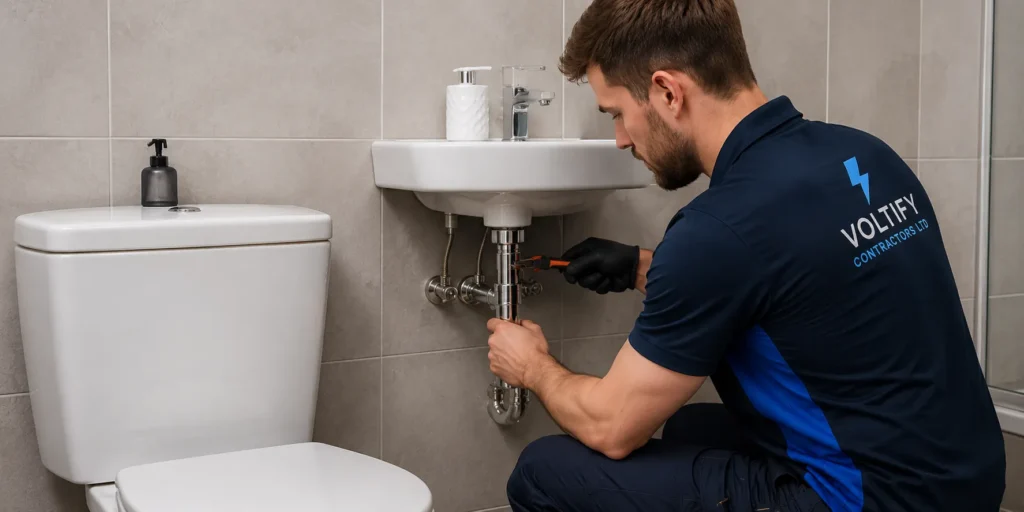

In most small businesses, property maintenance is somebody’s second job. The owner or office manager deals with the leaking tap, the door that will not close and the flickering corridor light in between everything else. A commercial property maintenance checklist only helps that person if it answers three questions in the right order: what are we actually responsible for, which of those things carry legal duties, and how often does each one need looking at?
This checklist follows that order. It is general guidance for small offices, shops and similar premises in England, not legal advice; your lease, your insurer and your own risk assessments may add to it.
First, check what the lease makes yours
Responsibility for maintaining commercial premises is set mainly by the lease, and leases vary a great deal. Some make the tenant responsible for repairing and maintaining the whole unit, inside and out. Others leave the structure, roof, exterior and shared parts with the landlord, who recovers the cost through a service charge. In a multi-let building, entrances, stairs, lifts and shared toilets are usually looked after by the landlord or a managing agent.
Before building a checklist, find these answers in your lease (or ask your landlord, agent or adviser):
- Which parts of the building you must repair: interior only, or exterior and structure too.
- Who maintains building services such as heating, hot water, the fire alarm and emergency lighting.
- Whether you must redecorate at set intervals or at the end of the term.
- What needs the landlord’s consent, such as fixing signage to the outside or making alterations.
- How faults in shared areas should be reported, and to whom.
This matters for more than the day-to-day. At the end of a lease, a landlord can claim for repairs the lease required but that were not done, often called dilapidations. Keeping on top of your share of the maintenance, and keeping a record of it, is the simplest way to limit that bill.
Duties that sit with the business
Some responsibilities apply to whoever runs or controls the premises, regardless of which contractor carries out the work. These belong at the top of the list.
Fire safety
The “responsible person” for a workplace, which can be the employer, owner, landlord or occupier, must carry out a fire risk assessment, review it regularly, and put in place and maintain appropriate fire safety measures (GOV.UK: fire safety in the workplace). Where a building has more than one responsible person, such as a landlord and several tenants, they are expected to work together. Fire alarms, emergency lighting and extinguishers are serviced by specialist contractors; your job is to make sure servicing happens and the records are kept.
Electrical safety
Employers must keep electrical equipment that could cause injury in a safe condition. HSE is clear that the law does not require portable appliances to be tested every year; it expects a risk-based approach, with frequent visual checks by users and more formal testing for equipment that is heavily used or moved around (HSE: portable appliance testing). For the fixed wiring, the electrician who carries out a periodic inspection records a recommended date for the next one on the report. Put that date in the diary and treat it as a deadline.
Water systems and legionella
If you are an employer or control premises, you have a duty to understand and manage the risk from legionella. Every water system needs a risk assessment, though a simple system that is properly managed may need little more than that, as long as the assessment is reviewed when anything changes (HSE: legionella risks in the workplace). Little-used outlets, such as a shower nobody uses or a tap in a spare room, are the usual weak point.
The workplace itself
The Workplace (Health, Safety and Welfare) Regulations 1992 cover the basics of a safe working building, including general maintenance, lighting, floors and traffic routes, toilets and washing facilities, and windows and doors (HSE: workplace health, safety and welfare). In practice, a lifting floor tile, a broken stair light or a staff toilet out of action for a week is a compliance issue as well as an annoyance.
The checklist, by how often things need checking
Once you know what is yours, the simplest system is to split it by frequency. Most of the frequent checks need nothing more than a few minutes and a pair of eyes; the less frequent ones are where contractors come in.
Every day, at opening
- Fire exits and escape routes are clear, and exit doors open from the inside.
- No new trip hazards: trailing leads, lifted mats, damaged flooring at doorways.
- Lights are working on stairs, in corridors and at entrances.
- Toilets and washbasins are working, with no water on the floor.
Every month
- Doors close properly. Fire doors should swing shut fully onto the latch on their own; a closer that has been wedged, damaged or slackened off defeats the purpose.
- Handles, locks, hinges and push plates are secure and working.
- Under sinks and behind toilets in washrooms and tea points: look for drips, damp cupboard bases and stained floors.
- Sealant around basins and worktops is intact and not blackened or split.
- Extractor fans in toilets and kitchens actually draw air.
- Sockets, plugs and leads have no cracks, scorch marks or exposed wires, and extension leads are not daisy-chained.
- Little-used taps and showers have been run, in line with your legionella risk assessment.
Every quarter
- Walls, corners and door frames in busy corridors: damage is easier and cheaper to patch before it spreads.
- Ceilings for staining, which often points to a leak above.
- External lighting, signage fixings and entrance thresholds.
- From the ground, gutters, downpipes and the roofline for blockages, overflow staining or visible damage, if these are your responsibility.
- Condensation or mould around windows, in stores and in washrooms.
Every year
- Review the fire risk assessment and the legionella risk assessment, and update them after any change to layout, use or occupancy.
- Confirm servicing of the fire alarm, emergency lighting and extinguishers has happened at the intervals your contractors and assessment set, and file the records.
- Service the heating and any gas appliances before winter, using appropriately registered engineers.
- Check the next fixed-wiring inspection date and the portable appliance arrangements are still right for how equipment is used.
- Plan decoration and larger repairs for quieter trading periods, and check them against any redecoration clause in the lease. Our guide to painting offices and retail units with minimal disruption covers how to zone and time the work.
Set the rules for reactive repairs before something breaks
Planned checks reduce breakdowns, but they never remove them. The businesses that handle faults well have usually agreed four things in advance:
- One place to report faults. A named person or a shared inbox, with a photo and the exact location of the problem. Faults reported verbally in passing tend to get lost.
- Simple priority levels. For example: make safe today (a leak, exposed wiring, an exit door that will not open); fix this week (a toilet out of use, a door that will not lock); add to the next planned visit (a scuffed wall, a loose handle).
- A spending limit. The amount a contractor can spend to complete a repair on the spot before checking back, so small jobs are not held up waiting for approval.
- An out-of-hours plan. Who staff or keyholders call if something fails after closing, and where the stopcock and the consumer unit are.
Keep the paperwork in one place
A single folder or shared drive holding the fire risk assessment, legionella assessment, electrical inspection report, servicing certificates, and a log of repairs with dates, invoices and photos does several jobs at once. It answers an insurer’s or fire inspector’s questions quickly, shows a landlord what you have maintained, and gives any contractor the history before they arrive.
If you would rather hand the monthly and quarterly items, and the repairs they turn up, to one contractor, Voltify Contractors’ commercial property maintenance service explains how reactive repairs and planned visits are organised around trading hours. Fire alarm and emergency lighting systems, lifts, air conditioning and gas appliances need their own specialist contractors. If your portfolio includes residential lets, the landlord property maintenance checklist covers the separate duties that apply to rented homes.