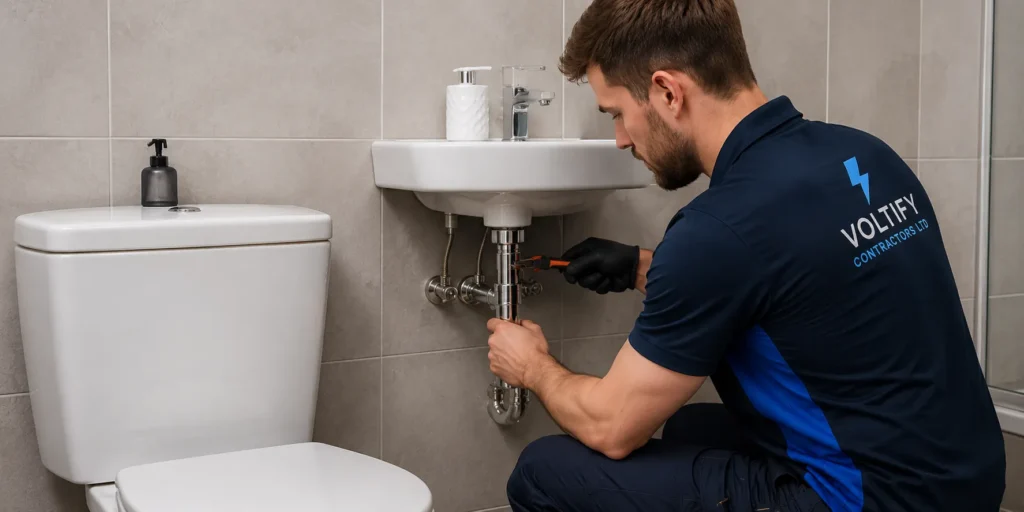

The repairs an East London property needs depend more on what kind of building it is than on which postcode it is in. A Victorian terrace, a flat in a 1960s block and a new apartment by the river will each wear out in different ways. One thing almost all of them share is hard water, which quietly shortens the life of taps, toilet valves, showers and appliances.
Voltify Contractors carries out property maintenance across East and South-East London, including Canary Wharf, Stratford, Canning Town, Greenwich, Woolwich and Barking. This guide explains the repairs that come up most often in each type of property, which trade each one needs, and the jobs that are better handed to a specialist.
Hard water: the problem nearly every property shares
Thames Water says most of the water in the South-East of England is hard, because much of it passes through chalk and limestone. Hard water is not harmful to drink, but it leaves limescale wherever water is heated or sits still, and over time that becomes a maintenance issue:
- Taps become stiff, and scale on cartridges and washers can stop them sealing, so they drip. Our guide on whether to repair or replace a leaking tap covers that decision.
- Toilet cisterns run on because scale stops the fill valve or flush valve closing properly. The running toilet guide explains how to tell which part is at fault.
- Shower heads and mixer valves clog, so the flow weakens or the temperature becomes hard to set.
- Washing machines, dishwashers and kettles build up scale on their heating elements. Regular descaling and using the right amount of detergent help them last longer.
Cleaning aerators and shower heads with a descaler every few months prevents a lot of these call-outs. When a tap or valve has already failed, it is usually a straightforward plumbing repair.
Older houses and converted flats
If your home is an older house, or a flat in a house that has been converted, its age brings a recognisable set of repairs.
Electrics that have been added to over decades
Older homes may still have a fuse box with rewireable fuses, too few sockets for modern use, or circuits extended by several owners over the years. Repeated tripping, warm sockets and lights that flicker are common reasons for a call-out. Our explainer on the difference between a consumer unit and a fuse box helps you work out what you have, and the electrical safety check guide explains what an inspection looks at.
Pipework and the supply pipe
According to the Drinking Water Inspectorate, homes built before 1970 may have lead pipes, because lead was commonly used to connect properties to the water main. A lead pipe at the internal stop tap looks dull grey, often with a swollen joint, and shows shiny metal if gently scraped with a coin. The pipe from the boundary into the house, and all the plumbing inside, are the owner’s responsibility. In a converted house, it is also worth knowing whether your flat has its own stopcock or shares a supply with the flats above or below, because that affects what happens when water has to be turned off.
Cracks, old paint and sticking doors
Older plaster cracks as buildings move with the seasons, doors drift out of square in their frames, and floorboards loosen and squeak. Most of this is cosmetic and routine to repair, but redecorating needs more care in older homes: paint from before the 1970s may contain lead, and textured coatings may contain asbestos, so neither should be sanded without checking first. Our interior painting preparation checklist covers those checks, and the guide to common door problems explains which faults are the door and which are the building.
Flats in older blocks
Post-war blocks of flats come with their own pattern. Walls are often concrete, which makes fixing shelves, curtain poles and TV brackets slower and needs the right drill and fixings. Socket numbers are often low, and kitchens and bathrooms may have been refitted several times, each time with different pipework. Condensation is common where ventilation is limited, and black mould around windows or in bathrooms usually points to a fan that is missing, undersized or not working. In blocks owned by a council or housing association, check which repairs the landlord or freeholder handles before booking anyone yourself.
Newer apartments
Newer apartment buildings avoid many of the problems of older homes, but they have their own. Silicone seals around baths and showers fail and let water reach the floor; extractor fans and ventilation filters get neglected; and in buildings with communal heating, faults may sit with the building rather than the flat. Managed blocks also add access rules, lease restrictions and, in taller buildings, legal duties not to interfere with fire doors, sprinklers and other safety items. Our guide to property maintenance for flats in Canary Wharf covers how responsibility is usually split between the flat and the building, and it applies to most managed blocks across the area.
Rented homes
For landlords, the same repairs come with deadlines: gas safety records, electrical inspections, smoke and carbon monoxide alarms, and repairs reported by tenants. Small faults that a homeowner might live with, such as a dripping tap or a loose handle, tend to grow into end-of-tenancy disputes if they are left. The landlord property maintenance checklist sets out what to check and when.
Which service fits the repair
| Repair | Where to start |
|---|---|
| Dripping taps, running toilets, leaks, low water pressure, bathroom and kitchen plumbing | Plumbing services |
| Tripping circuits, faulty sockets, switches and lights, extractor fans | Electrical services |
| Cracked or stained walls, repainting before a let or sale, wallpaper | Painting and decorating |
| Fitting or replacing washing machines, dishwashers, ovens and hobs (electric) | Appliance installation |
| Doors, floors, shelves, TV mounting, wall repairs and mixed lists of small jobs | Handyman and property maintenance |
Some problems need a different specialist. Gas appliances and boilers need a Gas Safe registered engineer. Blocked or collapsed drains, and sewers shared with neighbours, are a matter for a drainage contractor or the water company. Roof, structural and window replacement work also sits with specialist trades. Knowing this before you call saves a wasted visit.
Planning repairs rather than reacting to them
Most of the repairs above are cheaper to deal with as a planned list than one at a time. Standard work runs 7am–5pm, Monday to Friday, and the documented minimum call-out is £80 for the first hour, so grouping several small jobs into one visit makes better use of that time. For problems that cannot wait, such as water you cannot stop or an electrical fault that feels unsafe, out-of-hours emergency call-outs are available at different pricing.
To check whether your street is covered, see the full list of areas we cover across East and South-East London.