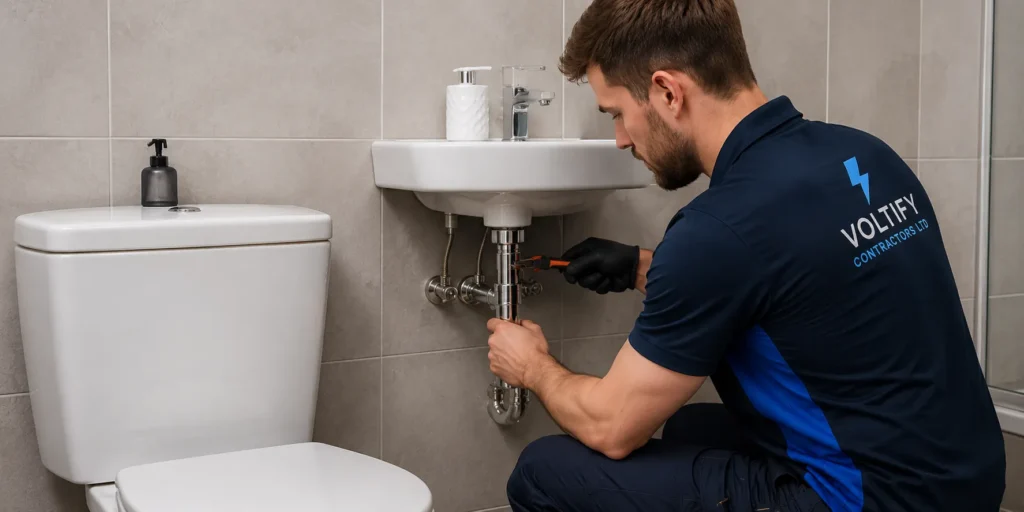

The main installation difference between integrated and freestanding appliances is how much of the kitchen gets involved. A freestanding appliance is a complete unit: it has its own finished casing, you slide it into a space and connect it, and it can leave with you when you move. An integrated appliance is designed to be built in. It needs a housing unit of the right size, a kitchen door panel fixed to its front, and the ventilation gaps its manufacturer specifies. Fitting one is partly a cabinetry job.
That difference affects more than installation day. It shapes what you can buy now, how easy the appliance is to replace later, and what happens if you change your mind.
Side-by-side: what each type asks of your kitchen
| Freestanding | Integrated | |
|---|---|---|
| Where it goes | Any space of the right size with the connections it needs | A housing unit or under-counter space built to the appliance’s stated dimensions |
| What the kitchen must provide | Floor space, clearance, and water, waste and power where needed | The above plus a matching door panel, fixings and the specified ventilation route |
| Fitting work | Mostly connection, levelling and checking | Connection plus fixing the panel, aligning the door with neighbouring units and securing the appliance into the housing |
| Getting at it later | Pulls out for cleaning, repairs or to reach a valve | Usually has to be unfixed from the housing, and the panel sometimes removed, before it can come out |
| Replacing it | Choose almost any model that fits the gap | You’re generally limited to models that fit the same housing and panel system |
| Moving home | Goes with you | Normally stays with the kitchen |
| Choice of models | Widest range of sizes, finishes and features | Narrower, because the size is set by kitchen standards |
| Purchase and fitting cost | Usually lower for both | Usually higher. Built-in models tend to cost more and take longer to fit |
None of this makes one type better. It depends on the kitchen you have, how long you plan to stay and how much the look matters to you.
What choosing integrated commits you to
The housing decides what you can buy. Integrated appliances are made to common kitchen sizes, but each model has its own required aperture, and fridges and freezers also depend on the hinge system the panel uses. When an integrated appliance fails in a few years’ time, the quickest replacement is one that matches the old one’s size and fixing method. Changing format, such as going from a slimline to a full-width dishwasher or from a built-under fridge to a tall one, usually means altering or replacing units.
The panel is part of the appliance. The kitchen door fixed to an integrated appliance generally has to come from the same range as the rest of the kitchen. If a panel is damaged, or an older kitchen range has been discontinued, an exact match can be hard to find. So it’s worth looking after the existing panel when an appliance is swapped.
Ventilation is easy to overlook. Built-in fridges, freezers and ovens rely on airflow paths through the plinth, the back of the housing or gaps above, as set out in the manufacturer’s instructions. If they’re blocked, a fridge may run constantly or an oven housing may get hotter than it should. With a freestanding appliance the clearances are simpler, though still worth respecting.
The detail of fitting a built-in model, including measuring the housing, the panel-fixing systems and alignment, is covered on our integrated appliance installation page.
When freestanding is the practical choice
- You rent, or expect to move soon. A freestanding washing machine or fridge freezer goes with you. An integrated one usually stays with the kitchen.
- The kitchen wasn’t designed for built-in appliances. If there’s no suitable housing, adding one means cabinetry work on top of the appliance itself.
- You want a particular size or feature. Large-capacity, American-style and range-type appliances are mostly freestanding, so the choice is wider.
- The appliance lives somewhere else. In a utility room, garage or cupboard, a hidden finish matters less than easy access.
- Access for maintenance matters. Being able to pull an appliance straight out makes it easier to deal with a leak, clean behind it or replace a hose.
When integrated makes more sense
- You’re fitting a new kitchen and can plan the housings, connections and ventilation from the start.
- The kitchen is open-plan or part of the living space, so you want appliances to blend in with the cabinetry.
- You’re replacing like for like in a kitchen that already has integrated housings. Here, fitting another integrated model is usually the simplest route, and a freestanding one might not suit the space.
Mixing both is normal
Many kitchens combine the two. An integrated dishwasher and fridge might sit beside a freestanding range cooker, or a fitted kitchen might have a freestanding washing machine in the utility room. What matters is that each appliance suits its space: a built-in model in a proper housing, a freestanding model with the clearances it was designed for.
Swapping one type for the other
From freestanding to integrated. You’ll need a housing unit, or an existing unit adapted, the right panel, and connections positioned so they don’t clash with the appliance or its fixings. It’s often worth doing alongside other kitchen work rather than on its own.
From integrated to freestanding. It can seem simpler, but a freestanding appliance won’t take a door panel. With its top on it may not fit under a worktop designed around a built-in model, and many are designed to lose heat through their sides and top, so manufacturers often advise against boxing them in. Check the appliance’s instructions before putting a freestanding model into a space built for an integrated one.
The connections behind either type are the same: water and waste for dishwashers and washing machines, and a suitable electrical supply for everything. What changes is how easy they are to reach afterwards. With integrated appliances, it’s worth making sure isolation valves and the socket or switched connection can be reached from a neighbouring cupboard, so the appliance doesn’t have to come out just to turn it off.
Before you buy, check
- Whether the space is an integrated housing, an under-counter gap or open floor space. Measure it in more than one place.
- The model number of the existing appliance if you’re replacing one, since it shows what the housing was built for.
- For integrated fridges and freezers, whether the kitchen uses a sliding-hinge or fixed-door system. If you’re replacing a fridge freezer, our guide to replacing an integrated fridge freezer lists everything that needs to match.
- Whether the existing door panel is in good enough condition to reuse.
- Where the water, waste and electrical connections are, and whether you can get at them without removing the appliance. For a dishwasher, our dishwasher installation checklist goes through these checks in more detail.
If you’re weighing up the options for a specific kitchen, Voltify Contractors’ appliance installation service covers both freestanding and built-in appliances. Sending photos of the space with the appliance model numbers is usually the quickest way to find out what’s involved.