
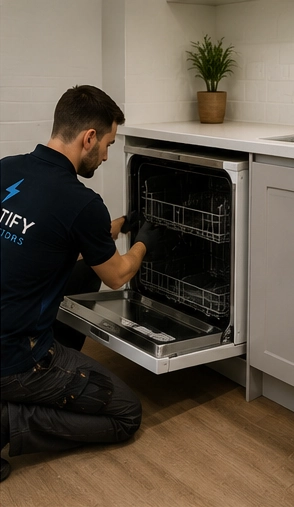
The first question with any dishwasher installation is whether the kitchen is already set up for one. If a dishwasher has been there before, the job is usually disconnecting the old machine, checking the valve, waste connection and socket, and connecting the new one. If it is the first dishwasher in that kitchen, there is a water supply, a waste connection, an electrical point and often a space to create first.
Voltify Contractors installs freestanding, slimline and integrated dishwashers in homes and rented properties across East and South-East London as part of our appliance installation service. If your new machine is a built-in model hidden behind a kitchen door, our page on integrated appliance installation explains how door panels and housings are dealt with.
Replacing a Dishwasher or Fitting One for the First Time
| What changes | Replacing an existing dishwasher | Fitting a dishwasher for the first time |
|---|---|---|
| Space | The gap is usually there — check the new machine matches its width (normally 60cm, or 45cm for slimline) | A base unit may need removing, with the worktop above properly supported |
| Water supply | The existing valve can be reused if it turns freely and does not leak | A new isolating valve is added to the cold supply, usually under the sink |
| Waste | The existing spigot on the sink trap or standpipe is reused | A new waste connection is needed — a trap with a spigot or a standpipe |
| Electrics | The existing socket is used if it is suitable and reachable | A socket or switched connection may need adding nearby |
| Overall | Usually a straightforward swap | Plumbing, possibly electrical work, and sometimes minor carpentry |
The Three Connections, and Why Each One Matters
Water supply
Most UK dishwashers fill from the cold supply and heat the water themselves. The fill hose connects to an isolating valve so the machine can be turned off without shutting off the whole property. A valve that has not been turned for years can seize, or start to weep once it is disturbed, so it is checked and replaced if necessary. The new dishwasher’s own hoses are used rather than the old ones.
Waste
The drain hose runs to a spigot on the sink trap or into a standpipe. It needs to be routed as the manufacturer specifies, usually with a raised loop, so that dirty water from the sink cannot siphon back into the dishwasher. When that is missed, the usual result is a machine that smells, or dishes that come out with grit on them. A kinked or crushed drain hose behind the machine is also one of the most common reasons for poor draining after an installation. If a washing machine already uses the same trap, the two hoses need arranging so neither backs up into the other — our washing machine installation page covers standpipes and shared waste in more detail.
Electrical supply
A dishwasher plugs into a standard socket, but it should not run from an extension lead or an adaptor. Ideally the socket sits in a neighbouring cupboard rather than directly behind the machine, or the supply is controlled by a switched connection above the worktop, so the dishwasher can be isolated without pulling it out. If there is no suitable socket nearby, one needs adding first — see our socket and switch installation service.
Levelling, Securing and the First Run
Once connected, the dishwasher is levelled on its adjustable feet. This matters more than it seems: a machine that leans can stop the door sealing properly and leave water sitting in the bottom. Freestanding models are positioned so the hoses are not trapped against the wall. Integrated and built-under models are fixed to the underside of the worktop or the side panels with the supplied brackets, so the machine cannot tip forward when a loaded rack is pulled out, and a steam strip is fitted under the worktop edge.
The installation finishes with a test run: filling, checking the valve and waste connections for leaks, and making sure the machine drains fully.
Signs the Existing Setup Needs Attention First
A few things found under the sink or behind the old machine can change the job:
- Water marks, swollen chipboard or mould in the sink unit, which can point to an old leak. That needs tracing and fixing before a new appliance goes in — see leak detection and repair.
- A stiff, corroded or dripping valve that will need replacing rather than reusing.
- A sink that already drains slowly. Adding dishwasher waste into a partly blocked trap will make it worse.
- A scorched, loose or cracked socket, or one hidden behind the machine with no other way to switch it off.
- New flooring laid up to the old machine, which can reduce the height under the worktop and stop a new dishwasher sliding in.
If you are also changing the kitchen tap or the pipework under the sink, it makes sense to do it at the same visit — our tap repair and installation page covers that work.
What Affects the Cost of Dishwasher Installation
The documented minimum call-out is £80 for the first hour. A like-for-like replacement using existing connections is at the simpler end. The cost rises when a new valve or waste connection is needed, a socket has to be added, a base unit has to be removed to make space, or an integrated door panel has to be fitted and aligned. If you need the old dishwasher taken away, mention it when you book so it can be confirmed.
To get an accurate answer quickly, send the model number or installation manual of the new dishwasher, a photo of the space, and a photo of the pipework under the sink. Our dishwasher installation checklist explains what to measure and look for before you buy or book. Contact Voltify Contractors to arrange the installation, or check the areas we cover.