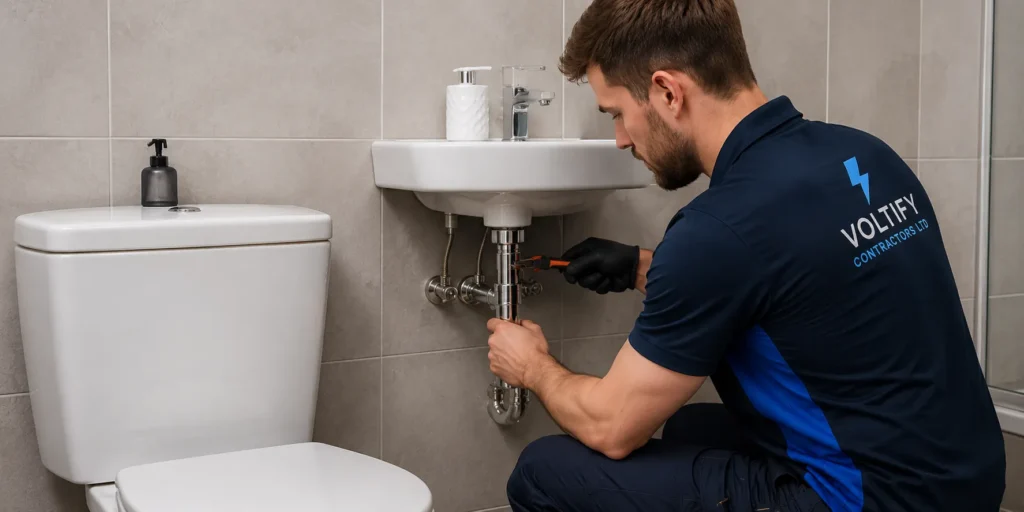

Where water appears is often not where it’s escaping. A brown ring on a downstairs ceiling, a damp patch at the bottom of a wall or a laminate board that has started to lift can be several metres from the joint, seal or pipe that is actually leaking. Water leak repair therefore starts with finding the source, and Voltify Contractors traces and repairs leaks on water supply and waste pipework in homes, rented properties and commercial premises across East and South-East London.
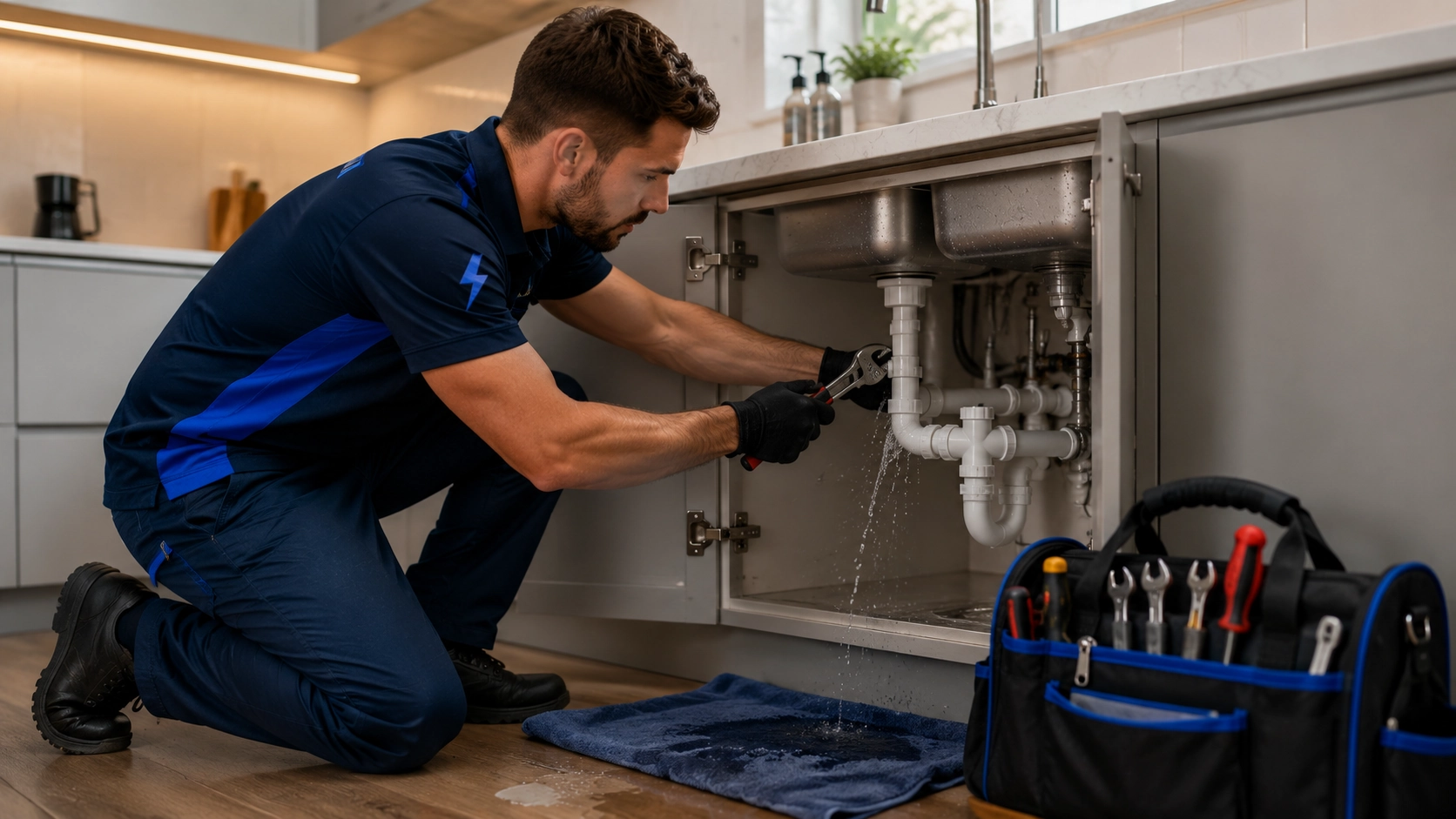
If water is pouring out right now and you can’t stop it, close the stopcock and see our emergency plumber page. This page is for leaks that are slower, hidden or hard to pin down. It sits within our wider plumbing services. If you’re not yet sure what kind of leak you’re dealing with, our guide on what to do when you have a water leak at home explains the first steps for each type.
Signs a Leak May Be Hidden
A concealed leak rarely announces itself with a drip you can see. More often it shows up as:
- a damp patch or stain that keeps growing, or returns after it has been painted over;
- grout cracking, tiles loosening or silicone blackening around a shower or bath;
- flooring that lifts, bows or feels soft underfoot, particularly near a kitchen, bathroom or radiator;
- a musty smell or mould appearing in one specific spot rather than across a room;
- the sound of running water when no taps, toilets or appliances are in use;
- a water bill that has risen for no obvious reason, if your supply is metered.
A Check You Can Do Yourself: the Water Meter Test
If you have a water meter, this simple test tells you whether water is escaping somewhere on your supply — without opening anything up:
- Turn off every tap and make sure nothing that uses water is running — washing machine, dishwasher, and no toilet flushing.
- Read the meter and write down the numbers. Some meters also have a small dial or indicator that turns while water is flowing.
- Wait at least 30 minutes without using any water.
- Read the meter again.
If the reading has changed, water is going somewhere between the meter and your taps. That could be inside the property or on the underground supply pipe outside. Leaks on the underground supply pipe within a property’s boundary are generally the owner’s responsibility, but some water suppliers offer help or advice with these — it’s worth checking with yours. Passing on the result of this test is one of the most useful things you can tell us before a visit.
Where the Water Shows Up, and Where It May Be Coming From
The table shows where a leak is commonly traced to, depending on where the water appears. These are places to check first, not conclusions — two leaks with the same symptom can have very different causes.
| Where you see the water | Places commonly checked first |
|---|---|
| Ceiling below a bathroom | Shower tray or bath seal, shower or bath waste, the toilet pan connector, supply pipes under the floor |
| Kitchen floor or the base of units | Sink trap and waste joints, tap connectors, washing machine or dishwasher hoses and valves |
| Around the base of the toilet | Pan connector, the seal between cistern and pan, or condensation running down a cold cistern |
| Low down on a wall or skirting | Pipework in the wall or floor, a radiator valve or pipe connection, or water coming in from outside |
| Spreading stain on a flat’s ceiling | The flat above — its bathroom, kitchen or appliances |
Not every damp patch is a plumbing leak. Condensation, rain getting in through a roof, window or gutter, and rising or penetrating damp can all look similar. Part of tracing a leak is ruling these in or out, so you don’t pay for plumbing work that won’t solve the problem.
How a Water Leak Is Traced During a Visit
Tracing starts with the history: when the damp appeared, whether it gets worse after showers or when an appliance runs, and what the meter test showed. From there, the approach is methodical rather than destructive:
- visible fittings, joints and seals near the damage are checked first;
- each fitting or appliance is run in turn to see which one causes water to appear;
- sections of pipework are isolated at their valves to narrow down where water is being lost;
- bath panels, kickboards and access hatches are removed where they give a view of hidden pipework.
If the leak turns out to be inside a solid floor, behind tiling or within a wall, some opening up may be needed to reach it. That is always discussed with you before anything is removed. For a small number of deeply concealed leaks, specialist trace-and-access equipment may be the most sensible route, and you’ll be told if that’s the case rather than having holes made on guesswork.
Water Leak Repair Once the Source Is Found
Once the source is confirmed, the repair itself is often the quicker part of the job. Typical water leak repairs include:
- re-making or replacing a leaking joint or compression fitting;
- cutting out and replacing a damaged or corroded section of pipe;
- replacing a failed pan connector, trap, waste fitting or appliance hose;
- renewing the seals around a shower tray or bath once any leak underneath has been fixed.
The last point in that list matters. Fresh silicone around a bath or shower can hide a leak for a while, but if the waste or pipework beneath is the real source, the damp will come back. The leak itself needs fixing first.
If the leak turns out to be obvious and self-contained — a dripping tap or a running cistern — it’s simply a routine plumbing repair rather than a tracing job.
A repaired leak doesn’t dry out the building. Plaster, timber and ceilings can take some time to dry fully, depending on how wet they became and how well the space is ventilated. Once they have, stained or damaged surfaces can be put right through our handyman and property maintenance or painting and decorating services.
Why Finding a Leak Can Take Longer Than Fixing It
The documented minimum call-out for standard-hours work is £80 for the first hour. On a leak job, the total is shaped less by the repair and more by the search:
- Tracing time. A leak that only appears when the shower has run for ten minutes takes longer to confirm than one that drips constantly.
- Access. Pipes under floorboards, behind tiles or inside boxing take longer to reach and to close up again.
- Making good. Replacing tiles, flooring or plaster after access is a separate cost from the plumbing repair.
- Parts and timing. Replacement fittings are charged on top, and out-of-hours attendance is priced differently.
Some home insurance policies include cover for tracing and accessing a leak, not just the resulting damage. It’s worth checking your policy — and keeping photos of the damage — before work starts.
Getting a Leak Looked At
When you get in touch, include where the damp or water is showing, how long it has been there, photos if you can, and the result of the meter test if you’ve done it. If the leak is under a sink and connected to a washing machine or dishwasher that needs moving or reconnecting afterwards, our appliance installation service covers that. Voltify Contractors works 7am–5pm, Monday to Friday, across East and South-East London — see the areas we cover for details.