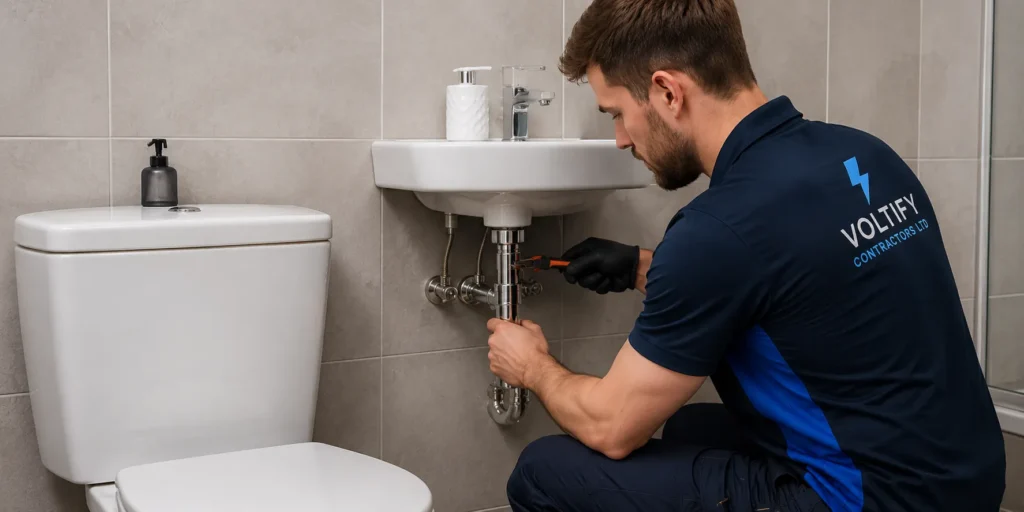

Turn off the water first. In most plumbing emergencies — a split pipe, a failed hose, water running through a ceiling — closing the internal stopcock does more to limit the damage than anything else you can do in the next few minutes. Once the flow is under control, Voltify Contractors can attend as your emergency plumber in East and South-East London, including Canary Wharf, Stratford, Bow, Canning Town, Greenwich, Woolwich and Barking, with out-of-hours call-outs available outside our standard working day.
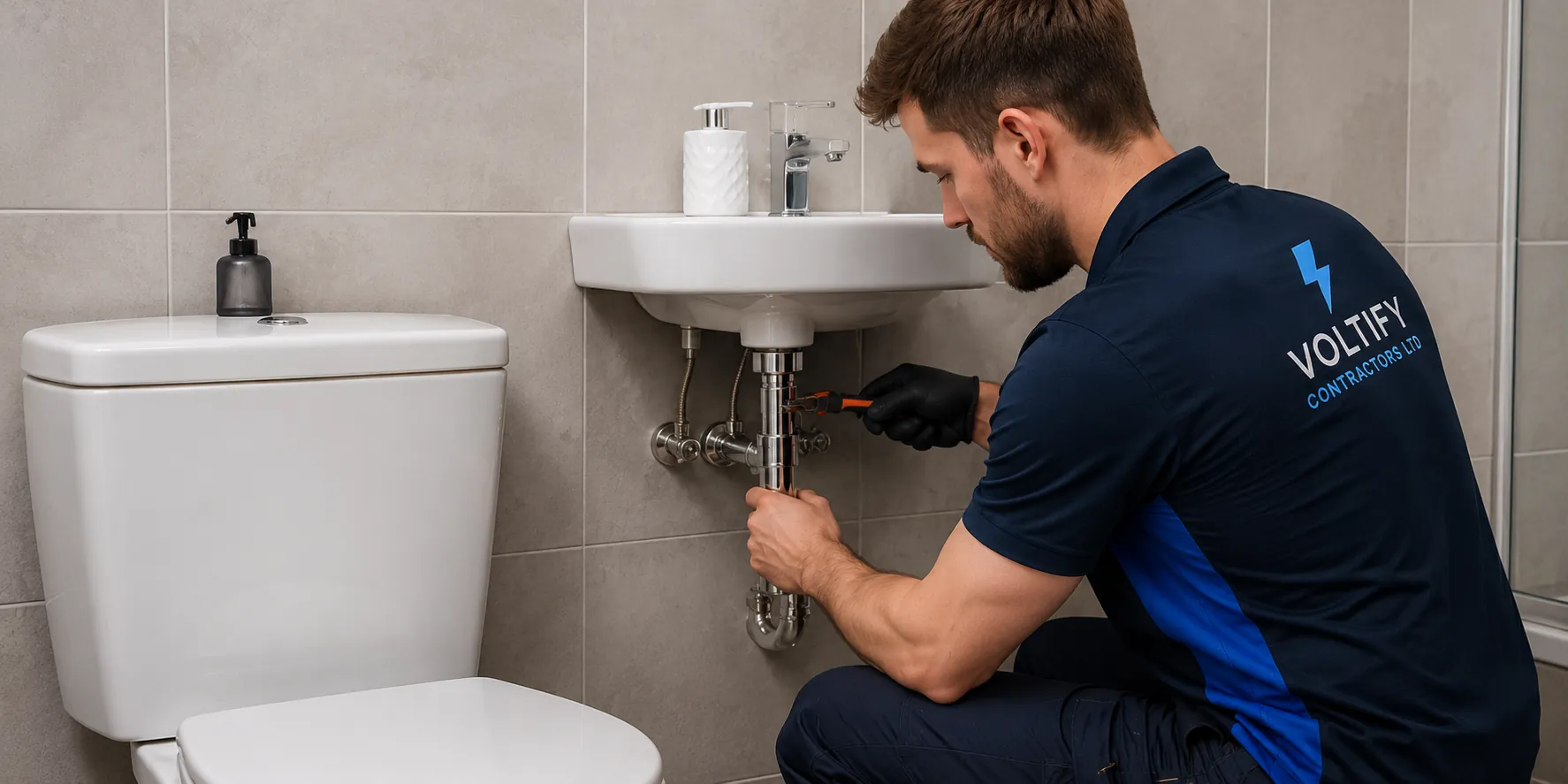
This page is part of our wider plumbing services. It explains what to do straight away, how to judge whether the problem really needs an emergency call-out, and what the first visit is designed to achieve.
Stop the Water Before Anything Else
These steps are safe for most people to carry out and can save a floor, a ceiling or the flat below:
- Close the stopcock. It is often under the kitchen sink, but may be in a downstairs toilet, utility cupboard, under the stairs or near where the supply pipe enters the building. In many flats it sits in a hallway cupboard, a riser or a communal area. Turn it clockwise until it stops.
- If only one fitting is leaking, use its isolation valve. Many toilets, taps and appliances have a small valve on the pipe feeding them — usually turned with a flat-head screwdriver so the slot sits across the pipe. This can stop the leak while leaving the rest of the water on.
- Open the cold taps once the stopcock is closed, to let the water left in the pipes drain away rather than out of the leak.
- Switch off the water heating — the boiler or immersion heater — if the leak is on the hot-water side, so the system isn’t heating with no water coming in.
- Contain and record. Move belongings away, catch what you can in buckets and towels, and take photos and a short video of the leak and any damage for your insurer or landlord.
If the stopcock is seized, broken or can’t be found and water is still escaping, that alone makes it an emergency — say so when you call. If a pipe has split and water keeps coming even with the stopcock closed, our guide to what to do with a burst pipe before the plumber arrives covers loft tanks, frozen pipes and other situations in more detail.
Water and Electrics: Keep Clear
If water is coming through a ceiling near a light fitting, or has reached sockets, switches or an extension lead, do not touch them. Only switch the electricity off at the consumer unit if you can reach it without standing in water or touching anything wet. If you can’t do that safely, keep everyone out of the area.
Water getting into an electrical installation needs checking once the leak is dealt with — see our emergency electrician page for what that involves.
Leaks in Flats, New-Builds and Tower Blocks
A lot of homes around Canary Wharf, Stratford and Canning Town are in purpose-built blocks, and a leak there plays out differently from one in a terraced house:
- Your stopcock may be outside the flat. Check under the kitchen sink and in hallway or airing cupboards first; in some blocks the valve for each flat sits in a communal riser cupboard on the landing. If you can’t find it, the concierge or building management may know where it is.
- Water from above has to be stopped above. If the leak is coming from the flat upstairs, contact that occupant, your landlord or the managing agent at the same time as calling a plumber, because the source can only be isolated from inside their property.
- Access may need arranging. Many blocks ask for contractors to be booked in with the concierge or security desk, and parking can be limited. Mention any entry system, fob or desk arrangements when you call.
Leaks between flats often involve the freeholder, the managing agent and more than one insurer. Our guide to dealing with a water leak at home covers who to contact and what to photograph while you wait.
Does It Need an Emergency Plumber Tonight?
An emergency call-out makes sense when water is causing damage that can’t wait until the next working day. Many plumbing problems feel urgent but are safe to leave once they are isolated.
| Situation | Usually treat as | Why |
|---|---|---|
| Burst or split pipe with water still escaping | Emergency | Damage continues every minute the water runs |
| Water coming through a ceiling or into the flat below | Emergency | Hidden damage to floors, ceilings and wiring can spread quickly |
| Stopcock won’t close and water is escaping | Emergency | There is no way of controlling the flow |
| The only toilet in the property is blocked or overflowing | Often urgent | Sanitation matters, especially with children or elderly occupants; if there is a second toilet it can usually wait |
| Leak has stopped since you closed an isolation valve | Standard appointment | The damage is controlled, so a standard-hours visit is usually fine |
| Dripping tap, running cistern or slow leak into a bucket | Standard appointment | Book a routine plumbing repair instead |
| No water from any tap | Check first | Contact your water supplier to rule out a local outage or planned works before calling a plumber |
If you’re not sure which applies, call and describe what you’re seeing. It’s reasonable to ask whether it can safely wait. For borderline cases such as a leaking radiator, an overflow pipe running outside or sewage backing up, our guide to what counts as a plumbing emergency explains how to judge them.
What the First Emergency Visit Is For
The first priority on an emergency call-out is making the situation safe: stopping the water, isolating the damaged section and, where possible, restoring supply to the rest of the property so you can still use a kitchen tap or toilet.
What happens next depends on what’s found. A failed fitting or short section of accessible pipe may be repaired properly on the same visit — our burst pipe repair page explains how split and frozen pipes are dealt with. A leak inside a wall or floor, or one that needs parts not carried as standard, may get a temporary repair first, with the permanent fix arranged for a standard-hours visit. You’ll be told which it is and why before further work is done. Where the source isn’t obvious, the follow-up may involve tracing the leak properly.
Drying out and repairing water-damaged ceilings, walls or flooring is a separate job for later. Once the plumbing is fixed and the area has dried, our property maintenance service can help put things right.
Out-of-Hours Call-Outs and How They’re Priced
Voltify Contractors’ standard working hours are 7am–5pm, Monday to Friday. The documented minimum call-out during those hours is £80 for the first hour, with parts and any further time on top.
Outside those hours, emergency call-outs are available at a different rate with a different minimum charge. The cost is confirmed when you call, because it depends on when the attendance is needed and what the job involves. More detail on how urgent work across all trades is handled is on our emergency call-out services page.
Smell Gas? That Needs a Different Call
Voltify Contractors does not work on gas appliances, gas boilers or gas supply pipes. If you can smell gas, don’t operate light switches or use naked flames, open the windows, leave the property and call the National Gas Emergency Service. A gas leak or a gas boiler fault needs a Gas Safe registered engineer rather than an emergency plumber.
Not sure which trade a problem calls for? Our guide to who to call for plumbing and electrical emergencies sets out the differences, so the first call goes to the right person.
What to Tell Us When You Call
A clear description on the phone helps the right parts and approach come with the first visit:
- what is leaking or broken, and roughly where in the property;
- whether you have managed to turn the water off, and how;
- whether water has reached ceilings, electrics or a neighbouring property;
- whether it’s a house or a flat, and which floor;
- anything about access, such as a concierge, entry system or who will be there to let us in.
Call Voltify Contractors on 020 3411 1855. We cover East and South-East London — see the areas we cover if you’re unsure whether your address is included.