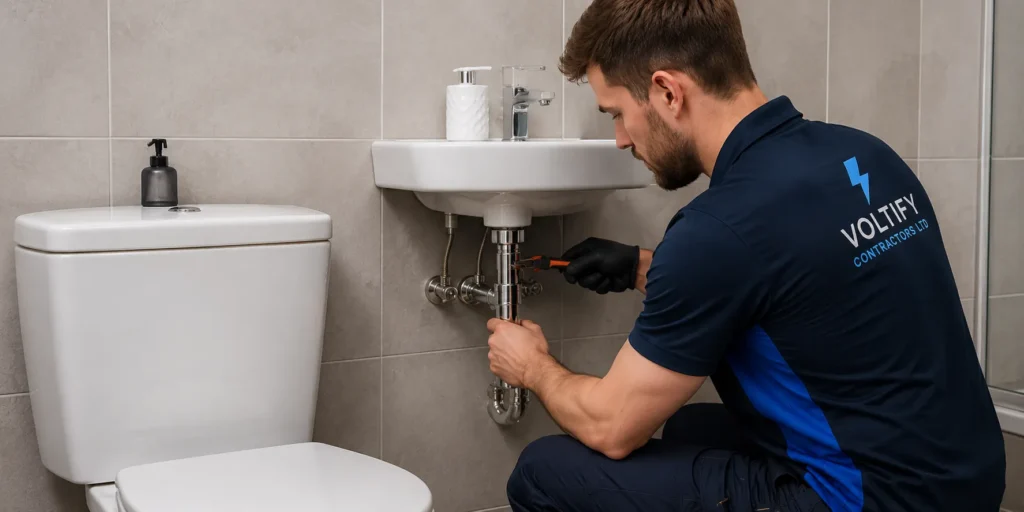

In an emergency home repair, call for whatever is causing the danger, not for the room it is happening in. Water escaping that you cannot stop is a job for an emergency plumber. Sparking, burning smells, scorch marks or a circuit that will not stay on are for an emergency electrician. Some problems need neither: fire, smoke or someone hurt by an electric shock means 999, a smell of gas means the gas emergency line, and a power cut that has hit the whole street goes to the electricity network operator on 105.
Most of the confusion comes from the problems in between: water dripping through a light fitting, an electric shower leaking, a washing machine that has flooded the kitchen and tripped the power. This guide works through who to ring first in those situations, and why the order matters.
Calls that come before any tradesperson
Some emergencies are not repair jobs at all, or not yet. Check these first, because a plumber or electrician cannot help until they have been dealt with.
- Fire, smoke, or a person injured by an electric shock, a fall or scalding water: call 999. Get everyone out first if there is fire or smoke.
- A smell of gas, or a carbon monoxide alarm sounding: call the National Gas Emergency Service on 0800 111 999. Do not operate electrical switches, and open doors and windows if it is safe to do so.
- No power, and neighbours or street lights are out too: that is a supply fault, not your wiring. Call 105, the free power cut line for England, Scotland and Wales. The same number is used to report damaged power lines or substations, with 999 as well if someone is in immediate danger.
- No water from any tap, or water bubbling up from the road or pavement: contact your water supplier. Leaks on the mains and the pipe connecting your property to them are the water company’s responsibility, not yours.
If none of those apply, the problem is inside your property, and the next question is which trade it belongs to.
Plumber or electrician: a quick routing guide
| What you can see | Call first | What usually follows |
|---|---|---|
| Water escaping from a pipe, tank or fitting, and you cannot stop it | Emergency plumber | Repair or isolation of the damaged section; an electrical check if water has reached wiring |
| Water coming through a ceiling near a light fitting or into sockets | Emergency plumber, after isolating the electricity if you can do so safely | An electrician to check the affected circuits once the leak is stopped and the area has dried |
| Burning smell, scorch marks or sparking from a socket, switch or fitting | Emergency electrician | Repair or replacement of the damaged accessory or cable |
| Circuit trips immediately every time it is reset | Electrician (emergency if there are heat, smell or damage signs) | Fault finding to trace which circuit or appliance is responsible |
| Electric shower leaking from the unit itself | Isolate both water and power, then a plumber or electrician depending on where the water is coming from | Often both trades if water has got inside the unit |
| Appliance has leaked and the power has tripped | Plumber for the leak; electrician only if the power will not stay on once the appliance is unplugged | Appliance repair or replacement |
| Only toilet in the property is overflowing or will not flush | Plumber | A standard appointment if there is a second working toilet |
| Gas boiler failed, no heating or hot water | A Gas Safe registered engineer | Not a general plumbing or electrical call-out |
The last row matters because “no heating” feels like a plumbing problem. Work on a gas boiler, cooker or fire must be carried out by an engineer on the Gas Safe Register, so check that whoever you call is registered for that type of appliance.
When water and electricity are both involved
This is the situation people most often get wrong, usually by trying to deal with the water first while standing next to a wet socket.
Start with the electricity, but only if you can reach the consumer unit without standing in water or touching anything wet. Switching off the main switch makes the room safer for everyone, including the plumber who arrives later. If the consumer unit is in the wet area, or you would have to reach past a dripping fitting to get to it, leave it and keep everyone out of that part of the home.
Then stop the water at the stopcock, or at the isolation valve on the leaking fitting if there is one. Our guide to what to do with a burst pipe covers stopcocks, loft tanks and what to do if water keeps coming.
Which trade to ring first follows from what you could not control yourself:
- If you have stopped the water but the power is off and you are not sure it is safe to turn back on, the leak is contained and the electrical check is the open question. A plumber may still be needed for the repair, but the electrician decides when power can be restored.
- If you could not stop the water, the plumber is the priority, because every minute adds to the damage. Mention on the phone that water has reached electrics.
- If water came through a light fitting, do not switch that light back on to “test it” once the dripping stops. Water can sit inside the fitting and the ceiling void for some time.
The order of repair is usually plumbing first, then electrics. There is little point testing circuits while water is still getting into them.
Appliances and fittings that sit between the trades
Electric showers
An electric shower is both a plumbing and an electrical appliance. Water leaking from the pipework or the shower head is a plumbing problem. A shower that trips the circuit, smells hot, has a scorched pull-cord switch or has water escaping from inside the casing needs the power isolated and an electrician to look at it. If you cannot tell where the water is coming from, isolate both and say so when you call.
Washing machines and dishwashers
A leak from the hoses, the valve behind the machine or the waste pipe is plumbing. If the leak has tripped the power, unplug the appliance once the area is dry enough to do so safely and try resetting the circuit. If the circuit holds with the appliance unplugged, the fault is probably in the appliance, and it does not need an emergency electrician. If the circuit still will not stay on, that is a fault in the installation and worth an electrician’s attention.
Immersion heaters and hot water cylinders
An immersion heater is electrical; the cylinder and its pipework are plumbing. A cylinder that is leaking is a plumbing priority. Switch the immersion heater off at its switch first, because heating an emptying cylinder can cause further damage. An immersion heater that has stopped heating, or a switch that is hot or discoloured, is an electrical matter.
Water near a consumer unit
If a leak is anywhere near the consumer unit, treat it as an electrical risk first. Do not touch the unit if it is wet or water is running towards it. Stopping the water from a safe position is still worth doing, but the installation should be checked before the power is relied on again.
If you rent or live in a managed building
Who you are allowed to call may not be your decision alone.
- Tenants should tell their landlord or letting agent as soon as the immediate danger is dealt with. Many tenancies set out an out-of-hours repair number, and calling a contractor yourself can leave a dispute about who pays.
- Flats in managed blocks often have stopcocks, risers or electrical intakes in communal areas controlled by the building management. If the problem is in a shared pipe or the flat above, the managing agent or neighbour needs to be involved, because a contractor can only work where they have access and permission.
- Home emergency insurance sometimes requires you to use the insurer’s own contractors. If you plan to claim, check before calling someone else. Take photos and video of the damage either way.
Getting the right help out of hours
When it is a genuine emergency inside your property, the most useful thing you can do on the phone is describe what you can see, smell and hear, what you have already switched off, and whether water has reached anything electrical. That tells the person you are speaking to which trade, parts and approach are needed.
Voltify Contractors handles both plumbing and electrical call-outs across East and South-East London, so a problem that crosses the two does not have to be passed between companies. Standard hours are 7am–5pm, Monday to Friday, and out-of-hours emergency call-outs are available at a different rate. Our emergency call-out services page explains how urgent work is handled and priced, and you can go straight to the emergency plumber or emergency electrician pages if you already know which you need.
If you are still unsure whether the problem can wait until morning, our guides to what counts as a plumbing emergency and what counts as an electrical emergency go through the warning signs for each.