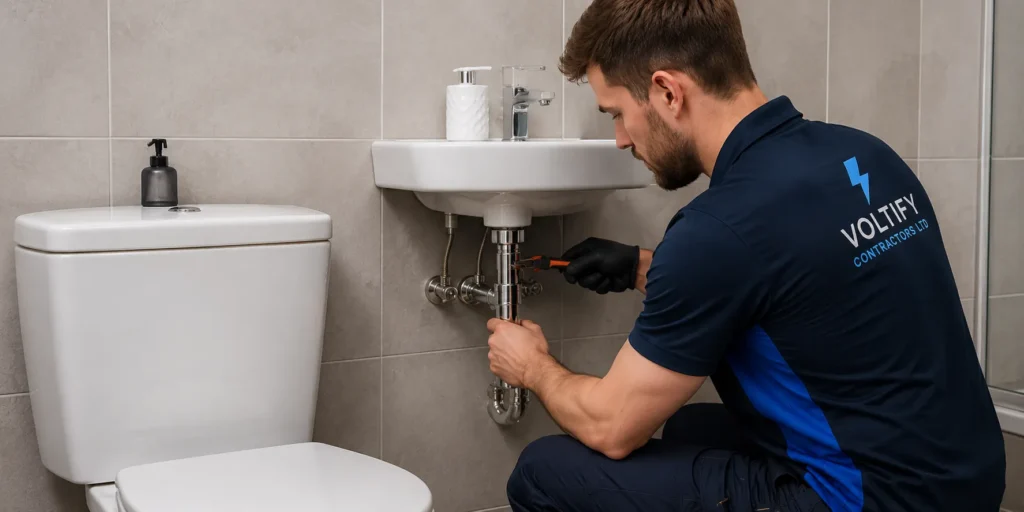

A plumbing emergency is water you cannot control, water reaching somewhere it will do serious damage, or a failure that leaves a home without something it cannot manage without until the next working day. A burst pipe still pouring after you have tried the stopcock is an emergency. A dripping tap is not. Most of the cases people are unsure about sit somewhere between the two, and they become much easier to judge once you ask the right questions.
Four questions that decide it
Work through these in order. A “yes” to any of the first three usually means it cannot wait.
- Can you stop the water? If closing the stopcock or the isolation valve on the fitting stops the flow, the damage has been contained, even if the repair is still needed. If the stopcock will not turn, cannot be found, or the water keeps coming, the situation is still active.
- Where is the water going? Water reaching light fittings, sockets or the consumer unit, coming through a ceiling, soaking into floorboards, or getting into the flat below causes damage that grows every hour, often out of sight.
- What does it leave the household without? Losing the only toilet, all running water, or the ability to wash and cook safely matters more in some homes than others. A second working toilet or a kitchen tap that still runs changes the picture.
- Who lives there? Babies, elderly people, or anyone unwell or with care needs can turn an awkward night into an unsafe one, and that is a fair reason to treat a borderline problem as urgent.
Notice what is not on the list: how alarming the problem looks. A cistern hissing all night is irritating but harmless once its valve is turned off. A small, quiet drip into a ceiling void can be the more serious problem.
Borderline cases, worked through
Water running from an overflow pipe outside
An overflow pipe dripping or running outside the house usually means a cistern or tank fill valve is not shutting off properly. The overflow is doing its job by taking the excess water away safely. It wastes water and needs fixing, but it is rarely an emergency unless water is running down a wall into the property or the flow is heavy and cannot be stopped at an isolation valve.
A leaking radiator or radiator valve
A weep from a radiator valve can often be caught in a container overnight. A steady leak from the radiator itself, or one that is soaking a carpet or floor, is more urgent, particularly upstairs or in a flat. On a sealed heating system, a leak will also make the boiler pressure drop and the boiler may stop working, which is a heating fault for a Gas Safe registered engineer if the boiler is gas.
No hot water or no heating
This feels like a plumbing emergency but usually is not one in the sense of a plumber. If the cause is a gas boiler, the work has to be done by an engineer on the Gas Safe Register. It becomes urgent when the home has no other heating in freezing weather and vulnerable people live there. If there is also any smell of gas, leave the boiler alone and call the National Gas Emergency Service on 0800 111 999.
A blocked or overflowing toilet
If it is the only toilet in the property and it is overflowing or unusable, it is reasonable to treat it as urgent. If there is a second toilet, it can wait. Stop using it, close the isolation valve on the cistern feed if it keeps refilling, and try the safe methods in our guide on how to unblock a toilet. If they do not work, see our page on blocked toilets for what a call-out involves.
Sewage coming back up through a toilet, sink or outside drain
This is urgent for health reasons, but it may not be a plumber you need first. If the blockage is in a sewer you share with neighbours, or in the public sewer under the road, the water company is responsible for clearing it. A quick check is whether next door is having the same problem. A drain serving only your property and within your boundary is your responsibility, and normally needs a drainage specialist rather than a general plumber.
A frozen pipe that has not burst
No water from one tap in cold weather often means a frozen pipe. It is not yet an emergency, but it can become one when it thaws if the pipe has split. Close the stopcock before thawing it gently, and keep an eye on it. Our guide to what to do with a burst pipe covers frozen pipes in more detail.
A slow leak, a damp patch or a stained ceiling
Damp that has appeared gradually is usually a slow leak. It needs finding, but rarely in the middle of the night. The exception is a ceiling that is sagging, bulging or dripping steadily, which can mean water is pooling above it. Keep people out from underneath it and treat it as urgent. Our guide to dealing with a water leak at home explains how different kinds of leak behave.
A washing machine or dishwasher leak
Turn the appliance off at the wall if you can do so without standing in water, then close the valve on the pipe feeding it. Once the supply is off, the leak has stopped and the repair can wait. It only stays urgent if water has reached electrics or is going through the floor.
When it is not a plumber you need
Some urgent water problems belong to someone else, and calling them first saves time and money.
- No water from any tap, or a leak in the road or pavement outside: contact your water supplier. The mains and the communication pipe that connects your property to them are the water company’s responsibility. The supply pipe from your boundary into the building, and everything inside, is yours.
- Water coming from the flat above: the leak can only be stopped at its source, so contact your neighbour, landlord or managing agent straight away.
- You rent: tell your landlord or letting agent. Many have their own out-of-hours arrangements.
- Water has reached electrics: keep clear of anything wet and electrical. Our guide on who to call when plumbing and electrical problems overlap covers the order of operations.
In short
If you can stop the water and it has not reached electrics, ceilings or another home, the problem has usually become a repair rather than an emergency, even if it still needs fixing soon.
If the water keeps coming, is going somewhere it will do lasting damage, or leaves the household without something it truly cannot manage without, treat it as an emergency.
Calling an emergency plumber
When a problem passes those tests, an out-of-hours call-out is the sensible next step. Voltify Contractors’ emergency plumber page explains what to do before anyone arrives, what the first visit is for and how out-of-hours call-outs are priced. If the problem can wait, a standard-hours plumbing repair between 7am and 5pm, Monday to Friday, avoids the out-of-hours rate.