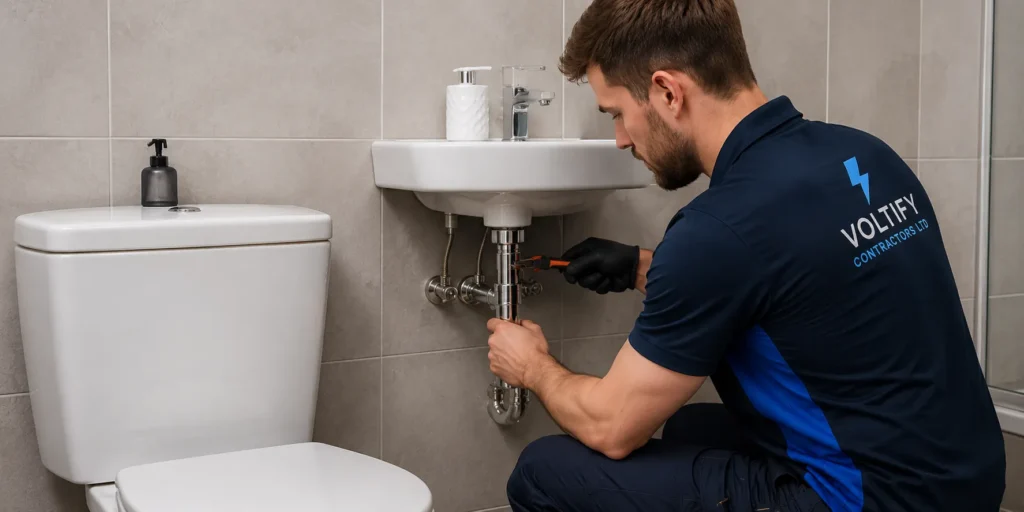

A tap that drips even when it’s turned off hard, a toilet cistern that never quite stops refilling, a slow puddle under the kitchen sink or a pipe joint that weeps every time the washing machine runs — most plumbing faults start small and get steadily worse. Voltify Contractors carries out plumbing repairs on the everyday water supply and waste fittings in homes, rented properties and commercial premises across East and South-East London, including Canary Wharf, Stratford, Bow, Canning Town, Greenwich, Woolwich and Barking.
This page is for faults that need fixing properly but aren’t flooding the property. If water is escaping faster than you can catch it, or you can’t stop it at the stopcock, go straight to our emergency plumber page instead. For an overview of everything we cover, see our main plumbing services page.
The Plumbing Repairs We Carry Out Most Often
Plumbing repairs cover faults in the fittings and pipework you use every day. They tend to fall into four groups.
Taps, valves and stopcocks
Dripping or running taps caused by worn washers or ceramic cartridges, loose or wobbling taps, stiff or seized isolation valves, and stopcocks that no longer close fully — which matters more than most people realise until the day they need to turn the water off. For tap-specific faults and fitting new taps, see tap repair and installation.
Toilets and cisterns
Cisterns that keep running or refilling, weak or failed flushes, handles and buttons that no longer operate the flush, and leaks at the cistern base or the pan connector behind the toilet. Our toilet repair and installation page goes into these faults in more detail. A blocked toilet is a different job and is handled separately from a mechanical toilet repair.
Sinks, basins and waste pipework
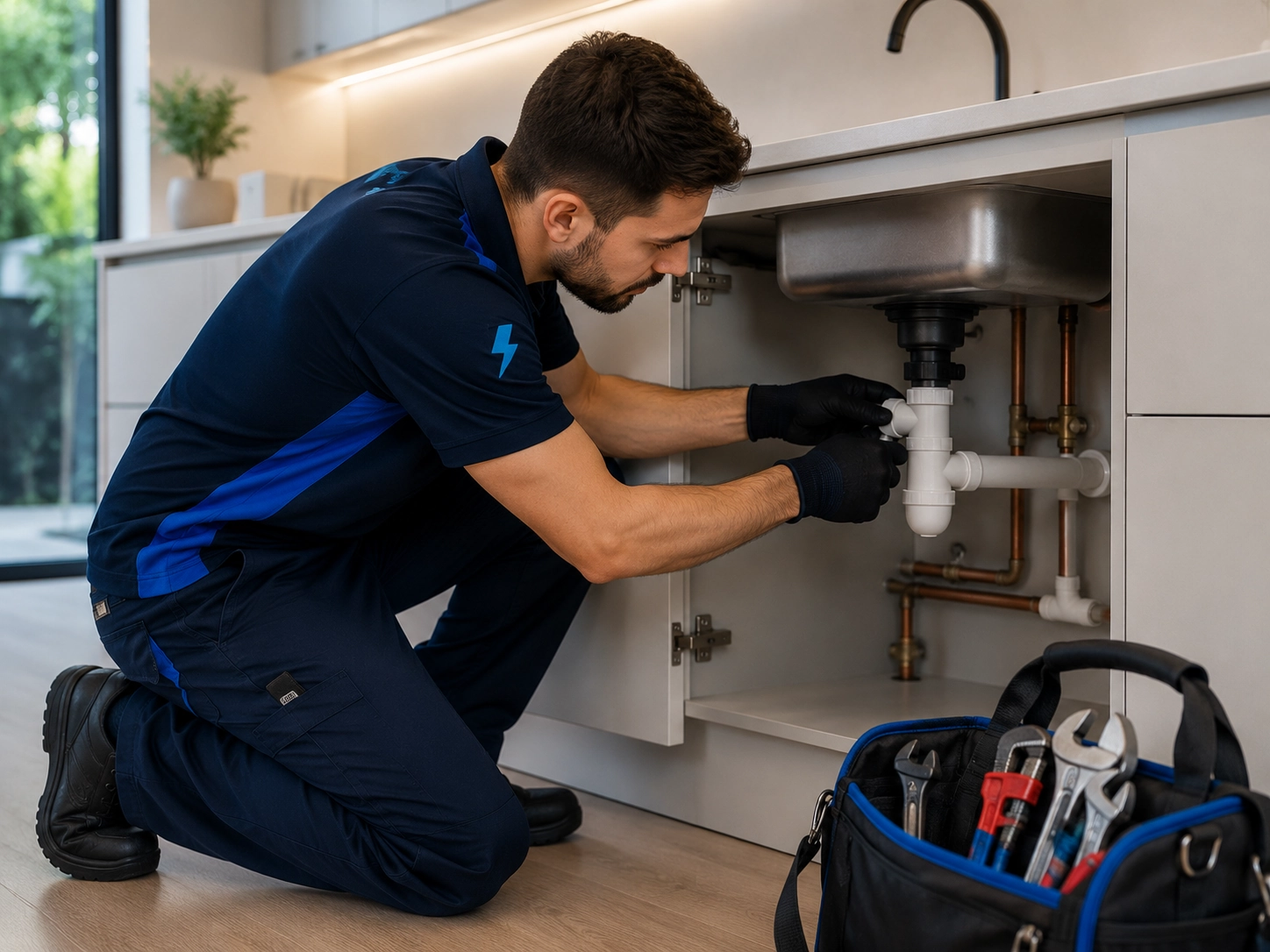
Leaking traps and waste joints under kitchen sinks and bathroom basins, loose waste connections, and slow-draining basins where the problem is a build-up in the trap rather than further down the drain.
Accessible supply pipework
Weeping joints, tired compression fittings, pipework that knocks or moves because it has lost its clips, and short sections of damaged pipe that can be reached without major disruption. A pipe that has split and is actively spraying water is treated as an emergency or burst pipe repair rather than a routine visit.
Start With the Symptom: Where the Fault Often Sits
You don’t need to know what’s wrong before getting in touch — describing what you can see is enough. The table below shows common starting points. It is a guide, not a diagnosis; the actual cause is confirmed once the fitting is inspected. If weak flow affects every tap rather than one, our guide to the common causes of low water pressure helps you tell a supply problem from a fault inside the property.
| What you notice | Where the fault commonly sits | Worth knowing |
|---|---|---|
| Tap drips when fully closed | Washer, ceramic cartridge or valve seat | Replacing the worn internal part is often enough; a very old or corroded tap may be better replaced |
| Toilet cistern keeps running or refilling | Fill valve, flush valve seal or float setting | Water may trickle silently into the pan, so check for a constant ripple at the back of the bowl |
| Water gathering under the kitchen sink | Trap, waste joints, tap connectors, or an appliance hose or valve | Dry the area, then run the tap, the sink waste and the appliance separately — noting which one causes water to appear is very useful |
| Low flow from one tap only | Partly closed isolation valve, blocked aerator or worn cartridge | If every tap in the property is weak, the cause is more likely to be the supply than a single fitting |
| Banging or knocking when a tap is shut off | Loose pipework or pressure surge in the pipes | Often improved by securing pipe runs; sometimes a change to the fitting or valve is needed |
| Damp patch or stain with no visible drip | Concealed pipe, joint or shower seal | This usually needs tracing first — see leak detection and repair |
Worth Checking Yourself Before You Book
A few checks are safe for anyone to do. They often narrow the fault down, and now and then they solve it outright:
- Find the isolation valve. A small slotted screw on the pipe below a tap, toilet or appliance turns off just that fitting. A quarter turn with a flat screwdriver is enough; forcing a stiff one can make it leak.
- Unscrew a weak tap’s aerator. If only one tap is slow, limescale in the nozzle is a common cause. Soaking it in vinegar costs nothing.
- Lift the cistern lid. If water is running into the overflow, the fill valve is set too high or failing. Our guide to a toilet that keeps running walks through the float adjustment.
- Tell a washer from a cartridge. A tap that turns several times is likely a washer; a quarter-turn lever usually has a ceramic cartridge. The guide on whether to repair or replace a leaking tap covers both.
Stop and call if a joint is soldered rather than screwed, the fitting is boxed in, water is near sockets or lights, or the stopcock won’t close. If water is coming through a ceiling, read what counts as a plumbing emergency before anything else.
Repair the Part or Replace the Fitting?
Many plumbing faults are fixed by replacing a single worn component — a washer, cartridge, fill valve or seal — and leaving the rest of the fitting in place. That is usually the sensible choice when the tap, cistern or valve is otherwise in good condition and replacement parts are still available for it.
Replacing the whole fitting starts to make more sense when:
- the body of a tap or valve is corroded, cracked or leaking from somewhere other than the moving parts;
- parts for an older or unbranded fitting are no longer available, or won’t match;
- the same fitting has failed several times in a short period;
- you were already planning to upgrade it, so repairing the old one would be money spent twice.
Where both options are realistic, you’ll be told what was found and what each route involves before work goes ahead, so the decision stays with you.
Details That Help Before a Plumbing Repair Visit
A few minutes of preparation helps the fault get sorted on the first visit rather than the second:
- which fitting is affected, and whether the problem is constant or only happens when something is used;
- whether you can already isolate it — many taps, toilets and appliances have a small isolation valve on the pipe feeding them;
- a photo of the fitting and, if visible, any make or model name, so suitable parts can be considered in advance;
- anything that may affect access, such as a tiled-in bath panel, boxed-in pipework or fitted kickboards under kitchen units;
- in a flat, where the stopcock is — some are inside the flat, others in a communal cupboard or riser.
On the Day: Five Stages of a Plumbing Repair
Every repair follows the same order, whether it is a single washer or a run of tired waste joints. Nothing is taken apart until you know what was found.
- Look and listen. The fitting is checked while it is in use, so the leak, drip or noise can be seen at its source rather than guessed at.
- Isolate. The water to that fitting is turned off at its own valve where possible, leaving the rest of the property in use.
- Explain the options. You hear whether a part swap will do or the fitting is past saving, and what each route involves, before work goes ahead.
- Repair. The worn part, joint or section is replaced, and anything that looks close to failing nearby is pointed out rather than quietly left.
- Test under pressure. The water is turned back on and the fitting is run several times, with joints wiped dry and checked again before the visit ends.
If the fault turns out to be hidden behind a wall or floor, tracing it becomes its own job; see leak detection and repair. For pipework that needs more than a joint, our pipe repair and replacement page explains what is involved.
What Affects the Cost of a Plumbing Repair
The documented minimum call-out for standard-hours work is £80 for the first hour. That covers attendance and the first hour of labour; it is not a fixed price for the whole repair, and it doesn’t include parts. The total depends on a few specific things:
- Parts. A washer costs very little; a replacement cartridge, fill valve or full fitting costs more, and some brands use proprietary parts.
- Access. Pipework behind tiling, inside boxing or beneath a fitted kitchen takes longer to reach and put back.
- Condition of the existing plumbing. Older fittings and pipework can be seized or brittle, which may turn a simple part swap into a small section of replacement.
- What else is found. A leak under a sink sometimes turns out to have more than one source.
- Timing. Out-of-hours call-outs are available but priced differently from standard-hours work.
If opening up boxing or tiles is needed to reach the fault, making good afterwards is a separate step — our handyman and property maintenance service can cover that if it’s needed.
Where a Plumbing Repair Stops
Some problems look like plumbing but belong elsewhere:
- Gas appliances, boilers and gas pipework are not part of a plumbing repair visit. Work on gas must be carried out by a Gas Safe registered engineer.
- A washing machine or dishwasher with an internal fault — one that won’t drain or fill even though the pipework feeding it is fine — is an appliance issue rather than a plumbing one. Connecting, moving or replacing a machine is covered by our appliance installation service.
- Blockages beyond the property’s own fittings, such as a shared drain or sewer, may need a drainage specialist or the local water company.
Arranging a Plumbing Repair
Voltify Contractors works 7am–5pm, Monday to Friday, with out-of-hours emergency call-outs available at a different rate. To book a repair, get in touch with a short description of the fault and, ideally, a photo — it makes it much easier to judge what parts may be needed before anyone arrives. Work is carried out across East and South-East London; check the areas we cover if you’re unsure whether your address is included.