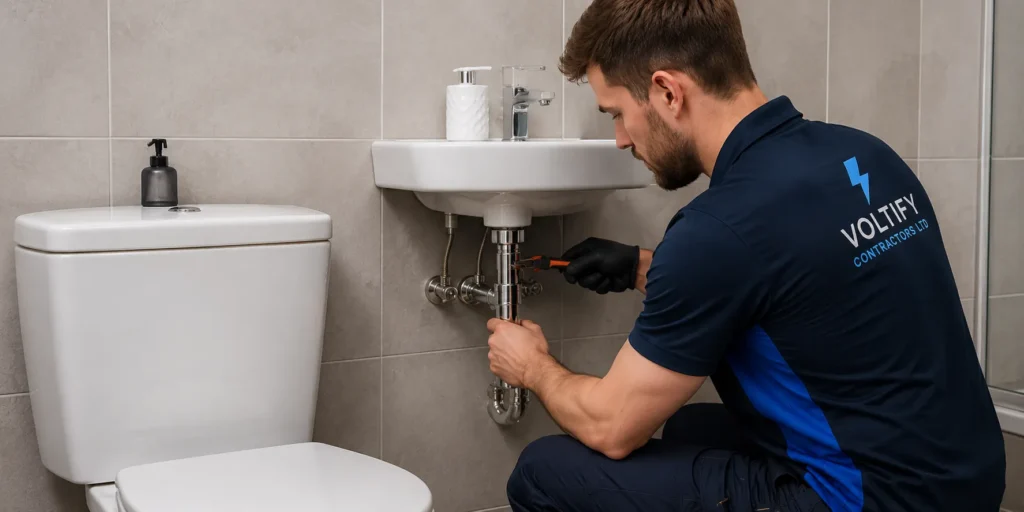

A toilet has only a handful of working parts, and almost every fault traces back to one of them. Toilet repair usually means replacing the fill valve that refills the cistern, the flush valve that empties it, or one of the seals between the cistern, the pan and the soil pipe. When the pan or cistern is cracked, or parts for an older model can’t be found, fitting a new toilet is the more practical fix.
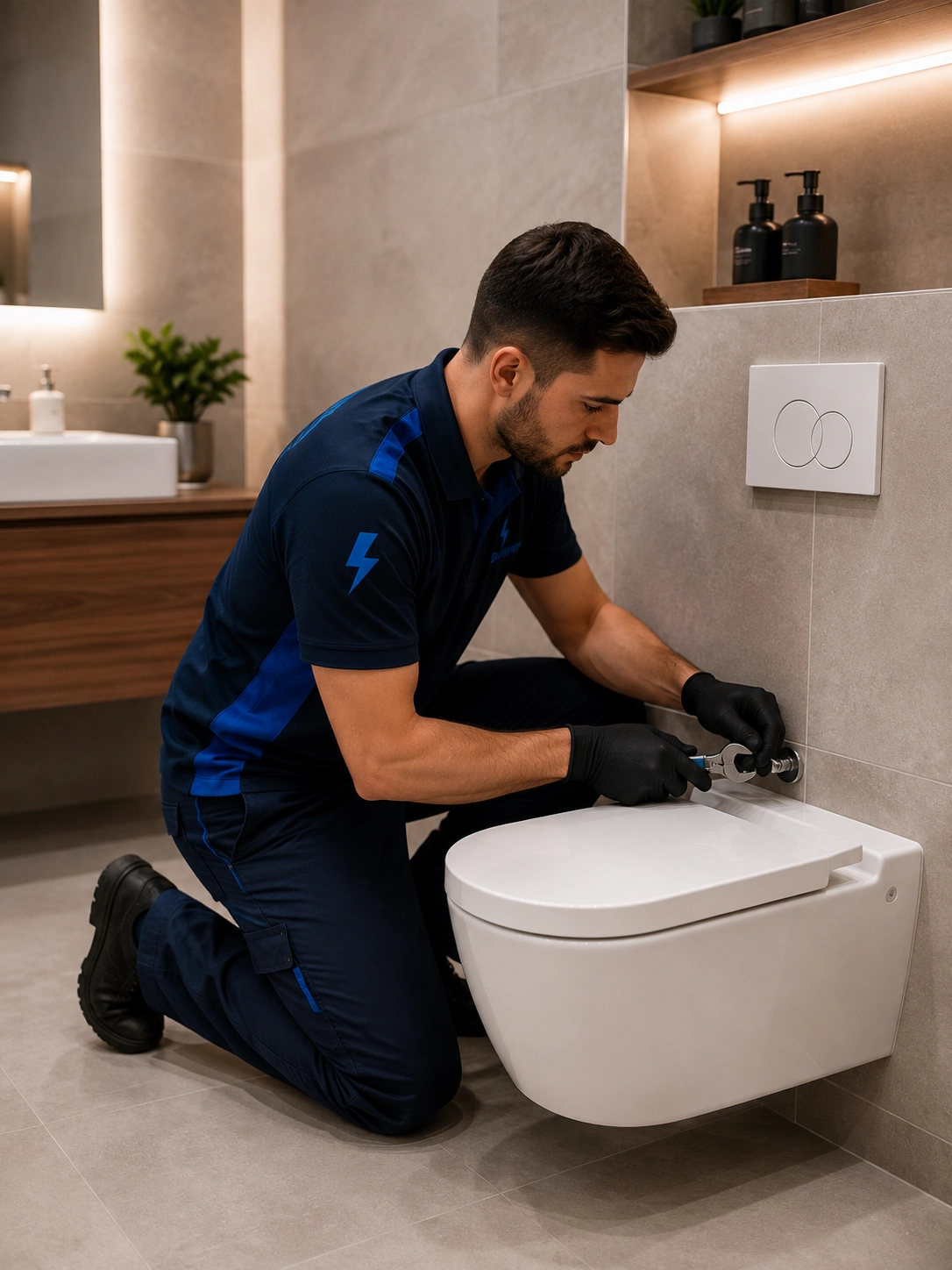
Voltify Contractors repairs and installs toilets in homes, rented flats and commercial premises across East and South-East London, including Canary Wharf, Stratford, Bow, Canning Town, Greenwich, Woolwich and Barking, as part of our plumbing services. A toilet that is blocked rather than faulty is a different job — see our blocked toilet page; for other everyday faults such as dripping taps or leaking sink wastes, see plumbing repairs.
Start Here: Is Your Cistern Visible or Hidden?
This is the first thing to establish, because it changes how a toilet is repaired.
- Close-coupled toilets have the cistern sitting directly on the back of the pan. Everything is reached by lifting the cistern lid.
- Back-to-wall and wall-hung toilets usually have a concealed cistern behind a panel, boxing or a wall frame. Many can be reached by removing the flush plate on the wall; others need an access panel. If the boxing has been tiled over with no access, reaching the cistern may mean removing tiles.
- Low-level and high-level toilets have a separate cistern joined to the pan by a flush pipe, and are common in older properties. The flush pipe joints are an extra place for leaks to start.
If you have a concealed cistern, mention it when you book, along with any access panel you know about.
What the Symptom Usually Points To
Water keeps trickling into the pan
A constant ripple at the back of the bowl means water is getting past the flush valve seal, or the fill valve isn’t shutting off and the cistern is draining through its internal overflow. The dye test further down helps tell the two apart.
Water runs from an overflow pipe outside
On older toilets with an external overflow, this means the fill valve isn’t closing at the right water level. It may be worn, set too high, or held open by debris or scale.
Weak or incomplete flush
Often a flush valve that isn’t lifting fully, a water level set too low, or a worn siphon diaphragm on an older lever-flush toilet. Sometimes the cause is a partial blockage further down the pipe, which is a different problem from a mechanical fault.
Button or lever does nothing
A broken lever arm, a snapped cable or air hose on a concealed cistern, or a push-button that has come loose from the valve. These are usually simple parts, though button mechanisms are often specific to one make.
Slow refill
A partly closed isolation valve, scale inside the fill valve, or low incoming water pressure.
Water on the floor around the toilet
Look at where it starts: the pan connector behind the toilet, the seal between cistern and pan, the supply connection, or condensation dripping off a cold cistern in a humid bathroom. Each has a different fix, and condensation needs no plumbing work at all. If the water keeps coming back or you can’t find its source — or a stain has appeared on the ceiling below — see leak detection and repair.
Pan rocks or moves
Loose or corroded floor fixings, or an uneven floor. A rocking pan can break the seal on the pan connector, so it’s worth fixing before it starts to leak.
A Simple Test for a Silently Running Toilet
A cistern leaking into the pan can waste a surprising amount of water without making any noise. To check yours:
- Once the cistern has filled, add a few drops of food colouring to the water in the cistern — not the bowl.
- Don’t flush for about 30 minutes.
- Look in the bowl. If the colour has appeared, water is getting past the flush valve and its seal needs attention.
- Flush afterwards to clear the colour.
If the bowl stays clear but water is still running from an overflow, the fill valve is the more likely culprit. Our guide on why a toilet keeps running explains how to tell the two valves apart with the lid off and which simple adjustments are safe to try first.
Fixing the Inside of the Cistern Yourself: What Is Reasonable
With the lid off a close-coupled cistern, a few jobs are within reach of most people: adjusting the float or fill valve so the water stops just below the overflow, clearing grit or scale from the fill valve, re-seating a flush button that has slipped off its rod, or fitting a new seat. Turn the isolation valve off before you touch anything, and check the valve’s instructions, as designs differ between makes.
Stop and book a visit if:
- the isolation valve is stiff or won’t turn at all, as forcing it can snap the pipe;
- the leak is between the cistern and the pan, which means taking the cistern off to renew the seal;
- the cistern is concealed and the only way in is through tiles or boxing;
- you can see a crack in the pan or cistern, however fine;
- water has reached the floorboards or a ceiling below.
Toilet Repair or a New Toilet?
Most toilet faults are fixed with a single part. Replacing the toilet makes more sense when:
- the pan or cistern is cracked, even with a hairline crack — ceramic doesn’t repair reliably;
- the model is old or discontinued and replacement internals don’t fit;
- the pan is badly stained or crazed and won’t come clean;
- you want a different style, such as a back-to-wall toilet in place of a close-coupled one;
- an older single-flush cistern is using more water per flush than you’d like, and a dual-flush toilet would reduce it.
Getting a Replacement Toilet to Fit
Toilets aren’t a universal size, and the most common installation problem is a new pan that doesn’t line up with the existing soil pipe. Before choosing one, check:
| Check | Why it matters |
|---|---|
| Whether the soil pipe leaves through the floor or the wall | Decides the outlet type and pan connector needed |
| Distance from the wall to the centre of the soil pipe | New pans vary in where the outlet sits; the wrong one may fall short or stand out from the wall |
| Where the water supply enters the cistern | Cisterns are fed from the side or from underneath; the supply may need moving |
| How far the toilet projects into the room | Matters in small cloakrooms where a door or basin is close by |
| Condition of the floor | A new toilet needs a sound, level floor; soft boards around an old toilet often point to a long-standing leak |
Fitting involves isolating the supply, removing the old toilet, fitting a new pan connector and seals, fixing the pan and cistern securely, connecting the supply and checking for leaks over several flushes. Where a concealed cistern or new boxing is involved, the job also includes the frame and access panel, and tiling or making good may be needed afterwards — our handyman and property maintenance service can help with that side of it.
A Leaking Toilet in a Flat or Rented Home
In a block of flats, water that escapes around a toilet rarely stays in your bathroom. It soaks into the floor and can show up as a damp patch or drip on the ceiling of the flat below, sometimes before you have noticed anything yourself. A small, steady leak at the pan connector or under the cistern is worth dealing with early for that reason.
- Slow it down first: turn the isolation valve on the supply pipe to the cistern, flush once to empty it, and put an old towel round the base so you can see whether fresh water appears.
- Tell the neighbour below if there is any chance water has gone through, so they can check their ceiling and light fittings.
- Renting? Report it to your landlord or letting agent in writing, with a photo of where the water is coming from. Landlords and agents can book the repair with us directly.
Our guide to what to do about a water leak at home covers turning off the water and protecting the room below in more detail.
Arranging a Toilet Repair or Replacement
Before you book, note which type of toilet you have and what it’s doing, and take a photo inside the cistern with the lid off, plus the flush button or plate — it often identifies the make of valve. If you’re replacing the toilet, send the product details of the new one.
A running or weak-flushing toilet can wait for a standard appointment. If it’s the only toilet in the property and it’s unusable, or water is leaking onto the floor and you can’t stop it at the isolation valve, see our emergency plumber page instead.
The documented minimum call-out is £80 for the first hour, during standard hours of 7am–5pm, Monday to Friday. Parts, a new toilet, and extra time for concealed cisterns or seized fixings are added to that. Contact Voltify Contractors to arrange a visit, or check the areas we cover.