
Low water pressure almost always starts in one of three places: the supply arriving at the property, the pipes and valves inside it, or a single tap or shower. The fastest way to narrow down the cause is to notice the pattern. Weak flow at every tap points towards the supply or the main pipework; weak flow at one outlet points to that fitting; weak hot water with strong cold points to the hot water system. Timing matters too: a sudden drop across the whole street is a different problem from pressure that has been slowly getting worse for months.
Many of the common causes can be checked safely in a few minutes. Others need a plumber, and a few belong to the water company rather than to you.
Read the pattern first
| What you notice | Where the cause usually sits | Worth checking first |
|---|---|---|
| Every tap, hot and cold, dropped suddenly | The water supply outside: a burst main, repairs or maintenance in the area | Your water supplier’s website or incident line, and whether neighbours are affected |
| Every tap has always been weak, or has got slowly worse | The supply pipe into the property, a stopcock that is not fully open, or old, narrowed pipework | That the internal stopcock is fully open; whether the supply pipe is old lead or steel |
| Weak only in the morning and early evening | High demand, especially on a supply shared with neighbouring properties | Whether the pattern matches times when others nearby use water |
| Weak only after work was done | A stopcock or isolation valve left partly closed, or debris disturbed in the pipes | Valves near where the work happened; the aerators on the taps |
| Hot water weak, cold water fine | The hot water system: the height of a cold water tank, the flow a combi boiler can deliver, or a valve on a hot water cylinder | What kind of hot water system you have (see below) |
| One tap or shower only | That fitting: a blocked aerator or shower head, a part-closed isolation valve, or a worn cartridge or mixer valve | Clean the aerator or head and check the small valve on the pipe feeding it |
| Weak upstairs, fine downstairs | Height: the water has further to rise, which shows up most on a weak supply or a gravity-fed system | Whether the upstairs outlets are fed from a tank in the loft |
The table is a starting point rather than a diagnosis. Two causes can overlap, for example an old supply pipe that is fine most of the day but cannot keep up at peak times.
Checks you can safely make yourself
- Find out whether it is just you. Ask a neighbour, and check your water supplier’s website for work or bursts in your area. The supplier’s name is on your water bill.
- Check the stopcock is fully open. It is often under the kitchen sink, in a downstairs cupboard or, in flats, in a communal cupboard or riser. Turn it anticlockwise gently until it stops. If it is stiff or seized, do not force it: a stopcock that breaks while you are turning it can leave you unable to turn the water off.
- Check isolation valves on the affected outlet. Many taps, toilets and appliances have a small valve on the pipe feeding them, with a screwdriver slot. When the slot lines up with the pipe, the valve is open; across the pipe, it is closed. A valve left halfway is a common cause of one weak tap.
- Clean the aerator or shower head. The small mesh at the end of most taps, and the holes in a shower head, collect limescale and debris, particularly in hard water areas such as much of London. Unscrew and soak them in descaler or vinegar, then rinse.
- Time the flow. Run the cold kitchen tap fully into a container. The Consumer Council for Water says a normal supply should be enough to fill a one-gallon (4.5 litre) container in 30 seconds. A note of how long yours takes is useful to the water company or a plumber.
- Rule out a leak. A leak on the supply pipe can steal pressure without being obvious. If you have a water meter, turn off every tap and appliance and see whether the meter keeps moving. Our guide on what to do if you have a water leak explains the signs and the first steps.
When the water company is responsible
Water companies have to supply water at a minimum pressure to the pipe that connects the main to your property, but their duty stops there. The Consumer Council for Water sets out the regulated minimum as 0.7 bar (7 metres static head) in that communication pipe. If pressure falls below that level on two occasions, each lasting more than an hour, within 28 days, the company should make an automatic payment under the Guaranteed Standards Scheme, subject to some exceptions. The company is not responsible for pressure lost inside your own private supply pipe or internal plumbing.
So if your neighbours have the same problem, or the drop was sudden and affects every tap, contact your water supplier first. If the supply is fine at the boundary but weak inside, the cause is on the property side, and that is where a plumber comes in.
Hot water pressure is a separate question
If only the hot taps and shower are weak, the type of hot water system matters more than the mains supply.
- Gravity-fed systems, with a cold water tank in the loft feeding a hot water cylinder, deliver pressure according to how high the tank sits above the outlet. Low pressure, especially upstairs, is normal for this kind of system rather than a fault.
- Combi boilers heat water as it flows, and each boiler can only heat so much water per minute. Opening two hot taps at once, or a mains supply that is already weak, shows up as weak hot water.
- Unvented hot water cylinders run at mains pressure through a pressure-reducing valve and other safety controls.
Faults inside a boiler or on the controls of an unvented cylinder need a suitably qualified heating engineer, and any work on a gas boiler must be carried out by a Gas Safe registered engineer. A plumber can still check the pipework, valves and outlets on the hot side.
Signs it is time to call a plumber
- The supply outside is normal, but every tap in the property is weak.
- The stopcock or an isolation valve is seized, will not open fully or leaks when moved.
- The water meter moves with everything turned off, or there is an unexplained damp patch, which suggests a leak.
- One tap or shower stays weak after the aerator or head has been cleaned and its valve checked.
- The property has old lead or galvanised steel supply pipes, which can narrow inside over time.
- Pressure dropped after building work, or comes with new knocking or banging in the pipes.
Low pressure on its own is rarely an emergency. The exception is no water at all with no explanation from the supplier, or a leak you cannot stop, in which case our guide to what counts as a plumbing emergency helps you decide how urgently to act.
What a plumber is likely to look at
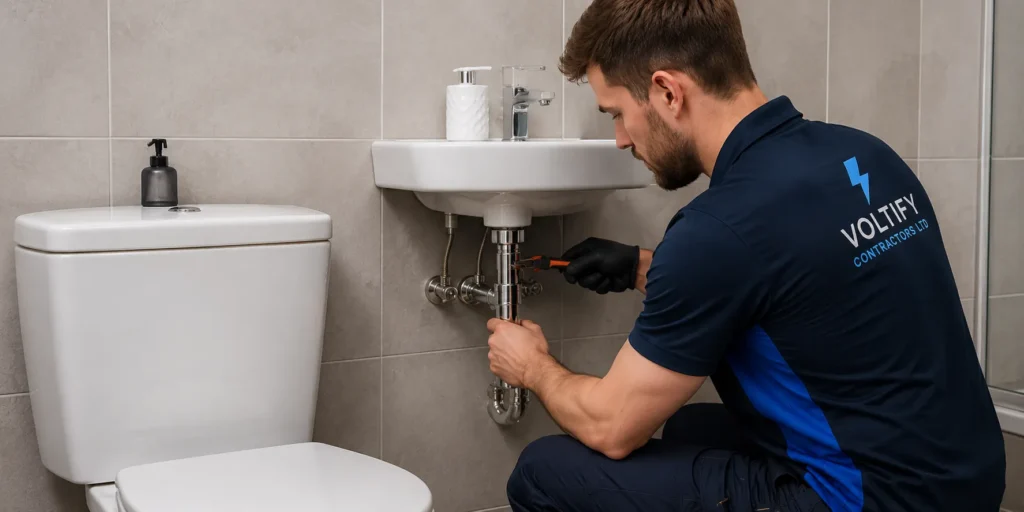
A plumber will usually start at the point where water enters the property and work towards the outlets: checking the stopcock and any valves on the way, measuring flow at different taps, looking at the material and size of the supply pipe and how it is laid out, and inspecting the fittings that are underperforming. That tells them whether the answer is a repair to a single valve or fitting, replacing a section of pipe, or something that needs the water company’s involvement.
If the cause is a valve, a tap cartridge or a length of accessible pipe, it falls under Voltify Contractors’ plumbing repairs service, which explains how a repair visit is priced and what to send beforehand. Where the problem is confined to a shower, the shower repair and installation page covers mixer valves, heads and hoses.