
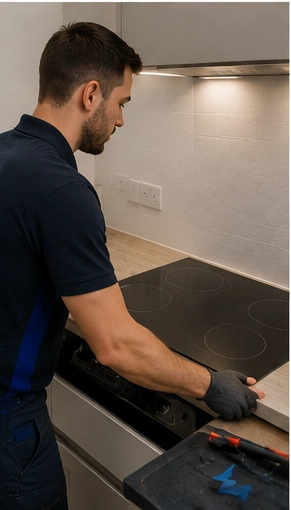
Two things shape almost every hob installation: the hole in the worktop and the supply that feeds it. A new hob that matches the old cut-out and runs on the same type of supply is usually a tidy swap. Change the size, or move from gas to induction, and the job becomes about the worktop and the electrics rather than the hob itself.
Voltify Contractors fits induction and ceramic hobs in homes and rented properties across East and South-East London, including Canary Wharf (E14), Stratford (E15), Bow (E3), Canning Town (E16), Greenwich (SE10), Woolwich (SE18) and Barking (IG11), as part of our appliance installation service. Gas hobs are covered below too, because the gas connection has to be handled differently.
Induction, Ceramic or Gas Hob Installation: What Each Needs
| What changes | Induction | Ceramic (electric) | Gas |
|---|---|---|---|
| Power or fuel | Electricity, often at a high rating | Electricity | Gas, plus a small electrical supply for ignition on most models |
| Usual connection | Cooker circuit via a connection plate; a few smaller models come with a plug | Cooker circuit or, for some smaller models, a plug | Gas supply connected by a Gas Safe registered engineer |
| Worktop | Needs a clear space underneath for airflow | Similar to induction | Needs space for the gas pipe and fittings |
| Cookware | Must be magnetic | Any flat-bottomed pan | Any |
The rating on the hob’s data plate or in its manual is the figure that matters. A large induction hob can draw more than an older kitchen circuit was designed for, so the existing supply is checked against the new hob before any work starts.
Can You Install an Induction Hob Yourself?
That depends on how the hob is powered. A small induction hob supplied with a 13A plug only needs a suitable socket nearby, and plenty of people drop one into a correctly sized worktop hole themselves.
A full-size induction hob is a different job. It is wired into a cooker circuit through a connection plate, and the cable, the cooker switch and the protective device at the consumer unit all have to suit its rating. A swap on an existing circuit already rated for the new hob is the simpler case. A new circuit is notifiable electrical work under the Building Regulations in England, so it cannot simply be connected and left. It is usually not a do-it-yourself job when:
- The new hob has a higher rating than the old one, or its manual asks for a larger cable or breaker.
- There is no cooker switch, or the connection plate is scorched, loose or hidden behind units.
- You are moving from gas, so there is no suitable electrical supply yet.
- The new cut-out is smaller than the existing hole, or the worktop is stone or quartz.
If any of those apply, have the supply checked before the new hob arrives. It saves a second trip and a hob sitting in its box.
Switching from Gas to Induction
This is one of the most common reasons for a hob installation, and it is the one most likely to involve more than one trade. Two things have to happen:
- The gas supply to the old hob is capped off by a Gas Safe registered engineer. That part is arranged separately, so mention it when you get in touch.
- A suitable electrical supply is provided where there was only a small ignition feed before. In many kitchens that means a new cooker circuit from the consumer unit. Whether the existing consumer unit has space and capacity for it is part of the assessment, and any new circuit is carried out as part of our electrical services.
The cut-out for a gas hob is often a different size and shape from an induction hob of the same width, so the worktop may need adapting as well. If you are still choosing between the two, our guide to what gas and induction hob installation each require compares the rules, checks and people involved.
The Worktop Cut-Out
Hob manufacturers publish exact cut-out dimensions, and they vary even between hobs of the same nominal width. Before ordering, compare the new hob’s cut-out size with the existing hole:
- Same size or slightly larger: the existing hole can often be used, or enlarged carefully in a laminate or solid wood worktop.
- Smaller than the existing hole: this is harder to fix neatly. A hob with a wider frame, or a filler, is sometimes possible; otherwise the worktop section may need replacing.
- Stone, quartz or compact worktops: these need specialist cutting tools, so any change to the cut-out is normally done by the worktop fabricator before the hob is fitted.
The cut edges of a laminate or timber worktop are sealed so steam and spills cannot swell the core. The hob sits on its seal and is clamped from below, so it cannot shift or let liquid run down into the unit.
Clearances Above and Below
Hobs sit between other things, and the manufacturer’s instructions set out the gaps each needs.
Below the hob, induction and ceramic models need airflow. If a built-under oven sits directly underneath, the combination must be one the manufacturers allow, and the specified ventilation gap has to be kept. A drawer beneath the hob may need a divider or a trimmed back panel. Where a new oven is going in at the same time, see our oven installation page for the housing and supply checks on that side.
Above the hob, there is a minimum distance to a cooker hood set by the hood and hob manufacturers, and it is usually greater for gas than for electric. There are also clearances to walls and to the side of tall units. Replacing an electric hob with gas, or the other way round, can mean the hood height needs reviewing too; our cooker hood installation page explains the height, width and ducting checks on that side.
Fitting an Induction Hob: How the Visit Goes
Most of the work happens before the new hob goes anywhere near the worktop. On a typical visit:
- The power is isolated at the consumer unit, then the old hob is disconnected and lifted out.
- The cooker switch, the cable and the connection plate are checked against the rating on the new hob’s data plate.
- The cut-out is measured against the new hob’s instructions, and the space underneath is checked for the airflow gap the manufacturer asks for.
- The hob is connected, seated on its seal and clamped from below.
- Power goes back on and every zone is tested with a magnetic pan before you are shown the controls.
If you would like the old hob taken away, mention it when you book and it can be removed and disposed of. Where the check shows that a new cooker circuit is needed, that work is carried out and an Electrical Installation Certificate is issued for it. Replacing a freestanding cooker instead? Our electric cooker installation page covers the supply checks on that side.
Pricing a Hob Swap or Conversion
The documented minimum call-out is £80 for the first hour. A like-for-like replacement in the same cut-out on a suitable existing supply is at the simpler end. The cost rises when the cut-out has to be altered, the connection plate or cable needs replacing, or a new circuit is needed for an induction hob. Gas work carried out separately by a Gas Safe engineer is not included. Parts and cable are not included in the call-out minimum.
To get an accurate answer, send the model number of the new hob, a photo of the existing hob and the worktop around it, the cut-out size from the manual, and a photo of the cooker switch or connection. Contact Voltify Contractors to talk through the installation, or check the areas we cover.