
Paint and wallpaper show every flaw in the wall underneath them. A crack that was filled but not sanded flush, a water stain that was never sealed, or a patch of chalky old paint that was painted straight over will all come back through a new finish, sometimes within weeks. Wall preparation is the stage that stops that happening: cleaning, scraping, filling, sanding, caulking and priming the surface so that whatever goes on top has something sound to hold onto.
Voltify Contractors carries out wall preparation and filling in homes, rented properties and commercial premises across East and South-East London, either as the first stage of a decorating job or as a preparation-only visit before you paint or paper yourself. It sits within our wider painting and decorating services.
What Wall Preparation Includes
Preparation is a sequence rather than a single task, and each step depends on the one before it. On a typical internal wall it runs like this:
- Washing down — sugar soap or a suitable cleaner removes grease, nicotine and handprints. Paint does not bond well to a dirty surface, particularly in kitchens, hallways and around light switches.
- Removing anything loose — flaking or blistered paint is scraped back to a firm edge, and crumbling filler from old repairs is cut out.
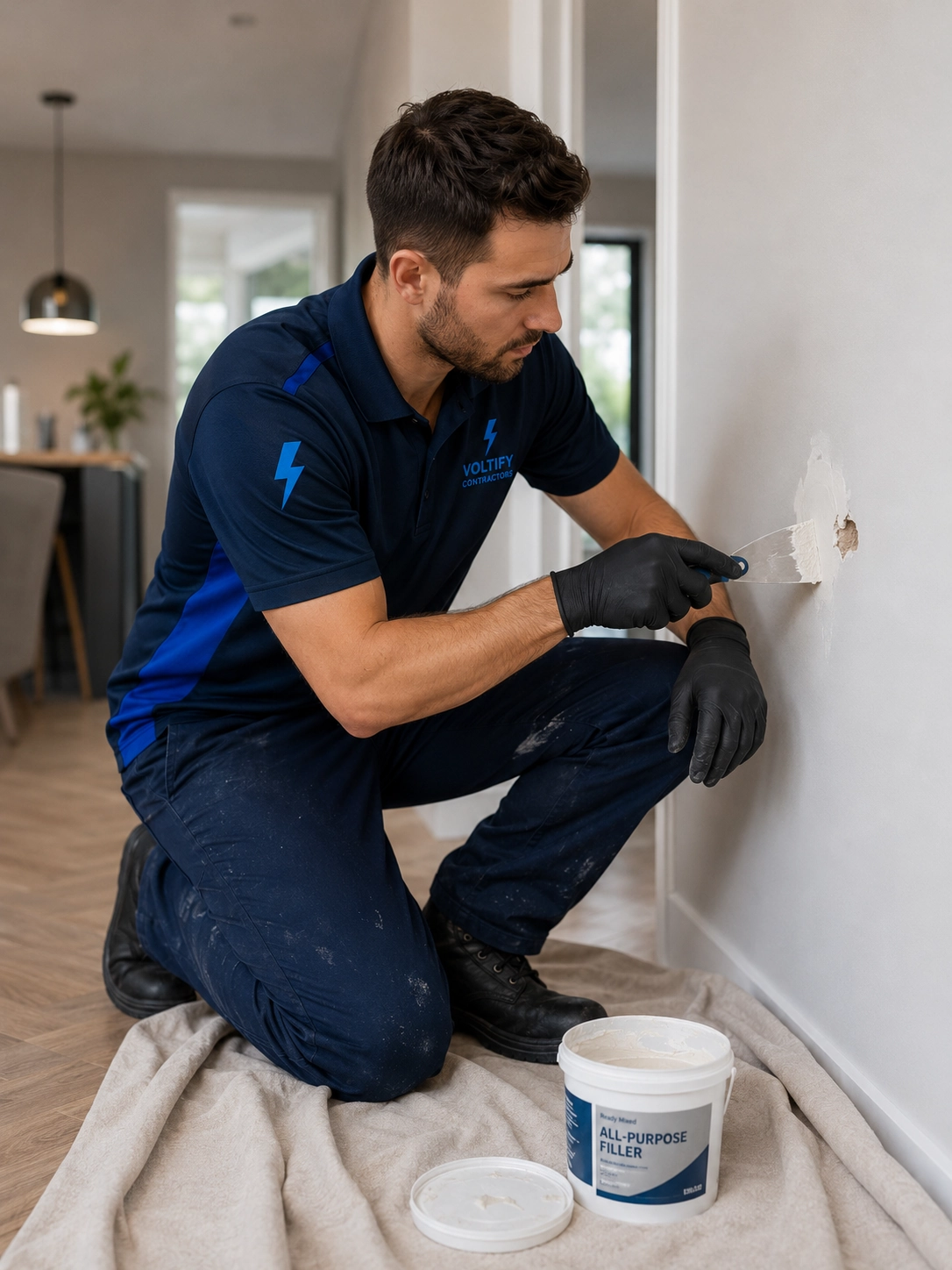
- Filling — cracks, holes and dents are filled, with deeper ones built up in layers.
- Sanding — filler is sanded flush, and the edges of scraped paint are feathered so they don’t show as ridges under the new coat.
- Caulking — gaps where walls meet skirting boards, door frames and window boards are sealed with flexible decorators’ caulk.
- Dusting off and priming — sanding dust is removed, and filled or bare areas are spot-primed or sealed so they take paint at the same rate as the rest of the wall.
Outside walls, render and external woodwork need different materials and a different approach to preparation, which is covered on our exterior painting page.
Reading the Wall Before Anything Is Filled
A few simple checks show what kind of preparation a wall needs, and they are worth doing before you settle on a finish:
- The wipe test. Run a hand or a damp cloth over the wall. If it comes away white or chalky, the old paint is powdery — often an old distemper or a thin contract emulsion — and new paint laid straight over it can peel off in sheets. That surface needs a stabilising primer first.
- The tape test. Press masking tape firmly onto the paint and pull it off sharply. Paint that lifts with the tape is poorly bonded and needs scraping back rather than painting over.
- Raking light. Hold a torch flat against the wall, or look along it when low sun comes through a window. Dips, ridges and old patch marks that are invisible face-on show up clearly — and they will show just as clearly through a sheen finish.
- Sheen. Silk or gloss-finish walls need keying with abrasive paper so the new coat has something to grip.
These checks also set realistic expectations. A wall that fails the wipe or tape test is a much bigger preparation job than one that only needs a few fixing holes filled, and it is better to know that at the quoting stage than halfway through the work.
Filler, Caulk and Why Repairs Show Through Paint
Most visible repair marks on a painted wall come from using the wrong material or rushing the filling.
Filler shrinks as it dries. A deep hole filled in one go will sink, leaving a shallow dish that shows under paint, so deep repairs are built up in layers and each layer is left to dry before the next. A fine surface filler is then used for the final skim, because it sands to a smoother finish than general-purpose filler.
Caulk and filler are not interchangeable. Flexible caulk is for joints that move slightly — where a wall meets a skirting board, or a ceiling meets a wall. Used on a flat wall it cannot be sanded and leaves a rubbery patch. Filler used in a moving joint will simply crack again, which is why hairline cracks that keep reappearing along the wall-to-ceiling line are usually a caulk job rather than a filler job.
Filled areas also absorb paint differently from the wall around them. Without a spot primer, patches can “flash” — showing as dull or shiny spots under the finish coat even when they are perfectly flat.
Stains, Mould and Damp: Sealing Versus Solving
Some marks cannot be covered with emulsion however many coats go on. Water stains, nicotine, smoke damage, felt-tip pen and similar marks bleed through water-based paint, so they are sealed with a stain-blocking primer before any finish coat.
Sealing a stain is not the same as solving it. If a water mark is still damp, or has come back after being painted before, the cause needs finding first — a leak above, a failed seal around a bath or shower, or water getting in from outside. Painting over active damp only hides it for a while.
Mould is cleaned off and treated with a fungicidal wash, and the wall is left to dry before any other preparation. Mould tends to return in the same place if the room stays poorly ventilated, so it is worth thinking about ventilation at the same time as redecorating, especially in bathrooms, kitchens and colder north-facing rooms.
Preparing for New Plaster, Wallpaper or a Big Colour Change
Freshly plastered walls
New plaster must be fully dry before it is decorated — it turns an even pale colour with no darker patches when it is ready. It is then sealed with a diluted mist coat. Full-strength emulsion or vinyl silk applied to new plaster tends to sit on the surface rather than soak in, and can peel later.
Walls that are going to be papered
Walls for wallpaper are sized or sealed so the paste doesn’t soak straight in and the paper can be slid into position. Plasterboard in particular should be sealed first: paper hung on unsealed board can tear the board’s face when it is eventually stripped, as explained on our wallpaper removal page. How paper type and pattern affect the hang is covered under wallpaper installation.
Going from a dark colour to a pale one
Covering a strong or dark colour with a pale one can take several coats. A suitable basecoat or tinted primer often reduces the number of finish coats needed and gives a more even result.
Where Preparation Stops and Repair Begins
Filling is for surface defects: small holes, dents, cracks and gaps. Some problems are beyond what filler can properly put right:
- Holes through plasterboard, broken external corners and board that has gone soft need patching or a section replacing. That work is covered on our drywall and wall repair page.
- Blown plaster — plaster that has come away from the brickwork and sounds hollow when tapped — needs cutting back and making good rather than filling over.
- Cracks that return or widen, particularly diagonal cracks running from the corners of doors and windows, can indicate movement in the building. They are a question for a surveyor or structural engineer before any decorating.
- Walls that are uneven over a large area may be better lined than filled; heavily damaged plaster may need replastering, which is discussed with you before any work goes ahead.
Anything found during preparation that changes the scope of the job is explained before extra work starts. If you want to understand what your own walls need first, our guide on how to prepare damaged walls before decorating explains how to tell surface damage from repairs and causes.
Preparation-Only Visits and What Affects the Price
Not everyone wants the painting done for them. Some people want the difficult part handled properly and then apply the finish coats themselves. Landlords often need walls filled and made good between tenancies, alongside other small jobs handled through our handyman and property maintenance service. In offices, shops and communal areas, preparation can be done in one visit with painting scheduled later, as part of commercial painting or planned commercial property maintenance. If you want the whole room finished, preparation is simply the first stage of interior painting.
How long wall preparation takes depends far more on the condition of the wall than on its size. The main variables are the number and depth of repairs, whether old paint has to be scraped back or stabilised, how many stains need sealing, how much caulking is needed around skirting and frames, ceiling height and access, and how much furniture needs moving and protecting. Deep filling has to dry between layers, which can mean a return visit before the wall is ready for paint. The documented minimum call-out is £80 for the first hour; larger preparation jobs are priced on the work once the walls have been seen.
The most useful things to send are daylight photos of each wall, close-ups of any cracks, stains or flaking areas, and a note of whether you plan to paint or paper afterwards. Contact Voltify Contractors to arrange a look at the walls, or check the areas we cover.