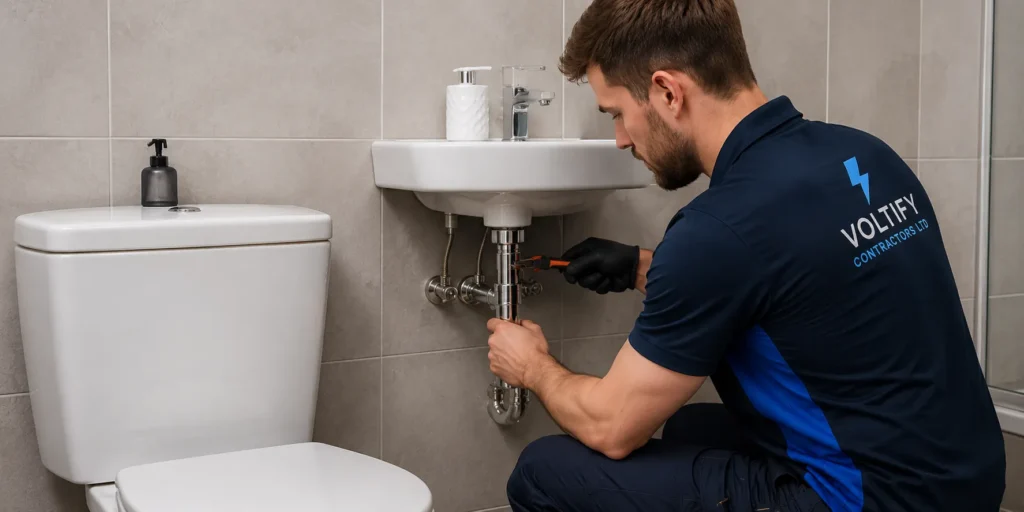

A fault with a socket, switch, light fitting or circuit is one of the most common reasons UK homeowners and landlords call an electrician. Some problems are small and self-contained — a cracked switch plate, a socket that has stopped working, a light that flickers or won’t come on. Others are a sign of a wider issue in the circuit or the property’s electrical installation. Voltify Contractors carries out electrical repairs across East and South-East London, including Canary Wharf, Stratford, Bow, Canning Town, Greenwich, Woolwich and Barking, working on the fixed wiring, accessories and fittings inside a property rather than appliances or electronic equipment.

This page covers general electrical repairs, part of our wider electrical services. If you already know the fault is with your consumer unit, your wiring, or you’re not sure what’s causing a problem, the sections below explain where those more specific issues are better handled.
What Counts as an Electrical Repair in Your Property
In a domestic or commercial property, “electrical repairs” typically covers faults and damage affecting the fixed electrical installation and its accessories, including:
- sockets and switches that have stopped working, feel loose, are cracked, scorched or make a noise;
- light fittings, pendants and switches that flicker, buzz, won’t switch off, or have failed completely;
- extractor fans, cooker circuits or other fixed appliance connections that have developed a fault;
- damaged or exposed wiring at an accessory (not full rewiring — see below);
- circuits that trip repeatedly when a specific socket, switch or appliance is used;
- minor fault correction found during another job, such as a loose connection behind a faceplate.
It does not cover repairing the appliance itself — a washing machine, oven or television with a fault is a manufacturer or appliance-repair matter, not an electrical-installation repair.
Electrical Repairs vs Other Electrical Services: Which Do You Need?
Not every electrical problem needs the same response. A quick way to check you’re on the right page:
| Situation | Best starting point |
|---|---|
| A socket, switch or light fitting has a specific, identifiable fault | Electrical Repairs (this page) |
| The cause of a problem isn’t clear — intermittent tripping, unexplained flickering across multiple circuits, or a fault that comes and goes | Electrical Fault Finding |
| Sparking, burning smell, exposed live wiring, or any situation that feels unsafe right now | Emergency Electrician |
| The fault is specifically a socket or switch that needs replacing or adding | Socket & Switch Services |
| The fault is with a light fitting, or you want new lighting installed | Lighting Installation & Repair |
| Your fuse box/consumer unit is tripping, old, or needs attention | Consumer Unit & Fuse Box Services |
| Cables are damaged, chased into walls, or you suspect a wiring problem behind the scenes | Electrical Wiring Repairs |
| You need a periodic inspection, EICR-related check or a general safety assessment | Electrical Testing & Inspection |
If your problem is a straightforward, identified fault with an accessory or fitting, general electrical repairs is the right route. If the cause is unclear or the situation feels urgent, use fault finding or the emergency page instead — both are set up to handle those situations properly.
Minor Electrical Repairs: Small Faults Still Worth Fixing Properly
Plenty of electrical repairs are small jobs that are easy to put off. They are still worth booking, because a minor symptom at an accessory is often the first sign of a loose or overheating connection behind it. Typical small repairs include:
- a faceplate that has come loose from the wall or a back box that has worked free;
- a single socket that has gone dead while the rest of the room still works;
- a light switch that crackles, feels warm or needs pressing twice;
- a ceiling rose or pendant with a cracked cover or a flex that has worn through;
- a fused spur or cooker switch that no longer clicks firmly on or off.
If you have several of these around the home, list them all when you call so they can be looked at on the same visit; the £80 minimum call-out covers the first hour on site. For sockets specifically, our guide on when electrical sockets should be replaced covers the signs, and socket and switch services covers new or additional points.
What Can Change the Scope of Your Electrical Repair
A repair that looks small can sometimes point to a larger issue once it’s inspected. Things that commonly widen the scope of a job include:
- Age and condition of the circuit. Older wiring, discontinued accessory types or previous non-compliant work can mean a like-for-like repair isn’t possible or advisable.
- Repeated tripping. If a socket or circuit keeps tripping after a repair, the underlying cause may sit elsewhere in the circuit, which shifts the job toward fault finding.
- Shared circuits. Some accessories share a circuit with others; a fault at one point can affect several sockets or lights, which may mean more of the circuit needs attention.
- Access. Fittings behind fitted furniture, under floors, or in a loft can affect how straightforward the repair is.
Because of this, Voltify Contractors assesses the fault on site before confirming the scope of work. This is standard practice — a repair that’s diagnosed accurately the first time avoids repeat call-outs. If a breaker or RCD is the problem, our guide on why a circuit breaker keeps tripping explains what the pattern of tripping can tell you before anyone visits.
Repair or Replace: Which Is Right for Your Electrical Fault?
For older or damaged accessories, repair isn’t always the most sensible option. As a general guide:
Repair
Repair usually makes sense when the fault is isolated, the accessory and circuit are otherwise in good condition, and a like-for-like fix restores safe operation.
Replacement
Replacement is usually the better route when an accessory is cracked, scorched, an obsolete type, or when repeated faults suggest it has reached the end of its working life.
This decision is made on site, not in advance — it depends on what’s found once the fitting or circuit is opened up.
What to Expect From Our London Electrical Repair Service
Before attending, it helps to know:
- roughly which socket, switch, fitting or circuit is affected;
- whether the fault is constant or intermittent;
- whether anything unusual happened before it started (a new appliance, water ingress, DIY work);
- whether the circuit trips when you try to use the item.
On site, the fault is assessed first so the scope of work is confirmed before repair begins. Voltify Contractors’ standard working hours are 7am–5pm, Monday to Friday, with out-of-hours call-outs available at a different rate for urgent situations. The documented minimum call-out is £80 for the first hour; the final cost of a repair depends on what’s found, the accessories or materials needed, and how straightforward access is — a call-out price is not the same as the total repair cost.
From Your Call to a Working Circuit: The Repair Visit in Order
Most repair visits follow the same sequence, whichever accessory has failed:
- You describe the problem. Ring 020 3411 1855 and tell us which socket, switch or fitting is affected and what it is doing. If you are not sure the cause is local to one accessory, our guide to signs you need electrical fault finding helps you decide.
- The circuit is isolated. On arrival the electrician switches off and proves the circuit dead before any faceplate or fitting is opened.
- The fault is found and explained. You are told what has failed, whether it can be repaired or should be replaced, and whether anything else on the circuit needs attention.
- You agree the work. Nothing beyond the agreed scope goes ahead without your say-so.
- The repair is made and checked. Power is restored and the repaired socket, switch or light is tested in use before the visit ends.
If something changes while you wait, such as a burning smell or sparking, stop treating it as a routine repair. Our guide on what counts as an electrical emergency explains the difference.
Electrical Safety: What to Do Before We Arrive
Do not attempt to open, rewire or test a faulty socket, switch or fitting yourself. If something is sparking, smells of burning, or you can see exposed or damaged live wiring, switch off the circuit at the consumer unit if it’s safe to do so and treat it as an emergency rather than a routine repair — see the Emergency Electrician page for what to do next. For independent home electrical safety advice, see Electrical Safety First.
Areas We Cover for Electrical Repairs in London
Voltify Contractors carries out electrical repairs across East and South-East London, including Canary Wharf & E14, Stratford & E15, Bow & E3, Canning Town & E16, Greenwich & SE10, Woolwich & SE18 and Barking & IG11. See the full list of areas we cover for your specific location.