

A fault with a socket, switch, light fitting or circuit is one of the most common reasons UK homeowners and landlords call an electrician. Some problems are small and self-contained — a cracked switch plate, a socket that has stopped working, a light that flickers or won’t come on. Others aren’t. A circuit that trips for no clear reason, lights that flicker across more than one room, or power that cuts out and comes back on its own are all signs that something in the electrical system needs investigating before it can be fixed. That investigation is what electrical fault finding covers.
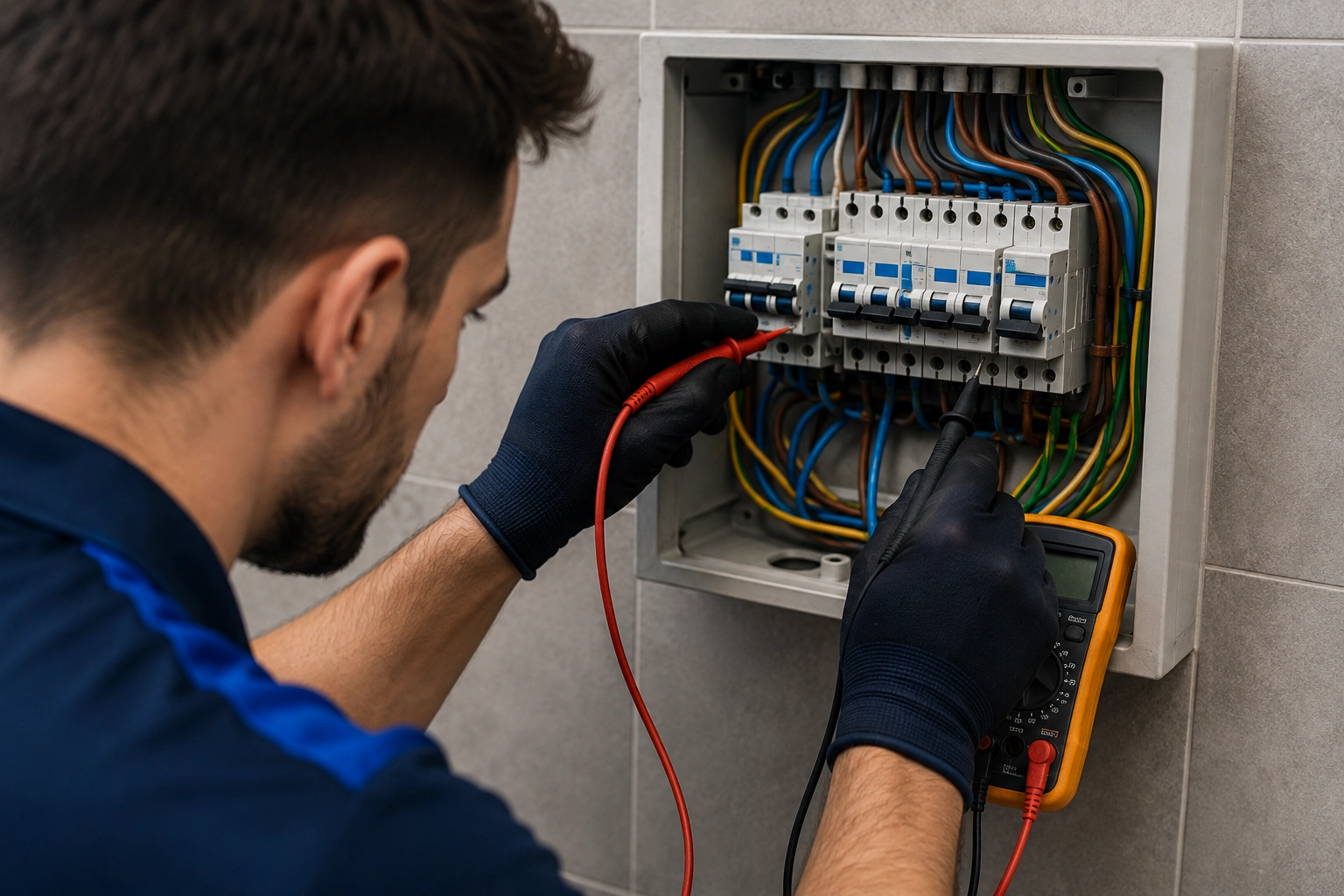
Fault finding is the diagnostic step that comes before repair. Rather than replacing parts and hoping the problem goes away, it identifies where in the circuit the fault actually sits, so the repair that follows addresses the real cause. Voltify Contractors carries out electrical fault finding across East and South-East London, including Canary Wharf, Stratford, Bow, Canning Town, Greenwich, Woolwich and Barking, as part of our full range of electrical services.
What Electrical Fault Finding Actually Involves
At a high level, fault finding means tracing a problem back to its source within the property’s electrical installation — the circuits, connections, accessories and protective devices (such as an RCD or RCBO, the safety switches inside a consumer unit that cut power when they detect a fault) that make up the system. It’s a process of elimination: checking which circuit is affected, what the symptom does and doesn’t affect, and narrowing down the likely location of the fault before anything is opened up or replaced.
This is different from a standard repair. A repair fixes a known, identified problem — a broken switch, a failed fitting. Fault finding is needed when the cause isn’t known yet, even if the symptom is obvious.
Why the Same Symptom Can Have Different Causes
This is the part that’s easy to underestimate. Two properties with an identical symptom — say, a circuit that trips whenever a particular room is used — can have completely different underlying causes: a fault in an accessory, a fault in the cabling, a fault in an appliance plugged into that circuit, or a fault in the protective device itself. Guessing based on the symptom alone, or replacing parts one at a time, often costs more in total than proper diagnosis from the start. This is why fault finding is treated as its own service rather than folded into a general repair visit.
Common Symptoms That Point Toward Fault Finding
- A circuit or the whole property trips repeatedly, especially without an obvious trigger.
- Lights flicker or dim in a pattern that doesn’t match a single failed bulb or fitting.
- Power to part of a property cuts out intermittently and restores itself.
- A socket or circuit works sometimes and not others, with no consistent pattern.
- A fault reappears shortly after being reset, or after using a specific appliance.
- Something feels “off” electrically but there’s no single obviously broken item to point to.
None of these symptoms confirm a specific cause on their own — that’s exactly why fault finding exists as a distinct step, rather than something that can be reliably diagnosed from a description over the phone. Our guide to the signs that point to electrical fault finding also covers symptoms that usually have a simpler explanation, and how to keep a fault log before a visit.
Fault Finding or Something Else: How to Choose
| If this describes your situation | Better starting point |
|---|---|
| The cause of a problem isn’t clear and you want it diagnosed | Electrical Fault Finding (this page) |
| A specific accessory or fitting has a known, identified fault | Electrical Repairs |
| There’s sparking, a burning smell, exposed live wiring, or anything that feels unsafe right now | Emergency Electrician |
| Your consumer unit itself is old, tripping on its own, or you want it upgraded | Consumer Unit & Fuse Box Services |
| You want a scheduled safety check rather than diagnosis of an active problem | Electrical Testing & Inspection |
If in doubt, fault finding is usually the safer starting point — it’s designed to work out what’s actually happening before committing to a specific repair.
Safe Checks You Can Make Before Booking
Some faults turn out to be an appliance rather than the wiring, and a couple of simple checks can show which. Only do these if nothing is hot, buzzing or smelling of burning:
- Reset once, not repeatedly. Put the tripped switch back up. If it drops again straight away, leave it down; forcing it back up again and again won’t fix anything.
- Unplug and retry. Unplug everything on the affected circuit, reset, then plug items back in one at a time. If the trip returns with one particular appliance, that appliance is the likely cause, not the house wiring.
- Note what you find. Even a negative result (it still trips with everything unplugged) is useful, because it points the investigation at the fixed installation.
Leave the rest to an electrician: don’t remove socket faceplates, open the consumer unit or swap breakers. For more on why breakers trip, see why a circuit breaker keeps tripping, and if you’re unsure whether it’s urgent, check what counts as an electrical emergency.
What to Have Ready Before the Visit
Being able to describe the following helps narrow things down faster on site:
- which room(s), socket(s) or circuit(s) are affected;
- whether the fault is constant, intermittent, or tied to using a particular appliance or switch;
- when it started, and whether anything changed beforehand (new appliance, DIY work, water ingress, a storm);
- whether resetting a trip switch restores power, and for how long;
- whether the fault affects one circuit or seems to affect the whole property.
How a Fault-Finding Visit Runs, Step by Step
Every property is different, but the order of work stays the same, so you know what’s happening at each stage.
- The phone call. You tell us what the fault does, where and when. We use this to plan the visit; we won’t guess the cause over the phone.
- Looking before touching. On arrival, the consumer unit is checked first: which device has tripped, how the circuits are labelled, and any visible signs of heat or damage at accessories on the affected circuit.
- Isolating and testing. The affected circuit is made safe, then tested section by section to narrow down whether the fault is in an accessory, a cable run, a connected appliance or the protective device.
- Explaining what was found. You’re shown where the fault sits and what the options are before any repair work goes ahead.
- Agreeing the next step. A simple fix may be possible on the same visit if you agree to it. Bigger work, such as wiring repairs, is scoped and booked separately.
What Happens After the Fault Is Found
Once the cause is identified, there are usually three outcomes: a straightforward repair, a component or accessory replacement, or — if the fault sits somewhere larger, such as ageing wiring or the consumer unit itself — a referral to the relevant specific service so that work is scoped correctly rather than patched. Voltify Contractors will explain what’s been found and what the appropriate next step is before any further work goes ahead.
What Affects Fault-Finding Cost and Complexity
Fault-finding jobs vary in how long they take and what they involve, depending on:
- how many circuits are potentially affected;
- how accessible the wiring and accessories are (behind furniture, under floors, in a loft);
- whether the fault is intermittent, which can take longer to reproduce and trace;
- the age and condition of the existing installation.
The documented minimum call-out is £80 for the first hour. Because fault finding is inherently a diagnostic process, it isn’t possible to quote a fixed price before the visit — the time needed depends on how quickly the fault can be isolated, which is exactly what makes this different from a repair with a known scope.
When to Treat It as an Emergency Instead
If you can smell burning, see sparks, notice scorch marks around a socket or fitting, or a circuit won’t stay reset no matter what’s switched off, don’t wait for a standard fault-finding appointment — switch off the affected circuit at the consumer unit if it’s safe to do so and see the Emergency Electrician page for what to do next. For independent home electrical safety advice, see Electrical Safety First.
Areas Covered for Electrical Fault Finding
Voltify Contractors provides electrical fault finding across East and South-East London, including Canary Wharf & E14, Stratford & E15, Bow & E3, Canning Town & E16, Greenwich & SE10, Woolwich & SE18 and Barking & IG11. See the areas we cover for full details of your location.