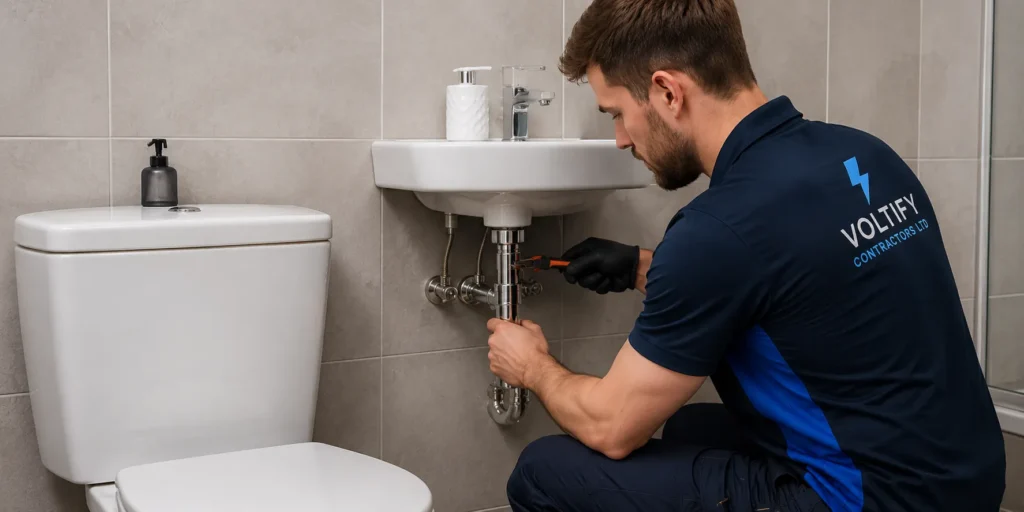

Most properties have a few woodwork jobs that are too small to plan a project around and too noticeable to ignore: a length of skirting split by a vacuum cleaner or swollen by a leak, an architrave hanging off after a door was forced, a missing door stop, bare pipes running across a wall, or a window board that has gone soft at the front edge. Handyman carpentry covers this kind of work, repairing and replacing the timber trim and small fittings that finish a room.
Voltify Contractors carries out minor carpentry, trim and skirting repairs in homes, rented properties and commercial premises across East and South-East London as part of our handyman and property maintenance service. This page covers repair and like-for-like work on existing woodwork, rather than bespoke joinery such as fitted wardrobes or staircases.
Small Woodwork Jobs This Covers
| Job | What is usually involved | Worth knowing |
|---|---|---|
| Skirting boards | Refixing loose lengths, replacing split or damaged sections, refitting skirting after flooring or plastering work | Older profiles may not be stocked; see below |
| Architraves | Refixing or replacing the moulding around door frames and openings | Often damaged at the same time as the door; the door itself is covered by our door repair service |
| Door stops and linings | Refitting the strip the door closes against, and packing or re-fixing loose frame linings | A door stop in the wrong place makes a door rattle or fail to latch |
| Window boards | Replacing split, loose or water-damaged internal sills | Condensation damage tends to return unless ventilation improves |
| Boxing in | Enclosing exposed pipework in a timber frame and board, ready for paint or tiles | Removable access panels are left over valves, stopcocks and joints |
| Cupboard doors and drawers | Adjusting or replacing hinges, refitting loose doors and drawer fronts, replacing runners | Chipboard with stripped screw holes needs repairing before a door will hold |
| Small timber repairs | Splicing new timber into a damaged section of frame, beading or trim | Suitable where the damage is local rather than spread along the whole piece |
Matching an Old Skirting Profile
Replacing one damaged length of skirting is simple when the profile is still made. Common modern profiles, such as torus, ogee, bullnose, pencil round and chamfered, are widely available in several heights, usually in pre-primed MDF. Older houses, particularly Victorian and Edwardian terraces, often have taller skirting with mouldings that are no longer stocked.
In that case there are three realistic options:
- use the nearest stock profile and replace a whole wall, so the difference is never seen side by side at a joint;
- have a length machined to match by a timber merchant, working from an offcut or a clear photo and measurements, which takes longer and costs more;
- move matching skirting from a less visible place, such as inside a cupboard, and fit a stock profile there instead.
Deciding before the old board comes off avoids ending up with a mismatched room.
How Skirting and Trim Are Fixed
The fixing depends on what is behind the board. On plasterboard walls, skirting is usually bonded with grab adhesive and fixed into the timber studs where they can be found. On brick or block, it is screwed and plugged or bonded. In many older houses, skirting was nailed to timber grounds (battens) built into the wall, and those grounds can themselves be loose or rotten, which is why a refixed board sometimes will not stay tight until the ground behind it is dealt with.
Cables and pipes often run behind skirting and architraves, particularly to sockets, so routes are checked before any drilling or nailing. Internal corners are normally scribed, with the end of one board shaped to fit over the face of the other, because a scribed joint stays closed when timber shrinks; external corners are mitred. Once fixed, pins are punched and filled and the top edge caulked to the wall, so the woodwork is ready for our painting and decorating team or your own decorator.
When the Woodwork Is a Symptom
Swollen, stained or rotten skirting at the bottom of a wall, next to a bath or below a window is usually telling you about moisture. Replacing the timber without finding the source means the new board fails the same way. Likely sources include:
- a leaking bath or shower seal, or a pipe running behind or under the skirting, which is traced through our leak detection and repair service;
- condensation running off a window onto the window board;
- damp in an external wall, which needs assessing by a damp specialist or surveyor before new timber is fitted.
If the floor next to the damaged skirting is also soft, the floor structure may be affected; our flooring repairs page explains how that is checked. Small round holes with fine, fresh dust around them can indicate active woodworm, which needs a specialist assessment before any replacement timber goes in.
Refitting Trim After Other Work
A lot of carpentry repair follows other trades. New flooring raises the floor level, so skirting is usually lifted and refitted on top of it; our laminate flooring installation page explains why the expansion gap has to be covered. After replastering or plasterboard repairs, skirting and architraves go back once the wall is dry, and any damage to the wall itself is handled by our drywall and wall repair service.
Boxing In Pipes Properly
Boxing in hides pipework without making it unreachable. A light timber frame is fixed to the wall and floor, clad in board, and finished to take paint or tiles. Any valve, stopcock, drain-off point or compression joint behind it needs a removable panel, so a leak or shut-off does not mean breaking the boxing apart. Gas pipes and boiler flues are not boxed in until the requirements for them have been confirmed, as they have their own access and inspection rules.
Offices, Shops and Managed Buildings
Skirting, door stops and trim take heavy knocks in corridors, receptions and communal stairwells. Repairs can be grouped and planned around opening hours as part of our commercial property maintenance work.
What Affects the Cost of Handyman Carpentry
The documented minimum call-out is £80 for the first hour. Many handyman carpentry jobs are small enough to combine, so listing everything together makes the best use of a visit; a single handyman visit can cover woodwork and other repairs. The total depends on:
- how many lengths of skirting or trim are involved, and whether the profile can be bought or must be matched;
- the materials needed, such as skirting, architrave, moulding, board and fixings;
- the condition of the wall and any timber grounds behind the trim;
- whether furniture, radiators or fitted units need moving for access;
- whether the finished woodwork also needs painting.
A photo of the damaged area, a close-up of the skirting or architrave profile with its height measured, and a list of any other jobs will help plan the visit. Get in touch with Voltify Contractors to arrange it for 7am–5pm, Monday to Friday, or check the areas we cover.