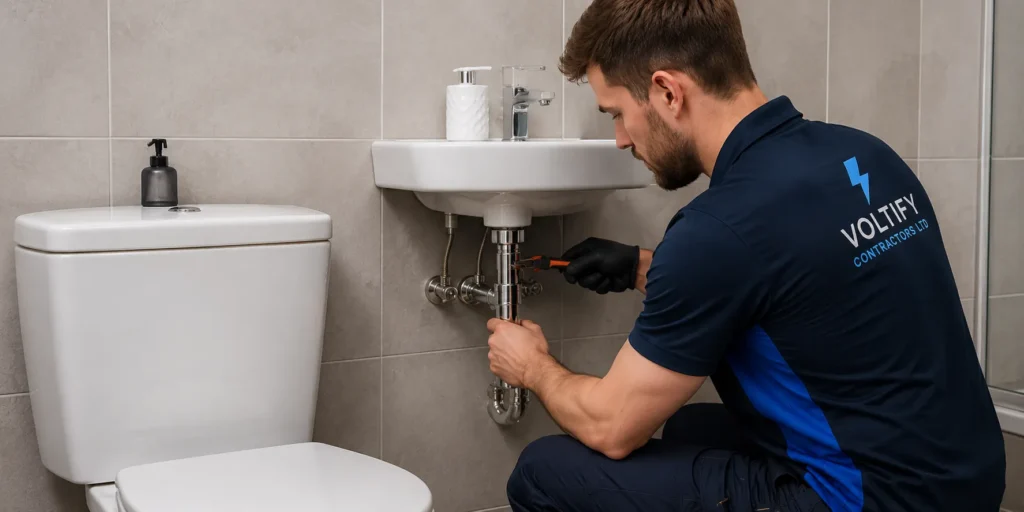

A general property repairs callout usually covers three things: getting to the property, looking at what is damaged and why, and carrying out the repair itself where it can be finished with the tools and materials to hand. Easing a door that catches, refixing a loose length of skirting, patching a small hole in plasterboard or renewing failed sealant around a bath are typical examples. What a callout does not usually cover is the cost of parts and materials, time beyond the first charged period, tracing a hidden cause such as a leak, or work that belongs to a specialist trade.
At Voltify Contractors the documented minimum call-out is £80 for the first hour during standard hours (7am–5pm, Monday to Friday). That is a minimum, not a fixed price for “a repair”, so it helps to understand how a visit is actually used and what can make one job take longer than another.
How the first hour usually gets used
People often picture a callout as an hour of hands-on repair. In practice the time is shared between several stages, and the repair is only one of them:
- Looking before fixing. Checking whether the damage is simple wear or the sign of something else, for example whether a sticking door is down to loose hinges or to the frame moving. Our guide to common door problems includes checks you can do before the visit.
- Clearing and protecting the area. Moving furniture out of the way, putting down dust sheets, and isolating water or power if the repair is near a pipe or fitting.
- The repair itself. Removing the damaged material, fixing, filling, refitting or resealing.
- Clearing up. Removing dust and offcuts from the work area and checking the result with you.
Because of that, a first hour tends to cover either one moderate repair or a handful of quick ones in the same part of the property. Three small repairs on three different floors will use more of the time than three in one room, simply because of the setting up and clearing away at each spot.
Which repairs usually fit a single callout
Most everyday repairs can be finished in one visit. The column on the right is what to watch for, because these are the details that turn a quick fix into a longer job or a return visit.
| Repair | Usually one visit? | What can stretch it |
|---|---|---|
| Door catching on the frame or not latching | Usually | Hinge screw holes that have stripped out of the frame, or a door that needs planing and then sealing or painting on the bare edge |
| Loose skirting or architrave | Usually | Damp or soft timber behind it, or a wall that will not hold a fixing |
| Small hole or dent in plasterboard | Usually | Deep filling that needs more than one coat, each left to dry before sanding |
| Larger hole in plasterboard | Often needs a return | Cutting in a new section, then filling, drying and sanding before it is ready to paint |
| Failed silicone around a bath or shower | Usually | Old sealant that is hard to remove, mould underneath, or a tray or bath that moves when stood in |
| Broken window or door handle | Usually, if the part fits | An unusual spindle length, fixing pattern or lock mechanism that needs a matching part ordering |
| Squeaking or loose floorboard | Often | Pipes or cables running under the board, or a floor covering that has to be lifted first |
| Cracked wall or floor tile | Often | Finding a matching tile, and grout that needs time to set before the area is used |
If you are not sure whether something is a straightforward repair or a sign of a wider problem, the property repairs page sets out how surface damage is told apart from symptoms such as a leak or movement in the building.
Why some repairs need a second visit
A return visit is not always a sign that something went wrong. These are the usual reasons:
Materials that need time. Filler has to dry before it can be sanded, and a painted patch needs time between coats. Sealant needs to cure before it is wet, and the curing time on the cartridge applies whatever the repair. Doing these steps quicker usually means the repair shows or fails early.
Parts that have to match. Handles, hinges, tiles, beading and trim come in many sizes and profiles. A common part can often be bought locally on the day; an older or unusual one may need identifying and ordering first.
The cause is somewhere else. Bubbling plaster under a bathroom, or a floor that has gone soft beside the washing machine, can be repaired only once the water source is dealt with. Repairing the surface first just means doing it twice.
The repair grows once it is opened. Rotten timber behind a skirting board, a crumbling section of old plaster or a loose joist under a creaking board only shows itself when the damaged material comes off.
Access. Heavy furniture, a loft hatch or, in a managed block, the building’s rules on working hours and communal areas can limit what is possible on the first day.
What is usually charged on top of the callout
- Parts and materials, such as replacement handles, hinges, timber, plasterboard, filler, sealant and paint. These are not included in the call-out minimum.
- Time beyond the first hour, when the list is longer or the repair turns out to be bigger than it looked.
- Making good over a larger area. Touching in one patch is normally part of the repair. Repainting a whole wall so the patch disappears is a separate decision, best agreed before work starts.
- Out-of-hours attendance. Emergency call-outs outside standard hours are available but are priced differently from standard-hours work.
- Taking things away. Removing old fittings, doors or other waste is not covered by default, so mention it when you book.
When a specific trade is the better booking
A general repair deals with the fabric and fittings of the property. Once the problem is in a system behind the wall, it is better booked as that trade’s work from the start, so the right person, time and parts are planned in:
- Water: a dripping tap, a running toilet or a leaking joint is a plumbing repair, and a stain that keeps spreading points to a leak that needs finding before anything is made good.
- Electrics: a cracked socket, a switch that sparks or a light that has stopped working is an electrical repair, not a general one.
- Gas: anything involving a gas appliance or pipe needs a Gas Safe registered engineer.
- Structure: cracks that keep widening, run diagonally from door and window corners, or come back soon after filling are a question for a surveyor or structural engineer.
Voltify Contractors carries out plumbing and electrical work as well as general repairs, so a tap or a socket can sit on the same visit as a sticking door, provided it is on the list beforehand. Repairs are also different from fitting jobs such as shelves, blinds and flat-pack furniture; if your list is mostly fitting, our guide to what a handyman does explains where that work sits.
Getting the most from one callout
- Send a list with a photo of each repair. A close-up and a wider shot showing where it is in the room tells far more than a description.
- Put the list in order of importance, so the most important repairs are done first if one item takes longer than expected.
- Note sizes for replacement parts. For a handle, hinge or tile, a photo with a tape measure alongside often means the right part can be brought on the day.
- Say what you already have, such as spare tiles, leftover paint or the original paint colour name, which makes matching much easier.
- Mention anything you know about the problem’s history, for example that a crack has been filled before or that a stain appeared after a leak upstairs.
- Clear access and check building rules, including permitted working hours or parking if you live in a managed block.
When the list is ready, the property repairs service page explains how repairs to homes, rented flats and commercial premises are arranged. If the list mixes repairs with fitting jobs, general handyman services covers how a mixed list is planned into one visit.