
In a commercial building, a broken door closer, a flickering light in a corridor or a toilet out of use in the staff washroom is not just an inconvenience. It affects staff, customers and sometimes whether an area can be used at all. Commercial property maintenance keeps those everyday parts of a building working, and it needs to be carried out in a way that fits around how the premises operate.
Voltify Contractors maintains offices, shops, schools, managed residential blocks and other commercial premises across East and South-East London. With 15 years of hands-on experience across handyman, plumbing, electrical and decorating work, one contractor can deal with most of a building’s routine maintenance list. This page covers what that includes, how reactive and planned work differ and what we need to know before quoting. It sits within our wider handyman and property maintenance services.
What Commercial Property Maintenance Covers
The work is best thought of by the part of the building it keeps in use:
- Doors and ironmongery: adjusting door closers, easing sticking doors, replacing worn handles, hinges and push plates, and refixing kick plates.
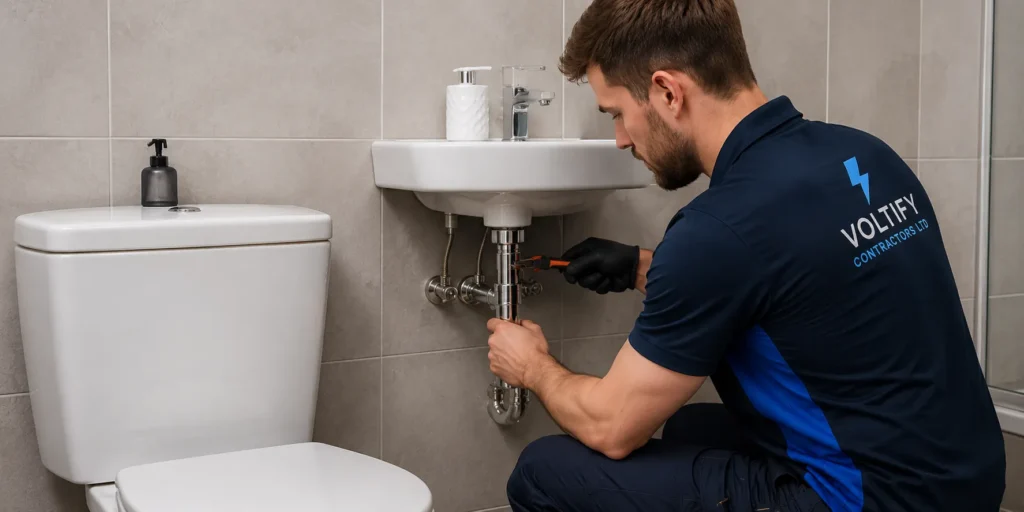
- Washrooms and tea points: fixing leaking taps, running cisterns and blocked toilets, replacing failed sealant and dealing with small leaks under sinks.
- Lighting and small electrical works: replacing failed fittings, faulty switches and damaged sockets, handled through our electrical services.
- Walls, ceilings and floors: repairing damaged plasterboard and corners in high-traffic corridors, refixing skirting and dealing with lifting floor finishes and thresholds that have become a trip hazard.
- Fixtures and fittings: putting up signage, noticeboards, shelving and blinds, and assembling office furniture.
- Decoration: touching in scuffed walls and doors between larger repaints; whole floors or buildings are planned through our commercial painting service.
Reactive Repairs and Planned Maintenance
Commercial maintenance is usually a mix of the two, and they are organised differently.
| Reactive repairs | Planned maintenance | |
|---|---|---|
| What starts it | A fault reported by staff, a tenant or a building manager | A list drawn up in advance, or a regular visit |
| Typical jobs | A leak, a door that will not lock, lights out in a stairwell | Checking and adjusting doors, resealing washrooms, replacing worn fittings, touching in decoration |
| Priority | Making the area safe and usable again | Stopping small problems becoming reactive ones |
| Timing | As soon as practical; out-of-hours emergency call-outs are available at different pricing | Agreed in advance to suit trading or occupancy |
If your building needs ongoing support rather than one-off repairs, ask about regular visits when you get in touch so the scope and frequency can be agreed. For an idea of what to check yourself between visits, and how often, see our maintenance checklist for small business premises.
Working in Occupied Premises
Most commercial maintenance happens while the building is in use. Standard working hours are 7am–5pm, Monday to Friday, which means an early start can often finish noisy or disruptive work before an office fills up or a shop opens. If a job has to be done while the premises are closed, raise it at the quote stage.
Other practical points to agree beforehand:
- Access and sign-in: who holds keys or fobs, where to report on arrival and any areas that are off limits.
- Site requirements: if your building needs an induction, risk assessments or method statements before work starts, say so at enquiry so it can be confirmed.
- Isolations: any work that needs water or power turned off to part of the building is planned so it affects as few people as possible for as short a time as possible.
- Dust and noise: drilling and cutting are grouped together where possible, and work areas are cleaned before they are handed back.
What We Need to Quote Accurately
A commercial quote is only as accurate as the information behind it. The most useful things to send are a list of the jobs with their locations in the building, photos of each problem, the type of premises and how it is used during the day, and any site rules or times when work cannot happen. For a multi-storey building, note whether there is a lift and where materials can be brought in.
The documented minimum call-out is £80 for the first hour, which covers a short reactive visit. Larger or planned work is priced on the jobs involved. The main things that change the cost are the number and spread of jobs across the building, materials and replacement parts, access restrictions, and any requirement to work outside standard hours.
Where a Specialist Contractor Is Needed
Commercial buildings contain systems that need their own specialist contractors, such as fire alarm and emergency lighting systems, lifts, air conditioning and ventilation plant, gas appliances and structural elements. These sit outside commercial property maintenance visits. If a reported problem involves one of them, we will say so, so the right contractor can be called.
For managing agents who look after rented flats as well as commercial units, landlord property maintenance covers tenant-reported repairs and work between tenancies. Damaged walls and ceilings in corridors and offices are covered in more detail on our drywall repair page, and a mixed list of small fitting jobs is explained under general handyman services.
Send your maintenance list, with photos and any site requirements, and contact Voltify Contractors to discuss the work. You can also check the areas we cover.