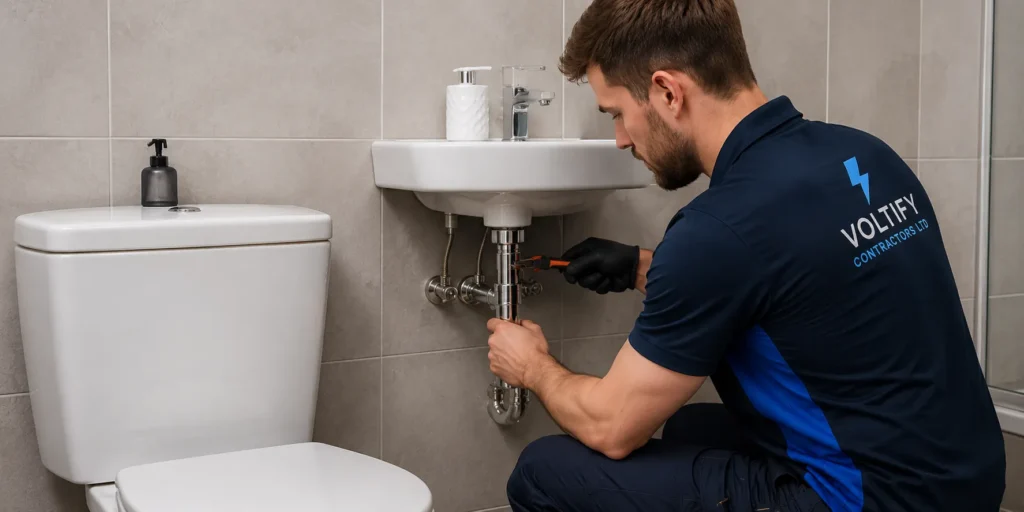

There is no single burst pipe repair cost, because the pipe itself is rarely the expensive part. Cutting out a split length of exposed copper and joining in a new section is a short job with inexpensive fittings. The price climbs when the burst is hidden inside a wall, floor or boxing, when the pipe is an unusual material, when the water has to be stopped with a temporary repair and the permanent one finished on a second visit, when the work happens out of hours, or when the pipe around the burst turns out to be worn as well.
This guide breaks the bill into its parts so you can see which of those apply to your situation, what you can do to keep the cost down, and who may pay for some of it. If water is still escaping, deal with that first: our guide on what to do before the plumber arrives covers the immediate steps.
What you are actually paying for
Most burst pipe invoices are made up of the same handful of components. Which ones are large depends on the job.
| Part of the bill | What drives it up | What you can do about it |
|---|---|---|
| Attendance and labour time | Finding the burst, getting at it, the number of joints to make, testing, and any return visit | Turn the water off, clear the area, and describe or photograph the pipe so the right fittings come on the first visit |
| Pipe and fittings | Lead, old steel or uncommon pipe sizes; adaptors between different materials; longer replacement runs | Usually small next to labour, unless a long section has to be renewed |
| Access | Lifting floorboards or flooring, opening boxing, cutting into plasterboard or tiles | Move furniture and stock away beforehand; mention any access panels you know about |
| Timing | Out-of-hours attendance, which is usually charged at a different rate | If the water can be safely isolated, a standard-hours repair may be enough |
| Making good | Replastering, re-tiling, new flooring, ceiling repairs and redecoration after the pipe is fixed | Often a separate job; check your insurance before anything is opened up |
A quote for the plumbing repair normally covers the first three rows and, where relevant, the timing. Making good the damage the water caused is a different piece of work, and it is often the larger cost.
Six things that change the price
1. Where the burst is
Location matters more than anything else. A burst on a pipe under a sink, in an airing cupboard or running along a loft floor can be reached in minutes. The same split behind a tiled bathroom wall, under a kitchen floor or inside a ceiling means opening things up first, working in a confined space, and leaving a hole that someone has to close again. Pipes inside boxing around a toilet or bath are a common middle ground: the boxing may unscrew, or it may have been sealed and tiled over.
2. What the pipe is made of
Standard copper and plastic supply pipes use widely available fittings, so the parts cost is modest. Lead pipework, old galvanised steel, imperial-sized copper in older properties, or thin microbore pipe can each need adaptors or a longer section renewed so the new pipe joins onto something sound. Where several materials meet, as they often do in homes refitted over the years, the repair has more joints and takes longer. The burst pipe repair service page explains how each material is usually repaired.
3. Why it burst, and the state of the pipe around it
A pipe pierced by a screw is usually a clean, local repair. A pipe that froze may have split in more than one place along the run, and some splits only show once the pipe is back under pressure. A pinhole in old copper often means the wall of the pipe is thin either side of it. In those cases the plumber may recommend replacing a longer length rather than adding fittings to tired pipe, which costs more on the day but avoids paying for the next failure a few centimetres away.
4. Whether a temporary repair comes first
Some bursts can be permanently repaired on the first visit. Others cannot: the pipe may be inaccessible until a floor or wall is opened properly, or need fittings that are not carried as standard. The first visit then stops the water, either with a temporary repair or by isolating that section so the rest of the property can go back on supply, and the permanent repair follows. Two visits cost more than one, but the alternative is often a property with no water at all until the parts arrive.
5. When the work is done
Out-of-hours call-outs are normally priced differently from standard-hours work. That premium is worth paying when the water cannot be stopped, the only stopcock is the main one and the household needs water, water is reaching electrics or a ceiling, or the leak is affecting a neighbour. It may not be needed when the burst section has its own isolation valve, the water has been safely turned off and the damage has been contained. If you are unsure which side of that line you are on, our guide to what counts as a plumbing emergency walks through the deciding questions.
6. What has to be put back afterwards
Once the pipe is fixed, there may be a hole in a ceiling, lifted floorboards, cut tiles or damp plaster. Some of this can only be done after the structure has dried out, so it is usually priced separately from the plumbing. Matching tiles or flooring that are no longer made can turn a small patch into a whole wall or floor, which is worth knowing before you agree where to open up.
Who pays for which part
Before paying for a repair, check that the pipe is yours to fix.
- Pipes in the street. The water main and the communication pipe that connects it to your property belong to the water company. Thames Water, for example, states that the homeowner is responsible for the supply pipe that runs from the boundary of the property into the home, and for all internal pipes and fittings.
- Flats. Pipework serving only your flat is usually the flat owner’s responsibility, while shared risers and pipes serving several flats usually fall to the freeholder or managing agent. Your lease is the document that settles it.
- Rented homes. Tenants should report a burst to the landlord or letting agent rather than arranging and paying for the repair themselves, unless the tenancy says otherwise or the landlord agrees.
- The water you lost. If you are on a water meter, the escaped water shows up on your bill. Some suppliers offer an allowance once a leak is repaired. Thames Water’s leak allowance, for instance, may cover the lost water for metered customers if the leak is fixed within four weeks and claimed within three months of the repair, with the plumber’s details and invoice as proof. Other water companies have their own terms, so ask yours.
Insurance: what is usually covered and what to check
Burst pipes and the water damage they cause are among the perils that standard home insurance policies cover, according to the Association of British Insurers, which also advises contacting your insurer as soon as possible after damage. The detail varies a great deal between policies, so three points are worth checking before you rely on a claim:
- Is the pipe repair itself covered, or only the damage? Some policies pay for the damage the water caused but not for fixing the failed pipe or fitting.
- Is “trace and access” included? This covers finding a hidden leak and opening up walls or floors to reach it. If it is included, the insurer may want to approve or arrange that work before anything is cut open.
- What is the excess? Escape-of-water claims can carry a higher excess than other claims. If the excess is close to the total cost, claiming may not be worthwhile.
Whatever you decide, take photos and a short video of the burst and the damage before the clear-up starts, keep any damaged items until the insurer says otherwise, and keep the repair invoice. An invoice that states what failed and why is more useful to an insurer than one that simply says “pipe repaired”.
When the cheaper fix is not the cheaper option
Repair clamps and quick-fix couplings sold for DIY use are useful for stopping water in a hurry, but they are a stopgap, not a joint designed to hold at full mains pressure for years. Leaving one in place behind a newly tiled wall, or under a floor that is about to be relaid, can mean paying twice: once for the eventual leak, and again for opening up the finished surface.
The same logic applies to old pipework. If the pipe around a burst is corroded, or a run has frozen and split before, renewing a longer length now may be cheaper than a series of single repairs. A good plumber should explain why they are recommending it, so you can weigh it up rather than take it on trust. Where the wider pipework is the real issue, our pipe repairs and replacement service covers renewing worn runs.
Getting a realistic price before the visit
Nobody can give a firm price for a burst they cannot see, particularly if it is hidden. What you can get is a clearer estimate and a better-prepared first visit by passing on:
- where the water is appearing, and whether you can see the pipe it is coming from;
- a photo of the pipe and any visible fittings, so the size and material can be judged;
- whether the water is off, and whether you had to use the main stopcock or an isolation valve;
- what is in the way: tiles, boxing, fitted units, flooring;
- whether a DIY clamp or temporary fix is already on it;
- whether you intend to claim on insurance, so the visit can be documented accordingly.
Ask how the price is made up: whether it is time-based, what happens if the job runs longer, whether parts are included, and whether a second visit would be charged as a new call-out. For Voltify Contractors, the documented minimum call-out is £80 for the first hour during standard hours of 7am–5pm, Monday to Friday. That is the starting point, not the total: parts, further time, access work and any return visit are added according to the job, and out-of-hours emergency call-outs are priced differently.
Key takeaway
The cost of fixing a burst pipe is driven mainly by access, timing and the condition of the pipework around the burst, not by the fittings. An exposed pipe repaired in working hours is at the low end; a hidden burst found out of hours, needing two visits and making good afterwards, is at the high end. Check who owns the pipe and what your insurance covers before anything is opened up.
To arrange a repair, see Voltify Contractors’ burst pipe repair service, or if the water cannot be controlled, the emergency plumber page explains how out-of-hours call-outs work.