
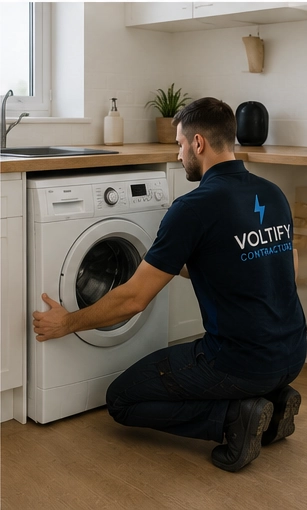
A new washing machine only takes a few minutes to connect when everything is already in place. Most of the problems people run into — a machine that walks across the floor, a kitchen that smells of drains, a drum that bangs on its first spin — come from details that were skipped or never checked. Washing machine installation done properly covers those details, not just the two hoses and the plug.
Voltify Contractors fits freestanding washing machines in homes and rented properties across East and South-East London, including Canary Wharf, Stratford, Bow, Canning Town, Greenwich, Woolwich and Barking, covering straight swaps, first-time installations and machines being moved to a new position. It is one part of our wider appliance installation service. If the machine you have bought sits behind a kitchen door panel, read our page on fitting integrated appliances as well, because the housing and panel add their own steps.
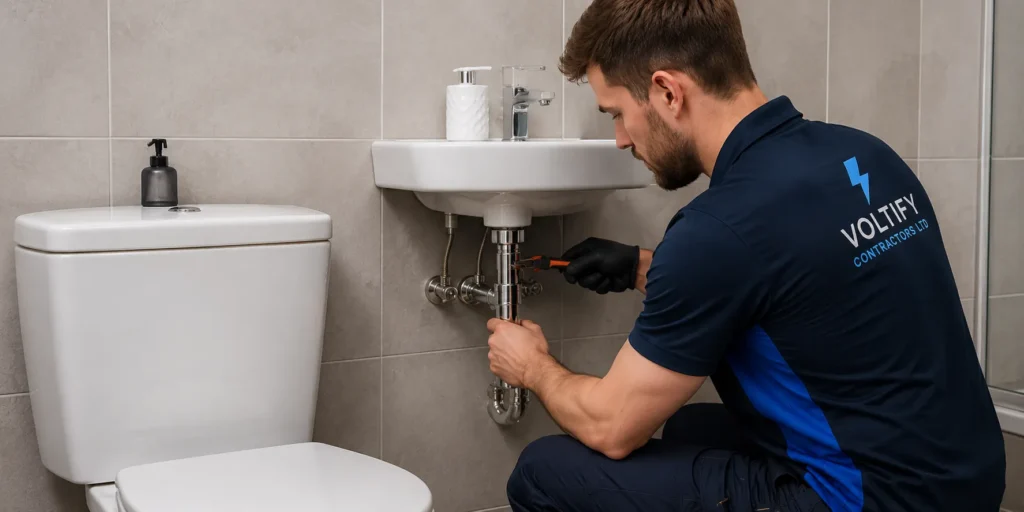
What a Washing Machine Installation Involves
For a replacement using existing connections, the job normally runs in this order:
- turning off the isolating valve and disconnecting the old machine, with a tray and towels ready for the water left in its hoses and pump;
- checking the valve, the waste connection and the socket before anything new is connected;
- removing the transit bolts from the new machine;
- connecting the new fill hose and routing the drain hose to the standpipe or sink trap;
- sliding the machine into place without kinking or trapping the hoses behind it;
- levelling it on its adjustable feet;
- a short test run to check for leaks at the valve and waste, and to confirm it drains and spins without excess movement.
A first-time installation adds whatever is missing — a water supply with its own valve, a waste connection and a suitable electrical point — and sometimes a space to be made in the kitchen units.
Can You Plumb In a Washing Machine Yourself?
Often, yes. If the old machine is coming out of a space that already has a working cold valve, a standpipe or sink-trap spigot and a socket in a sensible place, swapping in a new one with the supplied hoses and the manufacturer’s instructions is within reach for a lot of people. The steps are the ones listed above, and our checklist before installing a washing machine covers measuring the space and checking the connections first.
It stops being a simple swap when:
- the valve will not turn, drips once it is touched, or there is no valve at all;
- there is no waste connection, or the sink already drains slowly;
- the socket sits directly behind the machine, the machine runs from an extension lead, or it is going into a bathroom;
- the machine is moving to a new position or a kitchen unit has to come out;
- it is going into a flat above another home, where a small leak can reach the ceiling below.
In any of those cases the valve, waste or socket can be dealt with as part of the same job as connecting the machine, rather than as a separate booking.
Transit Bolts: the Part That Most Often Gets Missed
Every new washing machine is delivered with transit bolts screwed through the back panel. They hold the drum rigid so it is not damaged on the lorry. They must come out before the machine is used. If they are left in, the drum cannot move on its suspension, and the first spin makes the whole machine shake, bang and travel across the floor. It can also damage the bearings and the drum mounting.
The holes left behind are covered with the plastic caps supplied with the machine. Keep the bolts somewhere safe — they need to go back in if the machine is ever moved house.
Standpipe or Sink Trap: Where the Waste Water Goes
A washing machine pumps its waste into one of two places. A standpipe is an upright pipe with its own trap, usually behind the machine. A spigot on the sink trap lets the machine share the kitchen sink’s waste. Both work well when set up correctly, and both cause problems when they are not.
The drain hose has to be held at the height the manufacturer specifies. Too low, and water can siphon out of the machine while it is filling, which is why some machines never seem to finish a wash. Pushed too far down a standpipe, the hose forms an airtight seal and can do the same thing. On a sink trap, the hose normally needs a raised loop so dirty water from the sink cannot run back into the drum. A sink that already drains slowly will get worse once a washing machine is pumping into it, so that is dealt with first.
Hot and Cold Valves
Many older kitchens have two valves under the sink or behind the machine — a red one for hot and a blue one for cold. Almost all washing machines sold in the UK now fill from the cold supply only and heat the water themselves. The unused hot valve is left turned off, or the connection is capped if it is not needed. A valve that has not been turned for years is tested before it is relied on, because an old valve can seize open, or start to drip once it has been disturbed.
Floors, Upstairs Rooms and Vibration
A washing machine spinning at full speed puts a lot of movement into the floor. On a solid concrete floor it is rarely an issue once the machine is level. On a suspended timber floor, common in older London houses and conversions, some vibration is normal, but a machine that is not level on all four feet will make it much worse.
Where the machine is on an upper floor, in a flat above someone else, or on a floor finish that would be damaged by water, a leak tray underneath is worth considering. It will not stop a burst hose from flooding a room, but it catches small drips before they soak into a ceiling below.
Moving the Machine to a New Position
Moving a washing machine to a different part of the kitchen, a utility cupboard or a bathroom is a bigger job than a straight swap, because the water supply, waste and power need to be brought to the new spot. The new position needs:
- a cold water supply with an isolating valve that can be reached without pulling the machine out;
- a waste route with enough fall to drain, which is often the deciding factor;
- a socket that is not directly behind the machine, or a switched connection above the worktop, so the supply can be turned off easily. Adding one falls under our socket and switch installation work.
Bathrooms raise extra electrical questions about where the socket and the machine can safely go, so a bathroom position is always checked before any work is agreed. Where new pipework is needed, it is carried out as part of our plumbing services, and small carpentry jobs such as removing a base unit or trimming a plinth can be combined through our handyman and property maintenance service.
If you are also fitting a new dishwasher, both appliances can often share one waste connection — see our dishwasher installation page for how that works. Stacking a tumble dryer on top of a washing machine needs the correct stacking kit for the two models; our tumble dryer installation page explains stacking, vent routes and drain hoses. If you are weighing up a combined machine instead, see washer dryer installation.
After It Is Fitted: the First Wash and the First Few Weeks
Many manufacturers suggest running the first wash empty on a hot programme to clear water and residue left over from factory testing. The manual for your model says whether that applies. Over the first few washes, keep an eye on a few things:
- damp on the floor in front of or behind the machine, especially around the valve and where the drain hose meets the waste;
- a drum that still holds water at the end of a cycle, or a programme that stops part-way;
- a machine that rocks or creeps forward on a full spin instead of staying where it was set;
- a drain smell in the kitchen, which usually points to the drain hose height or a trap that has dried out.
If any of these show up, turn the valve off and get in touch before the next wash instead of running it again to see whether it settles. A leak that has already reached the floor or a ceiling below is covered on our plumbing repairs page.
How the Price Is Worked Out
The documented minimum call-out is £80 for the first hour. A like-for-like swap with sound valves, a working waste and a socket in the right place sits at the simpler end. The cost rises when a valve or waste connection has to be replaced or added, a socket needs fitting, the machine is moving to a new position, or a kitchen unit has to be altered. Parts such as valves, traps or leak trays are not included in the call-out minimum. If you need the old machine taken away, ask when you book so it can be confirmed.
The quickest way to get a clear answer is to send the model number of the new machine, a photo of the space, and a photo of the valves and waste behind or under the old one. If you have not bought the machine yet, our guide on what to check before installing a washing machine covers the measurements and positions worth checking first. Contact Voltify Contractors to arrange the installation, or check the areas we cover first.