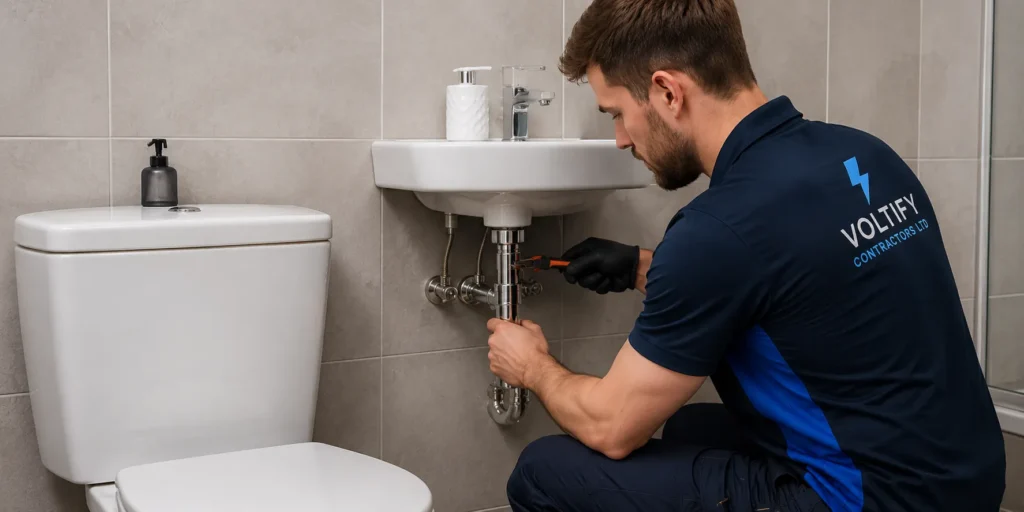

A radiator that stays cold, drips at a valve or needs to move to another wall is usually a water-side job — the radiator, its valves and the pipes feeding it — rather than a boiler fault. Voltify Contractors carries out radiator repairs, like-for-like replacements and radiator installation in new positions across East and South-East London, including Canary Wharf, Stratford, Bow, Canning Town, Greenwich, Woolwich and Barking, as part of our wider plumbing services.
The first useful question is whether the problem is one radiator or the whole heating system. If every radiator is cold, or the boiler is showing a fault code, the cause usually sits in the boiler, pump or controls, and boiler and gas work must be carried out by a Gas Safe registered engineer. If the boiler pressure keeps dropping, a slow leak on a radiator, valve or pipe joint is one of the possible causes worth checking.
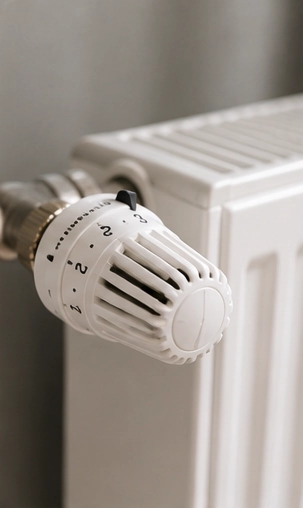
One Radiator Playing Up: What the Symptom Usually Points To
Where the cold patch sits, and whether the problem affects one radiator or several, narrows things down quickly:
| What you notice | Common cause | What usually sorts it |
|---|---|---|
| Cold at the top, warm lower down | Air trapped in the radiator | Bleeding the radiator; on a sealed (combi-type) system the boiler pressure then needs topping back up |
| Warm at the top, cold along the bottom or middle | Sludge (black iron oxide) settled in the panel | Flushing the radiator or the system; replacement if the panel is badly clogged |
| Stone cold while the others are hot | A stuck valve pin, a closed lockshield valve or a failed valve | Freeing or replacing the valve |
| Radiators furthest from the boiler only lukewarm | The system is out of balance | Adjusting the lockshield valves across the house so flow is shared evenly |
| Water at the valve spindle or the nut on the pipe | Worn valve gland or a loose or failed joint | Re-making the joint, repacking or replacing the valve |
| Rust spots or a weep from the radiator panel itself | Internal corrosion | Replacing the radiator — a corroded panel can’t be reliably repaired |
These are patterns, not a diagnosis. A valve that looks seized can turn out to be a stuck thermostatic pin that frees in minutes, while a cold bottom edge on several radiators points to sludge throughout the system rather than one bad panel. What is found on inspection decides the fix.
Bleeding a Radiator Yourself, and When to Stop
A radiator that is cold at the top and warm lower down can usually be bled at home with a radiator key from any hardware shop. Done carefully, it takes a few minutes:
- Turn the heating off and let the radiators cool, so you are not releasing hot water.
- Hold a cloth under the bleed screw at the top corner and turn the key about a quarter turn anticlockwise. Air should hiss out.
- Close the screw as soon as water, rather than air, starts to come out.
- On a sealed (combi-type) system, check the boiler pressure gauge and, if it has dropped, top it up as the boiler manual describes.
- Turn the heating back on and check the radiator now heats evenly from top to bottom.
It stops being a DIY job when the bleed screw is seized or rounded, when water comes out from the start instead of air, when the radiator stays cold along the bottom (bleeding won’t shift sludge), or when the same radiator needs bleeding again within days. A boiler pressure that keeps falling after bleeding can point to a leak somewhere on the system; our guide on what to do about a water leak at home covers the first steps. Radiators also sit within our wider non-gas heating services.
Radiator Leaks: Valve, Joint or Panel?
Where the water is coming from matters more than how much there is. Leaks from a valve body, the spindle or the compression nut where the valve meets the radiator are normally repairable. A pinhole in the radiator panel is not; once the metal has corroded through from the inside, the rest of the panel is usually thin as well, and the radiator needs replacing.
Heating water is often dark and dirty, so even a slow drip can stain carpets and boards. Until the leak is looked at, a container and towels underneath will limit damage. Closing both valves on that radiator can stop the flow, though a thermostatic head turned to its lowest setting does not always shut off completely. If water is coming out faster than you can catch it, or a pipe has split rather than a joint weeping, treat it as a burst pipe and call an emergency plumber. Slow weeps from joints on the pipework feeding the radiator are covered under pipe repair and replacement.
Gurgling, Ticking or Banging: Noisy Radiators Explained
Most radiator noises have an ordinary cause, and the sound itself is a useful clue:
- Gurgling or trickling — air in the radiator or the pipework. Bleeding usually quietens it; if the noise comes back within days, air is getting into the system and the cause needs tracing.
- Ticking or creaking as the heating warms up — metal pipes and brackets expanding against floorboards, notches or tight clips. Normally harmless, though the pipes can be eased or re-clipped where the sound is a nuisance.
- Knocking in the pipes when a valve closes or the heating switches on — loose pipework moving in its clips or under the floor. Re-securing it falls under pipe repair.
- Rumbling or banging from the boiler itself — often called kettling and usually linked to sludge or scale inside the boiler. That sits on the boiler side, so it needs a Gas Safe registered engineer rather than a radiator repair.
Replacing a Radiator Like for Like
Swapping an old radiator for a new one is simplest when the new one lines up with the existing pipes. The measurement that matters most is the pipe centres — the distance between the two valve connections. If the new radiator matches, the valves can often be reconnected without touching the pipework. If it doesn’t, the pipes have to be altered, which can mean lifting floorboards or rerouting surface pipework, and the job grows.
Before choosing a replacement it helps to note:
- the height and width of the existing radiator and the distance between the valves;
- whether it is a single panel, double panel, and whether it has convector fins between the panels — these change the heat output, not just the look;
- the heat output (in watts or BTU) of the old radiator, so the room isn’t left colder than before;
- whether the pipes come up from the floor or out of the wall.
A replacement is also a sensible time to fit new valves, particularly if the old ones are stiff or weeping, and to consider thermostatic radiator valves if the radiator doesn’t already have them. Heated towel rails follow the same principles; where a bathroom is being refitted and several fittings are moving, the work is usually planned alongside the rest of the bathroom plumbing.
Radiator Installation in a New Position
Adding a radiator where there wasn’t one, or moving one to free up a wall, involves more decisions than a straight swap:
- Heat output for the room — room size, windows and external walls all affect how much output is needed. A radiator that is too small leaves the room cold; one far too large wastes heat and money.
- What the boiler can supply — adding one radiator is rarely an issue, but adding several (for an extension, for example) should be checked against the boiler’s capacity by a heating engineer.
- Where the pipes will run — under a suspended timber floor, new pipework can usually be hidden. On a solid concrete floor, pipes are normally run along the surface and boxed in, or chased into the wall.
- Pipe size — some properties have microbore pipework (8mm or 10mm) rather than standard 15mm, which affects how a new radiator is connected.
- The wall itself — heavy column or cast-iron style radiators need solid fixings, and plasterboard walls may need extra support or floor-standing feet.
Boxing in new surface pipework and making good around it can be arranged through our handyman and property maintenance service, so the finished room doesn’t look like a work in progress.
What Happens When a Radiator Is Changed
- The heating is switched off and allowed to cool, and the floor under the radiator is protected, because dirty radiator water stains.
- The radiator is isolated at its valves or, where needed, the system is partly or fully drained.
- The old radiator comes off, new brackets are fixed if the size has changed, and the new radiator is hung and connected.
- The system is refilled, the radiators are bled, and on sealed systems the pressure is brought back to the right level.
- Corrosion inhibitor is topped up where the system has been drained, to help slow future sludge build-up.
- Joints are checked for leaks both cold and once the heating is back up to temperature.
Why Two Radiator Jobs Rarely Cost the Same
The documented minimum call-out is £80 for the first hour. Bleeding, freeing a stuck valve or re-making a weeping joint may be handled in a short visit; replacements and new installations are priced on what the job involves. The main variables are whether the system has to be drained, whether the pipework needs altering, how easy the floor or wall is to get into, whether you are supplying the radiator, and how many radiators are being done. Changing several radiators in one visit is usually more economical than one at a time, because the system only needs draining and refilling once. Out-of-hours call-outs for leaks are priced differently from standard hours.
Arranging a Radiator Visit
Standard hours are 7am–5pm, Monday to Friday. For a planned replacement, it helps to send a photo of the radiator and both valves, its height, width and pipe centres, and whether your boiler is a combi or has a water tank in the loft. Radiators are one part of the plumbing repairs we carry out, so other small faults can be looked at on the same visit.
For a leak that won’t stop, call 020 3411 1855; out-of-hours emergency call-outs are available at different rates. For everything else, get in touch with Voltify Contractors or check the areas we cover.