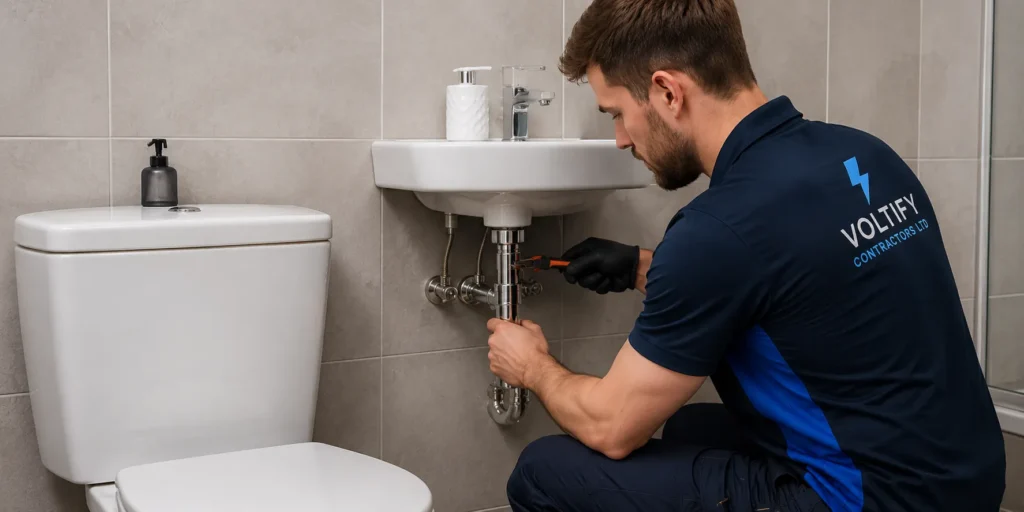

What to do if you have a water leak depends on how fast the water is escaping and whether you can see where it’s coming from. If water is flowing freely, turn off the stopcock now and deal with everything else afterwards. If it’s a slow drip or a damp patch, you usually have time to contain it, work out where it’s coming from and arrange a repair during normal hours.
Most leaks fall into one of a few types, and each needs a slightly different first response.
Work out which kind of leak you have
| What you’re seeing | First thing to do | How urgent it usually is |
|---|---|---|
| Water spraying or pouring from a pipe or fitting | Close the stopcock, open the cold taps | Urgent — damage grows by the minute |
| A steady drip from a visible joint, valve or hose | Close the isolation valve for that fitting, or the stopcock | Usually a standard repair once isolated |
| Water coming through the ceiling | Keep clear of lights and electrics; find the source above | Urgent if it’s still running or near electrics |
| A damp patch or stain with no visible source | Note when it gets worse; check the meter | Rarely an emergency, but shouldn’t be left |
| Water around a washing machine or dishwasher | Stop the cycle, switch off at the socket if dry, close the appliance valve | Usually a standard repair once isolated |
If water is escaping fast
Turn the stopcock clockwise until it stops — it’s commonly under the kitchen sink, but in flats it’s often in a hallway cupboard or riser. Then open the cold taps to drain the pipes, and switch off the boiler or immersion heater if the leak is on the hot side. A split or burst pipe has its own set of steps, including what to do if your home has a loft tank that keeps feeding water after the stopcock is closed; our guide on what to do with a burst pipe walks through them.
Any leak you can’t stop, or one that is reaching electrics or a neighbour’s property, is a job for an emergency plumber.
If it’s a drip from something you can see
Most taps, toilets and appliances have a small isolation valve on the pipe feeding them. Turning its slot so it sits across the pipe — usually with a flat-head screwdriver — stops that one fitting without cutting water to the whole house. Put a bowl or towel underneath and note exactly where the drip forms: on a nut, at a hose connection, along the pipe itself or from the base of a tap.
Be wary of the drip’s lowest point. Water runs along pipes and the underside of fittings before it falls, so the place it drips from is often a little way from where it’s actually escaping. Wiping everything dry and watching for where moisture first reappears gives a more reliable answer.
If water is coming through the ceiling
Treat the area underneath as unsafe until you know more. Don’t switch on a ceiling light that has water near it, and keep people away from any part of the ceiling that is sagging. If you can reach the consumer unit without touching anything wet, switching off the lighting circuit for that room is sensible.
Then go to the room above. In a house, it’s usually a bathroom, en suite, kitchen or radiator — check whether the leak gets worse when someone has just used the shower or bath, which points to a seal or waste rather than a supply pipe. In a flat, the source may be in the property above, so contact that neighbour, your landlord or the building’s managing agent straight away. The leak can only be stopped at its source.
If there’s damp but no obvious leak
Hidden leaks show up indirectly, and they’re easy to put off. Signs worth taking seriously include:
- a damp patch or stain that grows, or comes back after being painted;
- flooring that lifts, swells or feels soft near a bathroom, kitchen or radiator;
- grout cracking or tiles loosening around a shower;
- a musty smell or mould in one particular spot;
- a hissing or running-water sound when nothing is in use;
- a higher water bill with no change in use, if you’re metered.
Not every damp patch is a plumbing leak — condensation, rain getting in and penetrating damp can look very similar. What helps most is noticing a pattern. Does it appear after showers? After the washing machine runs? Only when it rains? Only in winter when the heating is on? That pattern is often the strongest clue to the source, and it’s worth writing down before anyone visits.
If you have a water meter, a simple meter check — reading it before and after a period when no water is being used — can confirm whether water is escaping somewhere on your supply. Our leak detection and repair page explains how to do it and how a hidden leak is traced without unnecessary damage. A leak on the incoming supply pipe can also show up as weaker flow at every tap, which our guide to low water pressure causes helps you tell apart from other reasons.
If an appliance is leaking
With a washing machine or dishwasher, stop the cycle first. Only switch it off at the socket if the plug, socket and floor around it are dry; if water has reached them, switch off at the consumer unit instead, if you can do so safely. Close the appliance’s isolation valve — usually a lever or small tap on the pipe behind or beside it.
Water under an appliance may be coming from the inlet hose, the drain hose, the waste connection under the sink, or the appliance itself. The first three are plumbing connections. A leak from inside the machine is usually an appliance fault rather than a plumbing one.
When to call a plumber
Some small leaks can be resolved by tightening an accessible fitting by hand or replacing a worn washer on a hose. Beyond that, it’s worth getting a plumber involved when:
- you can’t stop the water, or can only stop it by keeping the whole house off;
- the leak is inside a wall, floor or ceiling, or behind tiling or boxing;
- the same joint or area keeps leaking after it’s been tightened or resealed;
- there’s damp but you can’t find a source;
- water has reached electrics, ceilings or a neighbouring property.
Resist resealing around a bath or shower as a fix for a leak you haven’t traced. Fresh silicone can stop the visible symptom for a while, but if a waste or pipe underneath is the real source, the water keeps going into the floor where you can’t see it.
After the leak is fixed
Take photos of the damage before anything is cleaned up, and check whether your home insurance covers the damage and, in some policies, the cost of finding the leak. If you rent, tell your landlord or letting agent in writing. Let wet plaster, ceilings and timber dry fully before redecorating — painting too soon can trap moisture, and water stains usually need a stain-blocking primer. For other plumbing work in your home, our plumbing services page sets out what Voltify Contractors covers.