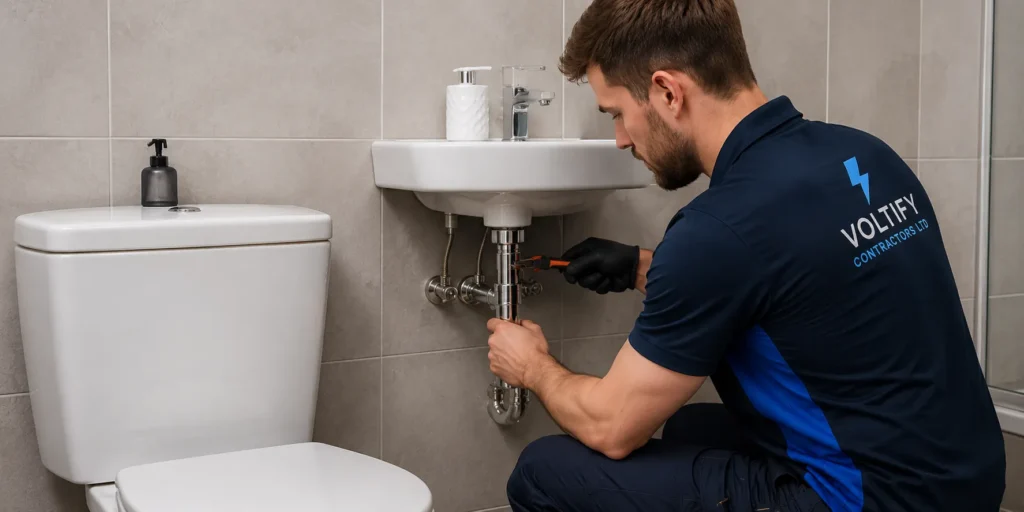

A burst pipe rarely looks like a dramatic rupture. More often it’s a hairline split along a copper run, a push-fit joint that has blown apart, or a pipe that froze in a loft or outside wall and only started spraying once it thawed. Burst pipe repair is about more than stopping the water: the damaged section has to be cut out and replaced so it holds at full mains pressure, not just patched until the next cold snap.
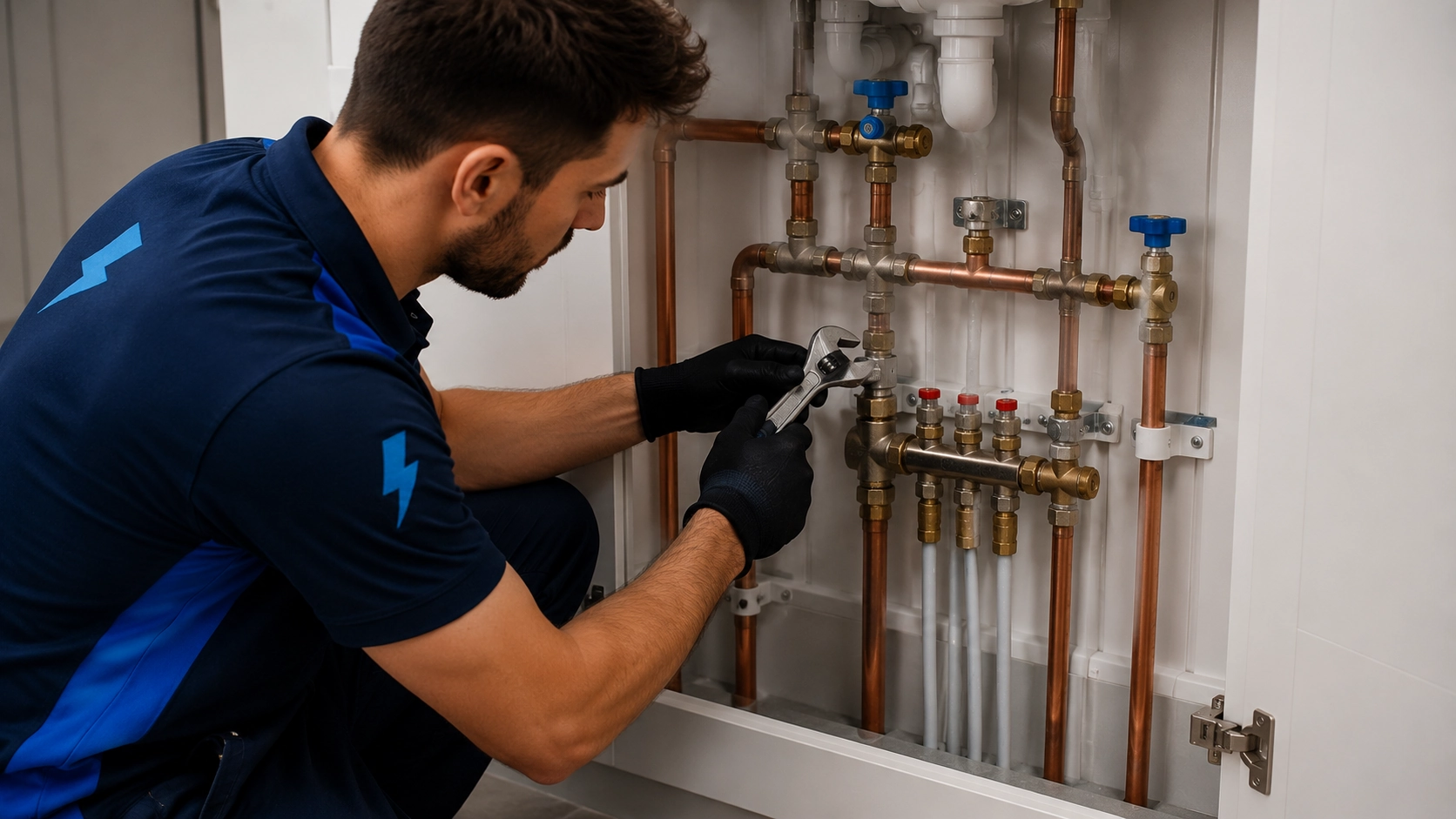
Voltify Contractors repairs burst and split water pipes in homes, flats and commercial premises across East and South-East London, including Canary Wharf, Stratford, Bow, Canning Town, Greenwich, Woolwich and Barking, as part of our wider plumbing services. If water is escaping right now, close the stopcock first — our emergency plumber page explains where to find it and what to do if it won’t turn.
Burst, Split or a Failed Joint — Why the Difference Matters
“Burst” gets used for any pipe that is suddenly losing water, but the repair depends on what has actually failed:
- Split pipe. The pipe wall itself has opened, usually along its length. The damaged length is cut out and a new section joined in.
- Pinhole leak. A tiny hole, often from corrosion in older copper, showing as a fine spray or a steady drip. Where there is one pinhole, the pipe around it is often thin too.
- Failed joint or fitting. A compression nut, soldered joint or push-fit connector has let go. Sometimes the fitting alone can be replaced; sometimes the pipe either side is damaged as well.
- Pipe hit by a fixing. A nail or screw driven through a floorboard or wall into a pipe. These can seep slowly for weeks — or burst the moment the fixing is pulled out.
A tap dripping or a joint weeping into a bucket isn’t a burst. A dripping tap is a routine plumbing repair, and a weeping joint or tired old pipework is covered by our pipe repairs and replacement service. And if water is seeping from somewhere you can’t see, it may be a hidden leak that needs tracing first — our leak detection and repair page covers how that works.
Common Reasons Pipes Burst
Knowing why a pipe failed matters, because it tells you whether the pipework around it is likely to be next.
- Freezing. Water expands as it turns to ice. Pipes in lofts, garages, outside walls, under suspended floors and in unheated voids are the most exposed, especially when a property is left empty and unheated in cold weather. The split often only shows once the ice thaws.
- Corrosion and age. Older copper, lead and steel pipework thins over time. A burst on an old run can be the first sign of wider wear.
- Poorly made or disturbed joints. A push-fit fitting that wasn’t fully seated, or a compression joint that has been knocked, can let go under pressure long after the work was done.
- Accidental damage. Drilling, nailing down floorboards, or fitting kitchens and shelving over hidden pipe runs.
- Pressure surges. Pipework that bangs or shudders when a tap closes is under repeated stress, particularly where pipe clips are missing.
If You Think a Pipe Has Frozen
A frozen pipe hasn’t necessarily split yet. Signs include one tap giving no water while others work, frost on an exposed pipe, or a gurgling noise when a tap is opened. What helps:
- Turn the stopcock off before the pipe thaws, so that if it has split, water won’t escape the moment the ice melts.
- Open the tap the frozen pipe feeds, so melting water has somewhere to go.
- Warm the pipe gently — turn the heating up, or wrap it in cloths soaked in warm (not boiling) water — starting at the end nearest the tap.
- Never use a blowtorch, heat gun or any naked flame, and don’t pour boiling water over plastic pipe or fittings.
- Once water flows, look along the pipe and its joints for splits before turning the stopcock fully back on.
If the pipe is somewhere you can’t reach safely, or you find a split once it thaws, leave the water off and arrange a repair.
Can You Fix a Burst Pipe Yourself?
You can limit the damage yourself, and you should: close the stopcock, open the cold taps to drain the pipework, and if water is reaching light fittings or sockets, switch off the electrics at the consumer unit as long as you can get to it without standing in water. Our guide to what to do with a burst pipe before the plumber arrives walks through each step, including what to do if the stopcock won’t move.
The repair itself is where home fixes tend to come unstuck. A slip coupling or repair clamp can hold on a straight, exposed length of pipe, but the joint has to survive full mains pressure once the water goes back on, and the fitting has to match the pipe material and size. If the burst is inside a wall or under a floor, is on lead or old steel pipe, or is next to a joint that has already been repaired, leave the water off and book a burst pipe repair instead.
Temporary Fix or Permanent Burst Pipe Repair?
On an urgent visit, the first job is to stop the water and, where possible, get the rest of the property back on supply. What happens after that depends on where the burst is and what the pipe is made of.
| Approach | When it’s used | What to expect |
|---|---|---|
| Permanent repair on the first visit | The damage is on an accessible length of copper or plastic pipe, and suitable fittings are to hand | The damaged length is cut out, a new section is joined in, and the repair is checked under normal water pressure |
| Temporary repair or isolation, then a return visit | The pipe is inside a wall or floor, is an unusual size or material, or needs parts not carried as standard | The leak is stopped by a temporary repair or by isolating that section so water can go back on elsewhere; the permanent repair is booked in |
| Replacing a longer run | The pipe around the burst is corroded, has frozen along its length, or has already been repaired several times | A longer length is renewed rather than joining new fittings onto tired pipe |
Repair clamps and quick-fix fittings sold for DIY use can hold for a while, but they aren’t a substitute for a properly made joint. If one has been fitted as a stopgap, mention it when you book so the permanent repair can be planned around it.
How the Pipe Material Changes the Repair
Many London properties have a mix of pipework, especially where kitchens and bathrooms have been refitted at different times.
Copper
The most common supply pipe in older homes and many newer ones. Damaged lengths are usually replaced using compression or soldered fittings, and the repair is clean where the surrounding pipe is sound.
Plastic
Flexible plastic pipe with push-fit fittings is common in newer installations and refurbishments. It copes with freezing better than copper but is easily damaged by screws and nails, and fittings must be the correct type for that pipe.
Lead and old galvanised steel
Lead is still found in some older properties, usually on the incoming supply. It isn’t normally patched; the affected section is replaced with modern pipe, and your water supplier can advise on replacing lead pipework more widely. Old galvanised steel corrodes from the inside and tends to fail again next to a repair, so renewing the run is often the more sensible option.
After the Water Is Off: Damage, Drying and Insurance
A repaired pipe doesn’t dry out the ceiling, floor or wall it soaked. Keep photos and a short video of the burst and the damage, and keep the repair invoice — insurers usually ask for both on an escape-of-water claim. Some policies also cover tracing and accessing the leak, so check yours before anything is opened up if you intend to claim. Our guide to what affects burst pipe repair costs explains which parts of the bill change most and who may pay for them.
If water reached light fittings, sockets or the consumer unit, have the electrics checked before relying on them — our emergency electrician page explains what that involves. Once plaster and timber have dried, damaged ceilings, boxing and skirting can be put right through our handyman and property maintenance service.
In a flat, a burst in the flat above or in a communal riser can only be stopped at its source, so contact the neighbour, landlord or managing agent straight away.
From First Call to Water Back On: How a Repair Visit Runs
No two bursts are quite the same, but a repair visit usually works through the same order, so you know what to expect before anything is cut or opened up.
- Make sure the water is under control: confirm the stopcock is closed, or isolate just the damaged section so the rest of the property can go back on supply.
- Find exactly where the pipe has failed. Boxing, a floor panel or a patch of ceiling is only opened where the pipe can’t be reached any other way, and we talk it through with you first.
- Check the pipe either side of the burst, which decides whether a short repair will hold or a longer run should be renewed.
- Cut out the damaged length and join in new pipe with fittings that suit the material, or make a temporary repair and book a return visit if the right parts aren’t to hand.
- Turn the water back on, check the new joints and the pipework around them under normal pressure, and explain what was found so you have the details if you are making an insurance claim.
Arranging a Burst Pipe Repair
Call Voltify Contractors on 020 3411 1855 and tell us where the burst is, what the pipe looks like if you can see it, and whether you’ve been able to turn the water off. A photo helps us bring fittings to suit the pipe size and material.
Standard working hours are 7am–5pm, Monday to Friday, and the documented minimum call-out during those hours is £80 for the first hour. Parts, additional time, access through tiling or boxing, and any return visit for a permanent repair are charged on top. Out-of-hours emergency call-outs are available at a different rate — see emergency call-out services for how urgent work is handled. We cover East and South-East London; check the areas we cover if you’re unsure whether your address is included.