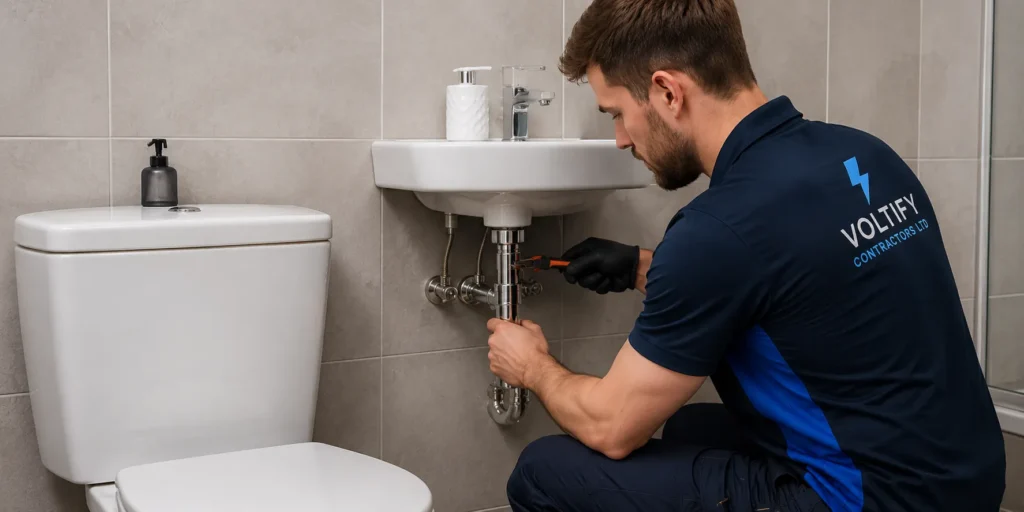

Most dripping taps don’t need replacing. A tap that won’t shut off cleanly, drips from the spout or leaks from under the handle usually has one worn internal part — a rubber washer, an O-ring or a ceramic cartridge — and tap repair means finding and replacing that part. The key is knowing which type of tap you have, because it decides which part has failed and whether a replacement is still available.
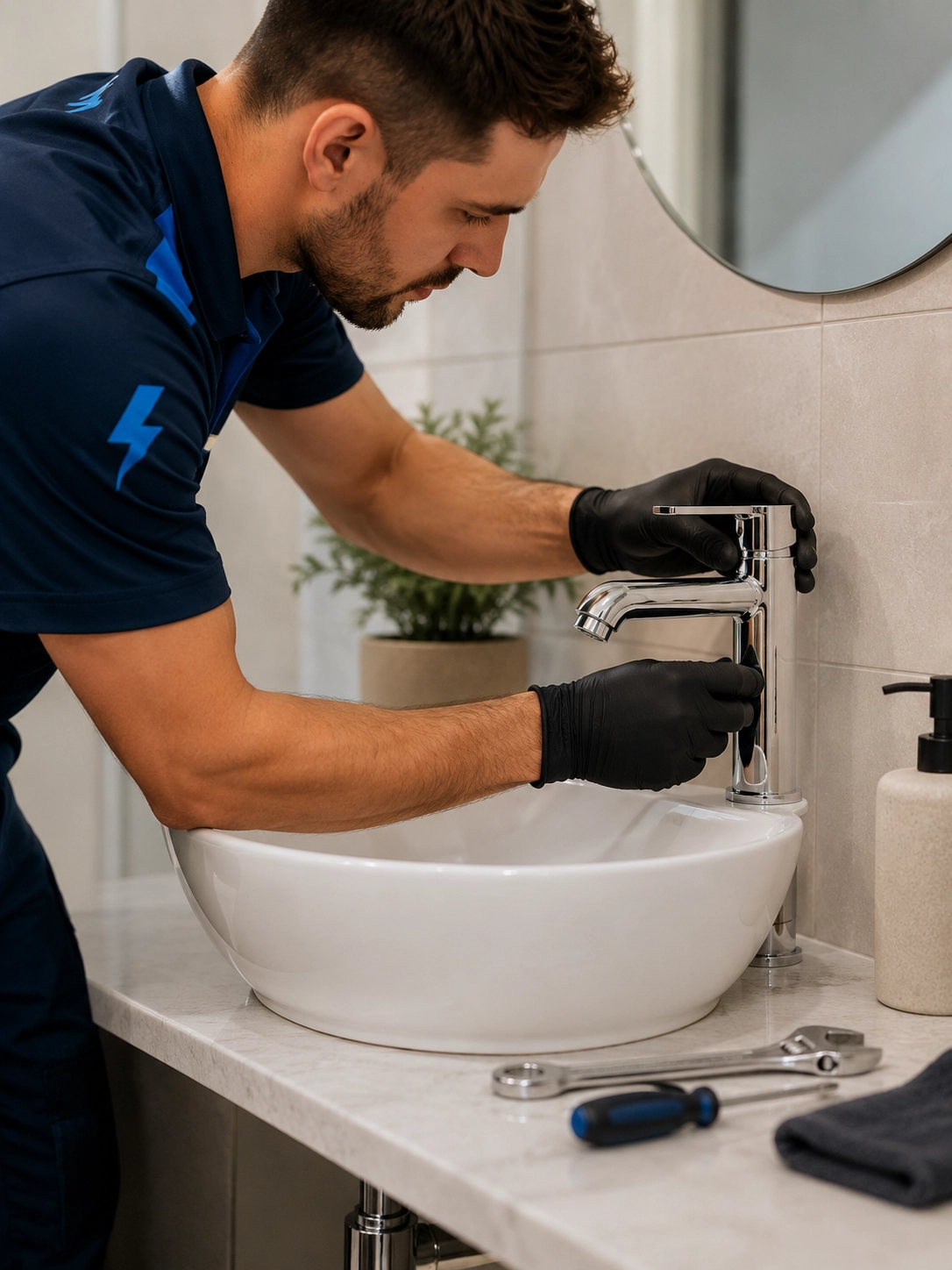
Voltify Contractors repairs and replaces kitchen, basin and bath taps in homes, rented properties and commercial premises across East and South-East London. This page covers both routes: fixing the tap you have, and fitting a new one when that makes more sense. It sits within our wider plumbing services.
Which Type of Tap Do You Have?
Turn the handle from off to fully on and notice how far it travels.
- Multi-turn (compression) taps turn several times and close down onto a rubber washer. A drip from the spout usually means a worn washer, or a worn valve seat beneath it. They’re common in older properties and are generally simple to repair.
- Quarter-turn taps go from off to on in a quarter or half turn, using two ceramic discs inside a cartridge. There’s no washer to swap; a drip normally means the cartridge needs replacing, and cartridges differ between brands and models.
- Single-lever mixers control flow and temperature with one handle and one larger cartridge. Drips from the spout or leaks around the lever usually point to that cartridge or its seals.
- Bath and shower mixers add a diverter that sends water up to the shower. Water still dribbling from the bath spout while the shower runs is often a worn diverter rather than a fault in the main valve. Faults in a separate shower valve or electric shower are covered under shower repair and installation.
If there’s a brand name on the tap, or you still have its box or paperwork, a photo saves time — the right cartridge can often be identified before anyone arrives.
Tap Repair by Symptom
Where the water appears tells you a lot. Use this as a guide rather than a diagnosis; the cause is confirmed once the tap is opened up.
| What the tap is doing | Usual cause | Typical repair |
|---|---|---|
| Drips from the spout when turned off | Worn washer or valve seat (multi-turn); worn cartridge (quarter-turn or lever) | New washer, reseated valve or replacement cartridge |
| Leaks from under the handle while running | Worn O-rings or gland seal around the spindle | Replacement O-rings or gland seal |
| Water pools around the base | Worn base seal, loose fixing, or a leaking connection underneath | Re-seal and re-fix the tap; check the tap tails and valves below |
| Stiff or hard to turn | Limescale build-up, or worn headgear or cartridge | Clean or replace the cartridge; occasionally a new tap |
| Wobbles or turns in the sink | Loose back nut or fixing bracket | Re-tighten or replace the fixing from underneath |
| Weak flow from this tap only | Scaled aerator, blocked cartridge filter or part-closed isolation valve | Clean the aerator, open or replace the valve, service the cartridge |
| Temperature jumps or hot and cold feel mixed | Worn mixer cartridge, or supplies connected the wrong way round | New cartridge or corrected connections |
If water is gathering under the sink and you can’t tell whether it’s the tap, the waste or an appliance hose, it’s more likely a general plumbing repair — or, if the source is out of sight, a hidden leak that needs tracing.
When a New Tap Is the Better Call
Repairing a tap is usually worth it while the body is sound and parts can be found. A replacement is often the better use of your money when:
- the tap is unbranded or discontinued and no matching cartridge is available;
- the body is cracked, pitted or leaking from the casting itself;
- the chrome is corroded or flaking around the spout and handles;
- a genuine cartridge would cost close to the price of a new mid-range tap;
- the kitchen or bathroom is being updated anyway.
Where both are realistic, you’ll be told what each involves before any work goes ahead. If you’re weighing the two up yourself first, our guide on whether to repair or replace a leaking tap walks through the factors that usually decide it.
Before You Buy a Replacement Tap
Most problems with new taps come from choosing one that doesn’t suit the existing sink, basin or water system. It’s worth checking these before you order.
Number of tap holes
A monobloc mixer needs one hole; pillar taps need two. Many deck-mounted bath mixers need two holes at a set spacing. Changing from one layout to another can mean a new sink or basin, or blanking off a hole.
Water pressure
Many modern mixers are designed for mains or higher pressure and can give a disappointing trickle on a low-pressure system, such as one where hot water is fed from a tank in the loft. Check the minimum pressure listed in the product details. If you’re not sure what kind of system you have, say so when you book.
Spout height and reach
The spout should reach far enough into the bowl to stop water splashing onto the worktop, and be high enough to fill a pan or kettle — but not so high that water bounces out of a shallow basin.
Connections and valves
Most taps come with flexible tails. They need to reach the supply pipes without being stretched or kinked, and suit the existing pipe size. Worn, stiff or missing isolation valves are best replaced at the same time, so the tap can be turned off on its own in future.
Worktop or basin thickness
The tap’s fixing kit has to suit the thickness of whatever it mounts through — particularly thick stone, quartz or composite worktops.
What Fitting a New Tap Involves
Replacing a tap is usually a contained job, but getting the old one out is often the hardest part. Back nuts under basins and sinks are frequently seized, and access can be tight behind a pedestal, vanity unit or bath panel. The usual sequence is:
- isolating the hot and cold supplies to the tap;
- disconnecting and removing the old tap, and cleaning the mounting surface;
- fitting the new tap with its seal and securing it from underneath;
- connecting the tails, adding or replacing isolation valves where needed;
- flushing the pipes, refitting the aerator and checking every joint under normal pressure.
A tiled-in bath panel or a sink under a fitted worktop with no removable panel can add time. If a washing machine or dishwasher shares the supply under the sink and needs disconnecting or reconnecting, that’s covered by our appliance installation service. If the tap is being changed as part of a new kitchen or bathroom, see kitchen plumbing or bathroom plumbing for how the wider pipework is planned.
Booking a Tap Repair or New Tap
Get in touch with a photo of the tap and a note of what it’s doing. If you’re replacing it and have already bought the new tap, send the make and model so it can be checked for suitability before the visit.
The documented minimum call-out is £80 for the first hour during standard hours, 7am–5pm Monday to Friday. Cartridges and other parts, new isolation valves, and extra time for seized fittings or awkward access are added to that. A dripping tap isn’t an emergency, but a tap that won’t turn off and can’t be isolated is — in that case, see our emergency plumber page. We work across East and South-East London; see the areas we cover.