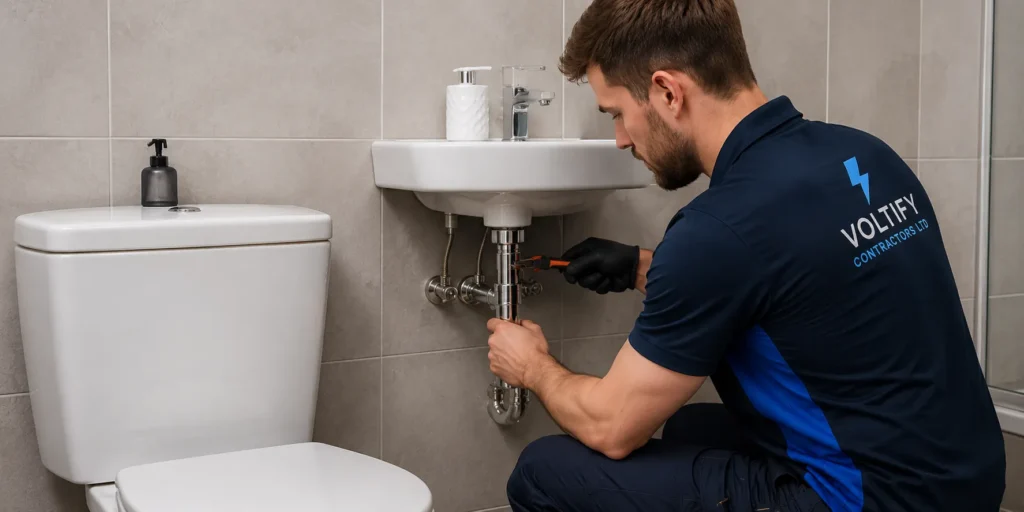

Not every pipe problem arrives as a burst. Far more often it is a joint under the sink that has been weeping into a tray for months, green crust building up on a copper fitting, pipes that bang every time the washing machine fills, or a stretch of old lead or steel pipe that someone has already patched twice. Pipe repair covers these slower, less dramatic faults, along with the bigger question they usually raise: is it time to replace the pipework rather than mend it again?
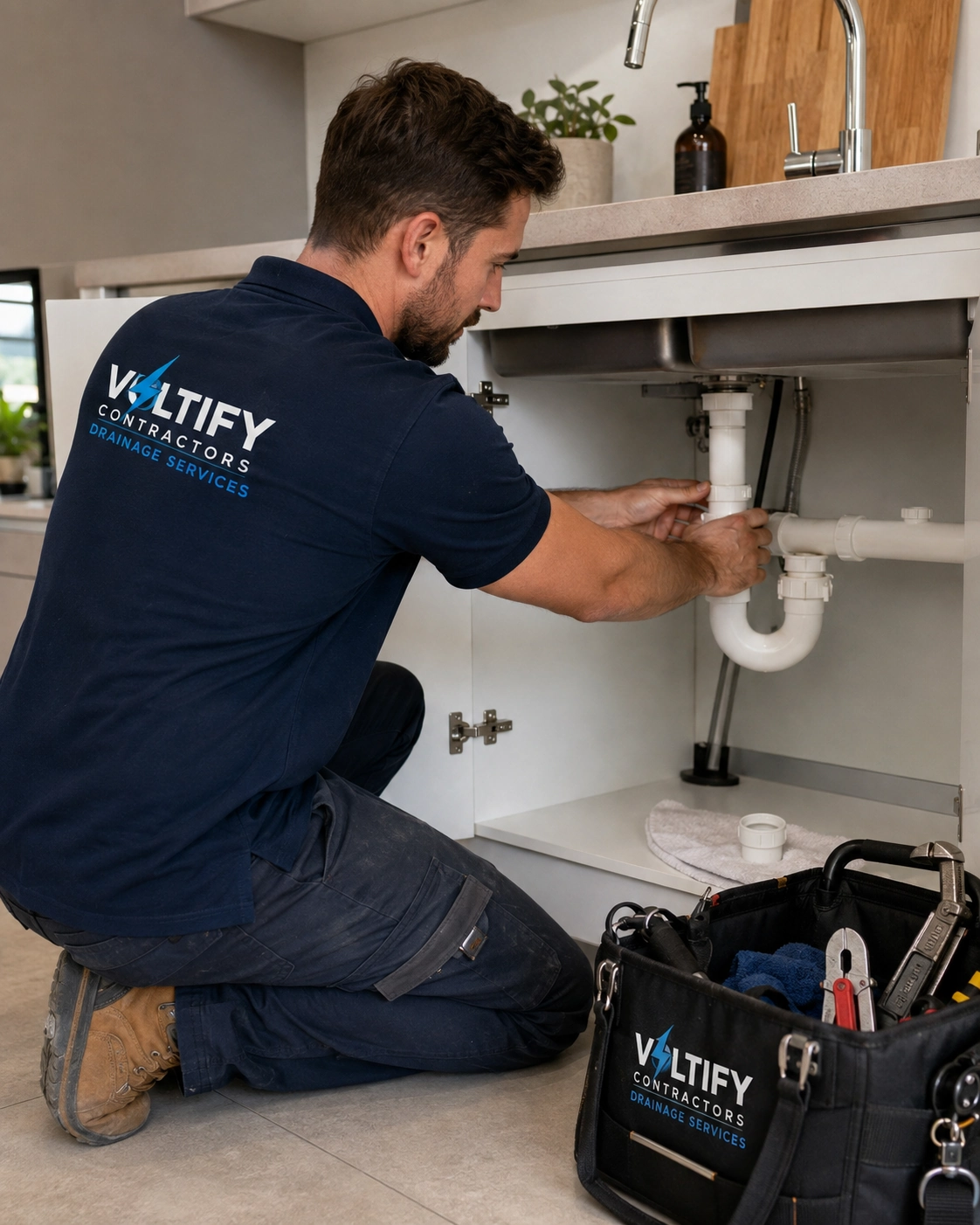
Voltify Contractors repairs and replaces water supply pipes, waste pipes and fittings in homes, flats and commercial premises across East and South-East London, including Canary Wharf, Stratford, Bow, Canning Town, Greenwich, Woolwich and Barking, as part of our wider plumbing services. If water is pouring out right now, turn off the stopcock and see our burst pipe repair page instead; this page is about planned repairs and replacement.
Pipe Problems This Service Covers
- Weeping or dripping joints. Compression nuts, soldered joints and push-fit fittings that let out a little water, often noticed as a damp cupboard base or a stained ceiling below.
- Corroded fittings. Green or white crust on copper joints is a sign of a slow leak that has been evaporating. It often looks worse than it is, but it does not fix itself.
- Pinholes in old copper. Small repeat leaks along the same run, a sign the pipe wall has thinned.
- Noisy, banging or vibrating pipes. Usually loose or missing pipe clips, or a surge when a valve closes quickly.
- Leaking or sagging waste pipes. Plastic waste pipes under sinks, basins and baths that drip at a joint, have dropped out of their clips or no longer fall properly towards the drain.
- Damaged pipework. Pipes nicked by a drill or nail, crushed behind a unit, or cracked where they pass through a wall.
- Pipes feeding radiators. Weeping joints on the copper pipework to radiators. Leaks from the radiator itself or its valves are covered under radiator repair and replacement. Anything involving the boiler itself or gas pipework is outside this service and needs a Gas Safe registered engineer.
If a leak is somewhere you cannot see and you only have the symptoms, such as a damp patch or a water meter that keeps turning, it needs tracing before it can be repaired; our leak detection and repair page explains how that works.
Fixing a Leaking Pipe Joint Yourself: What Is Safe and What Is Not
A slow weep from a visible joint can often be steadied before anyone arrives, but very few pipe leaks should be left as a home fix. These steps are reasonable for most people:
- Turn the water off locally. Most isolation valves have a slot: turn it a quarter turn so it sits across the pipe. If there is no valve, use the stopcock. Put a tray or bowl under the drip.
- Dry everything and watch. Wipe the pipe and fitting with a dry cloth to see whether water appears at the nut, the body of the fitting or the pipe beside it.
- Nip up a compression nut, gently. Hold the fitting body with one spanner and turn the nut with another, no more than a quarter turn. Overtightening crushes the brass ring inside (the olive) and makes the weep worse.
- Treat tape, putty and clamps as temporary. They can hold a pinhole for a few days, not for good.
Leave it to a plumber if the joint is soldered or push-fit, the leak is inside a wall or under a floor, water has reached a ceiling, light fitting or socket, or the pipe might be lead. If water is already spreading, our guide on what to do about a water leak at home covers the first few minutes.
Repair the Joint or Replace the Run?
This is the decision most pipe repair jobs come down to. A single failed joint on otherwise sound pipe is a quick, permanent fix. Old pipework that keeps failing is different, because each repair just moves the weak point along.
| What we find | Usual approach |
|---|---|
| One weeping joint, pipe either side in good condition | Remake or replace the fitting |
| A damaged section, such as a nail hole or a crushed length | Cut out the damaged section and join in new pipe |
| Several pinholes or old repairs along the same run | Replace the run rather than add more joints |
| Old galvanised steel pipe, often corroded inside | Replace, as it tends to fail again beside any repair |
| Lead pipe | Replace the section rather than patch it, and consider wider replacement |
| Waste pipe dripping at a joint | Remake the joint, or replace the trap or section if the plastic is cracked |
Repair versus replacement also depends on access. Replacing a run that is exposed under a floor is very different from one buried in a solid wall behind tiles, so the likely extent of opening up and making good is part of the recommendation.
Old Lead and Steel Pipework
Lead water pipes are still found in some older London properties, usually on the incoming supply and around the stopcock. Lead is not patched: the affected section is replaced with modern pipe. Your water supplier can advise on lead pipework on the incoming supply, and on which part of that pipe is your responsibility and which is theirs.
Galvanised steel pipe, found in some older buildings, corrodes from the inside and can restrict flow as well as leak. Where it is part of a longer run, replacing it with copper or plastic is usually the lasting option.
Lead, Galvanised or Copper? How to Tell Which Pipe You Have
The quickest place to look is where the water supply enters the property, usually under the kitchen sink or beside the stopcock. A fridge magnet and a coin are enough to narrow it down.
- Lead: dull grey and soft. Scratching it gently with a coin leaves a shiny silver mark, a magnet will not stick, and joints often look like rounded bulges rather than neat fittings.
- Galvanised steel: grey or dull silver but hard, a magnet sticks to it, and lengths are joined with threaded fittings.
- Copper: orange-brown, or green where the surface has oxidised. A magnet will not stick.
- Plastic: white or grey inside the home, often with push-fit joints. Blue plastic is common on newer incoming supplies.
If the incoming supply looks like lead, your water supplier can confirm which length is theirs and whether they offer any help with replacing it. Galvanised pipe that has narrowed inside often shows up first as weak flow at the taps; our guide to common causes of low water pressure explains how to tell that apart from other pressure problems.
Banging and Noisy Pipes
A loud bang or shudder when a tap is turned off, a toilet cistern fills or an appliance takes water is often called water hammer. It is worth dealing with, because the repeated movement stresses joints over time.
Common causes are pipes that are not clipped securely, so they move and knock against joists or boxing, and valves that close very quickly. The fix depends on the cause: re-clipping and packing loose pipework, adding a device to absorb the surge close to the appliance, or looking at the incoming water pressure. Creaking or ticking as hot water pipes warm up is a different noise, usually from pipes expanding against timber, and is often solved by easing where the pipe is held tight.
Moving or Rerouting Pipes
Pipework is often in the wrong place for a new kitchen, a different bathroom layout or an alcove being turned into storage. Moving it is a planned job rather than a repair, and it is easier to arrange before new units, tiling or flooring go in.
Rerouting may involve new isolation valves so each fitting can be turned off on its own, clipping pipes properly where they cross walls and floors, and leaving access to joints that may need attention later. If the change also involves new appliance connections, our appliance installation service covers the appliance side.
What to Expect From a Pipe Repair Visit
- Isolate the water at the nearest isolation valve, or at the stopcock if there is none.
- Find the extent of the problem, which sometimes means removing a kick board, bath panel or section of boxing.
- Agree the approach, especially if what is found is more than a single joint.
- Carry out the repair or replacement using fittings that suit the pipe material.
- Restore the water and check the work under normal pressure before panels are put back.
Access panels and boxing are replaced where they came off. If plaster, tiles or flooring have to be opened to reach pipework, or have been damaged by a long-term leak, the making good can be done through our handyman and property maintenance service.
Pipe Repair Cost
The documented minimum call-out is £80 for the first hour during standard hours, 7am–5pm Monday to Friday. Parts and any additional time are charged on top. The total depends on the pipe material and size, how easy it is to reach, whether one joint or a whole run is involved, and how much opening up and making good is needed. A photo of the pipe and the area around it helps give a more accurate picture before the visit.
If a slow drip turns into an active leak you cannot stop, our emergency plumber page explains what to do first. Out-of-hours emergency call-outs are available at a different rate; see emergency call-out services.
For everyday faults that are not pipework, such as dripping taps or running toilets, see our plumbing repairs page. Otherwise, contact Voltify Contractors to arrange a pipe repair, or check the areas we cover across East and South-East London.