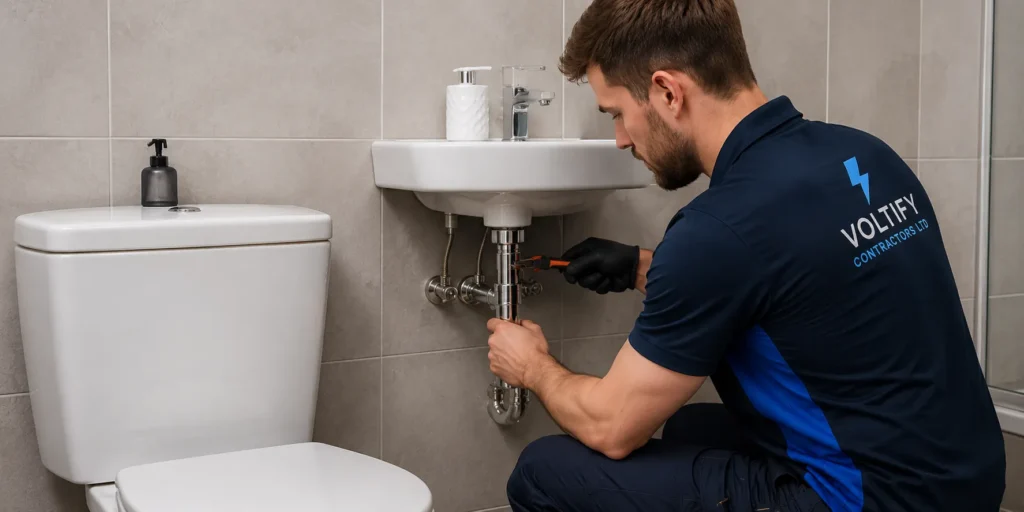

Almost all the plumbing in a kitchen meets in one cramped cupboard: hot and cold supplies, the sink waste, a dishwasher, often a washing machine, and sometimes a filter or boiling-water tank as well. That’s why a drip, a smell or a slow-draining sink can be hard to pin down, and why a kitchen refit needs its pipework planned before the units go in. Voltify Contractors carries out kitchen plumbing repairs and installation across East and South-East London, for homes, rented properties and staff kitchens.
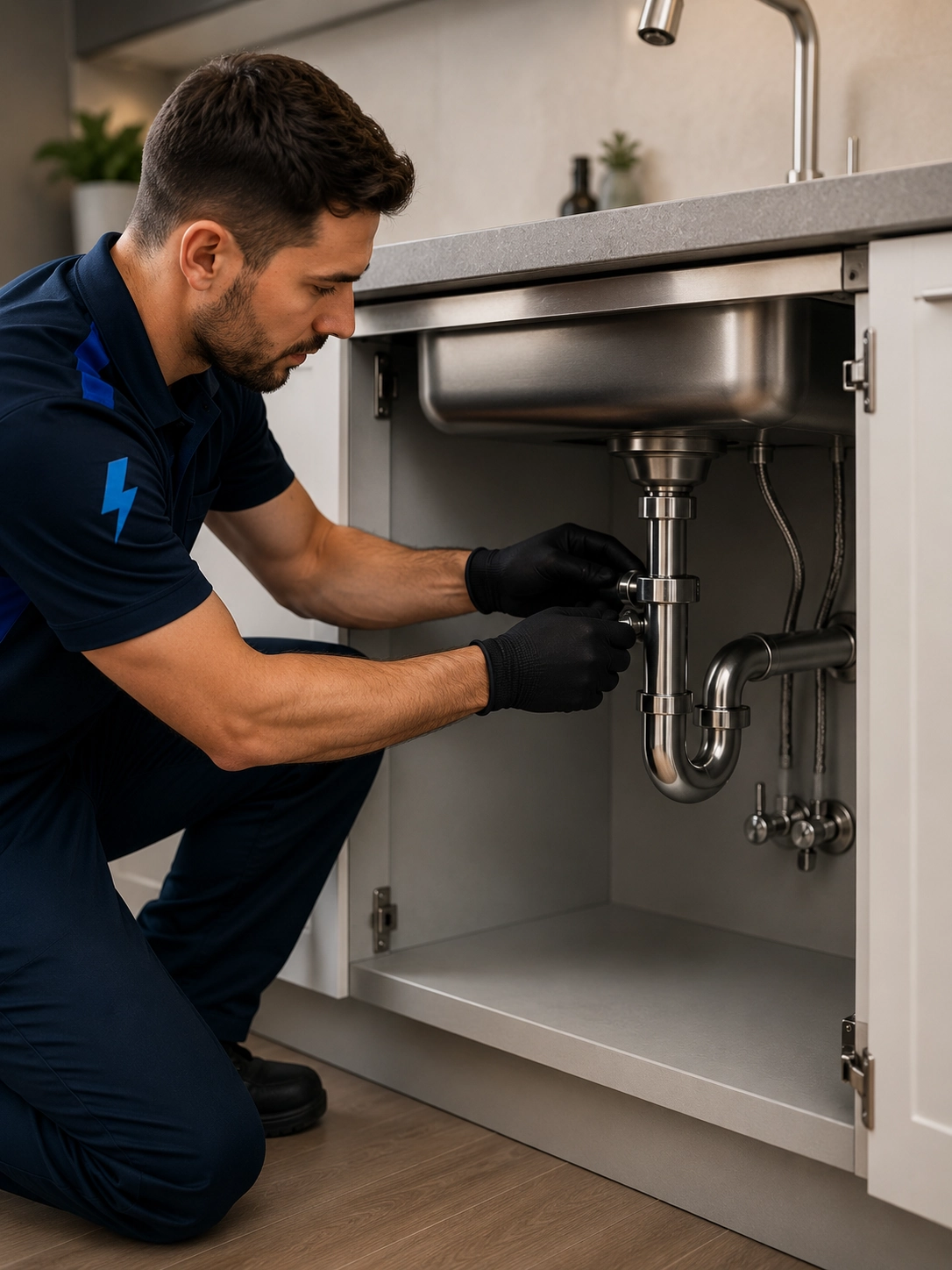
This page is about the kitchen as a whole — the sink, its waste, the supplies and the connections that serve appliances. It sits within our wider plumbing services.
What’s Under a Typical Kitchen Sink
Knowing what each part does makes it much easier to describe a problem, or to spot where water is coming from.
- Tap tails and isolation valves — flexible hoses from the tap to the hot and cold pipes, ideally with a small valve on each so the tap can be turned off on its own.
- Appliance valves — usually a lever valve on the cold supply for the washing machine and dishwasher inlet hoses.
- Basket waste and overflow — the plughole fitting in the sink bowl and the overflow pipe that joins it.
- Trap — the U-shaped or bottle-shaped section holding water that keeps drain smells out. Many have a spigot for a dishwasher or washing machine drain hose.
- Waste pipe — normally 40mm plastic, running through the wall to an outside gully or into the soil stack.
Kitchen Plumbing Problems, Traced to Their Source
Water in the cupboard
Dry the area, put a sheet of kitchen roll under each joint, then run the tap and, separately, the dishwasher or washing machine. Water that appears only while the sink drains points to the waste or trap; water that appears without anything running points to a supply connection or the tap itself. A dripping or loose tap is covered on our tap repair page. If the cupboard base is swollen but you can’t find a wet joint, the source may be behind the units, and it may need tracing as a hidden leak.
Slow draining or gurgling
Kitchen wastes block gradually. Fat and food residue coat the inside of the trap and pipe until the flow slows. If only the sink is affected, the blockage is usually in the trap or the first run of pipe. If the sink gurgles when the washing machine empties, or water backs up into the sink, the shared section of waste is struggling. Where the problem is further down, in an outside gully or the underground drain, it may need a drainage specialist or the water company rather than a plumber.
Bad smells from the sink
A smell usually means the trap is being emptied or bypassed. Long waste runs, or an appliance draining hard through the same trap, can siphon the water out of it. The fix may be a different trap, rerouting the appliance hose, or fitting an air admittance valve that lets air into the waste so the trap doesn’t empty.
Weak flow, noisy pipes or no way to turn the water off
Poor flow at the kitchen tap alone is usually the tap, its aerator or a part-closed valve. Banging when a tap or appliance valve shuts, or discovering there’s no working stopcock, are plumbing repairs worth sorting out before they’re needed in a hurry. Corroded or old sections of supply pipe are covered by pipe repair and replacement.
Keeping a Kitchen Waste Flowing
Most kitchen blockages are avoidable. Let cooking fat cool and put it in the bin rather than the sink, scrape plates before they go in the dishwasher, and use a sink strainer to catch food. Coffee grounds, rice and pasta are frequent culprits. Pouring boiling water down a sink moves grease further along the pipe, where it sets again and is harder to reach. Chemical drain cleaners can damage older traps and seals, and are best avoided if the sink is already full of standing water.
Planning the Plumbing for a New Kitchen
Kitchen plumbing for a refit works best when it’s settled before cabinets are ordered. The usual sequence is:
- isolating and capping the old sink and appliance supplies so the room can be stripped while the rest of the house keeps its water;
- first fix: running supplies and the waste to the new sink position and to each appliance space, with valves where they can be reached;
- units, worktops and any electrical work being fitted, with the sink and tap cut-outs made in the worktop;
- second fix: fitting the sink, tap, waste and trap, connecting appliances, then testing every joint with water running and appliances cycling.
The main decisions sit at first fix. Moving the sink to an island or another wall means finding a route for the waste with enough fall, which can mean running it under the floor. Appliance valves should be accessible from a neighbouring cupboard rather than hidden behind an integrated machine. The sink bowl depth, the tap’s hole size and the space left for a trap under a deep drawer or a boiling-water tank all need to agree with each other.
Appliances, Boiling-Water Taps and Filters
Connecting a dishwasher or washing machine is part of the same set of pipes, and is covered in more detail under dishwasher installation and our broader appliance installation service.
Boiling-water taps and under-sink filter systems each come with their own tank or cartridge housing, valves and fitting instructions, and most need a nearby socket as well as cupboard space. Send the make and model before a visit so the manufacturer’s requirements can be checked against the space and supply you have. Gas hobs and cookers are not part of kitchen plumbing; their connection needs a Gas Safe registered engineer.
What Affects the Cost
For repairs during standard hours, 7am–5pm Monday to Friday, the documented minimum call-out is £80 for the first hour. Parts such as a new trap, valves or tails are added, as is extra time where the leak is behind fitted units, a plinth or an integrated appliance has to come out, or a blocked waste runs through the wall. Refit plumbing is quoted once the layout and the route for the waste are known.
A leaking joint you can catch in a bowl can wait for a booked visit. A leak you can’t stop, even with the valves under the sink closed, belongs on our emergency plumber page. For anything else, send us a photo of the cupboard under the sink or your kitchen plan, and check the areas we cover.